
 E-Paper



A flashpoint in the sea
India has refused to take a stand on China’s territorial claims over islands in the South China Sea, but is committed to upholding the freedom of navigation in the area

 Prefer HTon Google


On Tuesday Prime Minister Narendra Modi met United States President Barack Obama in Washington, their fourth meeting in two years. Although the joint statement is silent on it, one of the principal drivers of this new level of engagement is the shared concern on ensuring peace and stability in the Asia-Pacific and India Ocean regions, and the recognition that the South China Sea could be one flashpoint that could put the region in trouble. This is for a number of reasons, not the least that the South China Sea islands have many claimants; the sea connects the Indian and Pacific Oceans; and, it has now drawn in the US and China into a stand-off.
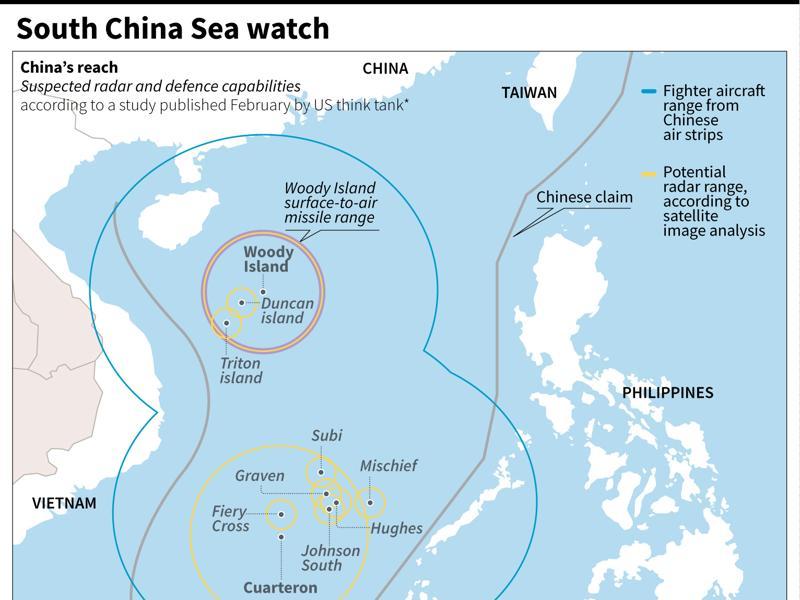
At The Shangri-La Dialogue, US defence secretary Ashton Carter and Chinese Admiral Sun Jianguo of the Central Military Commission were involved in a verbal duel on South China Sea. While Carter warned China of isolating itself on South China Sea claims and assertions, the admiral retaliated, saying that Beijing was not afraid of any trouble when it came to the question of its national sovereignty. The posturing was on account of tension rising over Chinese reclamation works and military activity on disputed reefs in the South China Sea. China claims some 80% of the waterway through a self-drawn nine-dash line, which hosts a major global shipping route, while The Philippines, Vietnam, Brunei, Malaysia and Taiwan have overlapping claims.
Read | India, Japan say no prosperity possible in South China Sea amid tensions
Although influential voices in Washington are talking about an India-US-Japan partnership to counter Chinese aggression in South China Sea, India is careful to commit itself on anything beyond the freedom of navigation and innocent passage in the South China Sea. The Indian position is in harmony with its partners, particularly the US, which has not taken any stand on Chinese territorial claims and counter-claims of some Asean countries, but is committed to upholding the freedom of navigation and the law of seas in this area and claims through recourse to peaceful means and in accordance with international law.
The reason for strategic ambiguity over territorial claims are not difficult to fathom as Asean nations themselves are divided over what constitutes territorial aggression by China in the South China Sea with Laos and Cambodia on Beijing’s side, Malaysia and Indonesia largely sitting on the fence.
However, India, like the US and Japan, wants unhindered access to sea lanes of communication in the South China Sea as more than 50% global trade passes through the Malacca Straits and no less than 55% Indian trade with China, South Korea and Japan passes through this waterway. The historical fact is that at the end of World War II, neither of the contested Paracel Islands or Spratly Islands or Scarborough Shoals were occupied by any power. It was post-war that China started moving into these territories and this led to bloody clashes with Vietnamese soldiers twice in the past century.
Read | China to ‘pressure’ US on maritime issues: Report
Today, China has established military air bases in some of these island territories with proper administrative set-up and is ready to exploit its tourism potential. Even though the US, India and Japan want territorial disputes to be settled peacefully according to international law, China will not give up its territorial claims and its military influence, and its capability will grow by the day in the South China Sea. This assertion could lead to ships being denied access into the waterway with possible restrictions from the Peoples Liberation Army Navy (PLAN), which is on the verge of acquiring blue water status with two aircraft carriers and ballistic missile-armed nuclear submarines projecting power in the region.
With China defining South China Sea as its core interest, Beijing’s intention to dominate the waterway is evident through its enhanced military capabilities. This is also essential to its declared aim of becoming a maritime power. The problem facing Asean nations is that they are convinced of Chinese aggressions but are rather unsure about US’ long-term military and political commitment to the region. In this context, the big question now facing India is what should be its posture on China’s assertion as any action by New Delhi will have a fallout on interlinked Indian Ocean.
While New Delhi has no intention of exploiting Chinese vulnerabilities in the South China Sea given its long-standing territorial dispute with Beijing, it is all for maintaining peace and stability in the waterway due to interlinked repercussions. India deals with Asean nations with varying degree of economic and diplomatic engagement, and thus New Delhi should be working with big powers in the region to ensure peace.
Read | India can’t rise by bashing or containing Beijing: Chinese media
The week-long India-US-Japan Malabar naval exercise starting on June 10 off the coast of Okinawa in Japan is not only to assure the region but also to act as a deterrent to any aggression on sea lanes of communication. While China and its neighbours like The Philippines and Vietnam contest each other’s claim, India must be part of the global endeavour to keep unrestricted access to the South China Sea.
The play in South China Sea is not without ramifications towards Beijing as it shows China as an aggressive dominating power and could lead to serious militarisation of Japan as a counter-reaction. It also could end up drawing in Europe into the dispute, decades after the departure of colonial powers that enabled China to fill in the vacuum in the first place. Given that the South China Sea debate has heated up, it is time Asean nations took a united view on how to sort out territorial claims amicably without any hindrance to global trade and sea traffic. It is also clear that China should put an end to its ambitious territorial claims and muscle-flexing in the South China Sea as this could turn into a global flashpoint drawing big naval powers into the Pacific vortex. India cannot remain isolated from this storm.
shishir.gupta@hindustantimes.com


