
Sign in

Less dust in north Indian plains can alter early monsoon rain, says a new study

The study showed that when dust absorbs solar radiation over the Arabian Sea, it warms the area and strengthens winds carrying moisture eastward

Updated on: Nov 26, 2017, 23:36:16 IST
Hindustan Times | By , Mumbai
Share
Share via
  • facebook
  • twitter
  • linkedin
Copy link
  • copy link

A new study has found that a decrease in dust particulates — the largest constituents in the air during the pre-monsoon season over the sub-continent— translated into clearer skies over the Indo-Gangetic Plains (IGP) with the scattering and absorption of light at the earth’s surface also getting low at 3% per year during the same period.
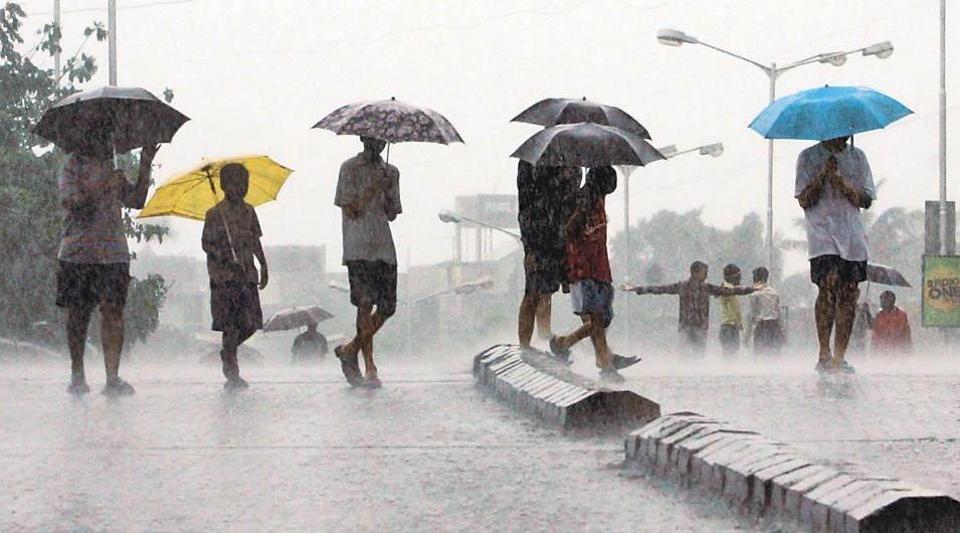
With these new findings, researchers said it is yet to be studied whether the increase in pre-monsoon showers, decrease in dust emissions, and weakened winds will affect total rainfall. (HT File)

“Local dust is also declining over the Indian region. This can alter the early monsoon rainfall we depend on,” said V Vinoj, lead author and assistant professor, School of Earth, Ocean, and Climate Sciences, IITBBS .

What the study found

Mineral dust is among dominant natural aerosol species in the atmosphere globally. It is generated by wind erosion over arid and semi-arid regions of the world.

Aerosols over north India are about three times higher than the global mean values, and have been rising by about three percent every year annually. Aerosols can be natural or anthropogenic — generated by human activity.

Dust comprises 60% of aerosols. The study found a decrease of up to 20% dust during pre-monsoon with the maximum decline recorded over the Thar desert and extending through the Indo-Gangetic Plains.

A previous study by Indian Institute of Technology–Bhubaneshwar (IITBBS), had shown how dust from West Asia, combined with local factors, influences the summer monsoon rainfall that India is heavily dependent upon.

The study showed that when dust absorbs solar radiation over the Arabian Sea, it warms the area and strengthens winds carrying moisture eastward. This leads to India receiving more rain a week later. According to the new study, the reduction in extinction — or cleaner sky — was spread from Lahore in Pakistan to Kanpur in the east.

With these new findings, researchers said it is yet to be studied whether the increase in pre-monsoon showers, decrease in dust emissions, and weakened winds will affect total rainfall.

Researchers said clear skies, owing to a decrease in dust emissions, was strong over the arid and desert regions over north-western part of Indian subcontinent, including the Thar Desert.

The three-member team said weakening winds over the IGP also reduced the amount of fine dust travelling over long distances — in addition to an increase in pre-monsoon rainfall.

“It is difficult to say that the frequency and intensity of dust storms have decreased based on season. They are episodic events,” Ramesh P Singh, professor, earth system science and remote sensing at Chapman University, who was not part of the study told HT.

  • Snehal Fernandes
    ABOUT THE AUTHOR
    Snehal Fernandes

    Snehal Fernandes is senior associate editor, who joined HT in 2006. She heads the Mumbai edition’s city reporting team that writes on civic and urban governance, transport and infrastructure, health, and education. She is also the National Science Editor. With a career spanning more than two decades, her expertise lies in writing on science and technology, space, environment, sustainable development, climate change, and nuclear energy. Her work consistently breaks down, and without oversimplyfying, science and research developments into an easy read for a broad audience. In 2009, she was among the very first journalist to report on the opposition to the Jaitapur nuclear power plant in Ratnagiri (Konkan) following the Indo- US civil nuclear agreement and consistently followed it with multiple stories from ground zero; wrote about the introduction and subsequent halt to the cultivation of genetically modified (BT) brinjal, and has interviewed Nobel laureates and award winning scientists. In 2012, she was awarded ‘The Press Club Award for Excellence in Journalism’ (Political category) for reports on the mining scam in Goa. Prior to HT, she wrote on education and transport at the Indian Express. She graduated in sociology from St Xavier's College, and firmly believes in the phrase by Karl Marx that ‘Religion is the opium of the people’. When she is not keeping a tab on the going-ons in Mumbai and the scientific world, you'll find her reading world news, or watching crime/espionage series or political dramas. She can repeatedly watch Kill Bill with the same interest as Planet of the Apes and Spiderman. For someone who was not remotely interested in dogs or cats, she loves every bit of her time with her two-year-old Indie cat Bunny.Read More