India’s economic growth in the past two decades has been led largely by the services sector, with manufacturing trailing behind. As the new government aims to give India a prominent place in the global economic order, manufacturing will revive growth, increase employment and investment in the sectors that will transform India.
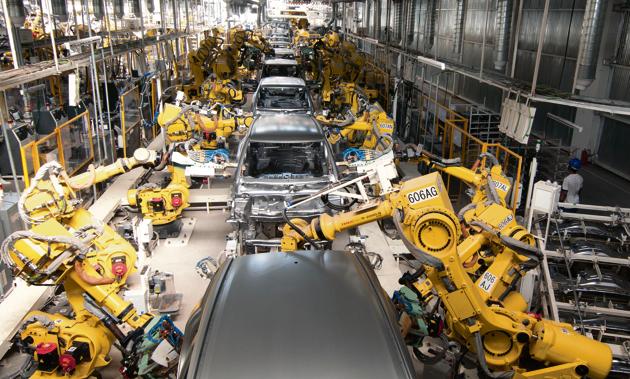
Our Asian neighbours have effectively demonstrated that a robust manufacturing sector can act as a strong lever for economic advancement. So, it is perhaps a good time to revisit and rethink the country’s manufacturing strategy.
What would be the strategy that could help transform manufacturing into a key contributor to the Gross Domestic Product? Lessons from other economies and attempts to replicate their policies won’t work for India today. We should chart our own course.
Let us take a leaf out of the services sector. A decade-and-a-half ago, India was among the most poorly-connected countries with a weak telecom infrastructure. Today, the kind of telecom penetration India has achieved is remarkable. How was this achieved? By choosing to forego the building of legacy landline networks first, and instead leapfrogging directly into mobile and, then, digital telephony.
With a strong digital ecosystem and abundance of trained workers, India is in a unique position to recast the framework of manufacturing but this will require a quantum shift in our mindset and approach. The most important requirement is shunning of the cost arbitrage mindset and moving to value arbitrage as the goal. Historically, India has attracted global technology largely in areas where there is a huge domestic market to serve. The automobile industry is an example. All global players are in India, but chiefly to serve an exploding base of customers, with few using India as a hub to build their global manufacturing strategies. As a country, we have offered them a big market, and are now in a position to leverage the capability and capacity to scale up for a global market. Today we need to think of shifting the manufacturing strategy from just domestic consumption to export-led growth, magnifying the benefits of foreign and domestic investments.
{{/usCountry}}With a strong digital ecosystem and abundance of trained workers, India is in a unique position to recast the framework of manufacturing but this will require a quantum shift in our mindset and approach. The most important requirement is shunning of the cost arbitrage mindset and moving to value arbitrage as the goal. Historically, India has attracted global technology largely in areas where there is a huge domestic market to serve. The automobile industry is an example. All global players are in India, but chiefly to serve an exploding base of customers, with few using India as a hub to build their global manufacturing strategies. As a country, we have offered them a big market, and are now in a position to leverage the capability and capacity to scale up for a global market. Today we need to think of shifting the manufacturing strategy from just domestic consumption to export-led growth, magnifying the benefits of foreign and domestic investments.
{{/usCountry}}Our approach should be that of building an ecosystem, not industrial islands. For the manufacturing sector to thrive, we would need connected and efficient value chains spanning raw material providers, technology providers, trained workforce at all levels, multispeciality service providers, research and development centres and the crucial logistics infrastructure. Given India’s territorial diversity and distribution of natural resources across a large geography, we could well be building a national grid where parts of the country are connected through a manufacturing superhighway.
Some critics believe that disruptive, smart and automation-centric manufacturing capacities are unsuitable for generating mass employment. This is a fallacy. The strategy isn’t to eliminate jobs but to shift from low-value low-skilled jobs to higher value-added jobs. What we fail to realise is that for any sector to succeed we need lighthouses. High-end, world scale, industrial automation capacities can act like spearheads. As global players start looking at India with interest, and value-based production starts to grow, we will see an exponential growth in downstream manufacturing activities, much needed to complete the supportive ecosystem, which will lead to mass employment.
India’s defence and aerospace sector offers a big opportunity in this context. With nine defence public sector undertakings, 41 ordnance factories, an exclusive research organisation and more than 100 private companies, India undoubtedly has a huge defence industrial base. Despite this, the country remains one of the largest importers of major weapons. This sector is critical from the perspective of national security and the government’s goal is to develop a high degree of self-reliance. This provides an excellent opportunity to build and/or scale up an industrial base centred on manufacturing. Cocreation, with the goal to not only serve India but the world, is a plausible answer here.
As we move forward, one big hurdle would be the availability of the right kind of talent. This will require reskilling the existing workforce, which is a slow game. It needs a progressive education system with focus more on experience-based learning than academic excellence. There could be incentives in bringing in the right talents to mould this workforce. Might industry-university partnerships be the way to go? We need to challenge the current models to generate new ideas for a new India.
Kishore Jayaraman is the president for India and South Asia, Rolls-Royce
The views expressed are personal