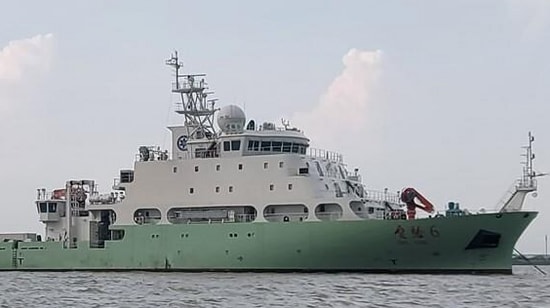
Virtually a month after Sri Lankan President Ranil Wickremesinghe assured Prime Minister Narendra Modi that his country will be sensitive to security and strategic concerns of India, a Chinese marine research vessel, Shi Yan 6, is expected to dock at Colombo and Hambantota deep sea ports late October and stay till November 2023. As of now, Sri Lanka government is still to give clearance to the maritime research vessel.
Already PLA warship Hai Yang 24 Hao with a crew of 138 with Commander Jin Xin as captain is currently docked at Colombo port for what has been described as a formal port call.
The warship is expected to sail out of Colombo today with Sri Lankan papers quoting their own foreign ministry as saying that India was sanguine with formal port calls by PLA vessels but not with survey-research vessels.
According to reports from Colombo, the 3999 ton Shi Yan 6, based in Guangzhou, is currently in South China Sea and moving towards the south. It is learnt that scientists of Sri Lanka’s National Aquatic Resources Research and Development Agency aka NARA will embark on Shi Yan 6 to conduct survey of the exclusive economic zone (EEZ) of the island nation and in the south Indian Ocean.
The vessel will be docking at both Colombo and Hambantota ports and carrying out surveys for nearly a month with one part of survey being without Sri Lankan Scientists.
{{/usCountry}}The vessel will be docking at both Colombo and Hambantota ports and carrying out surveys for nearly a month with one part of survey being without Sri Lankan Scientists.
{{/usCountry}}While South Block is tight-lipped about the development, it is learnt that India has taken up the issue at the highest diplomatic levels and it is now up to Wickremesinghe government to address Indian concerns.
Last August, Chinese ballistic missile tracker Yuan Wang 5 docked at Hambantota port, leased to Beijing for 99 years when Wickremesinghe was the Prime Minister under Rajapaksa regime, despite India raising serious concerns about the survey ship.
With the PLA Navy expanding rapidly and having open global ambitions, the larger question is how long will the Modi government allow countries in the Indian sub-continent remain impervious to India’s strategic interests. The question is particularly pertinent to those countries with whom India has stood up for in thick and thin—from humanitarian disaster, vaccine supply to economic support.
Even though China provided high interest aid for white elephant projects during the past Beijing friendly Rajapaksa regime, Sri Lanka hosting Chinese research vessels shows that it is rather apathetic or indifferent to New Delhi’s concerns. It is now an open secret that China is mapping the Indo-Pacific for future nuclear submarine operations to counter the QUAD and other ASEAN powers.
Over the years, Chinese research vessels are entering the Indian Ocean through Ombi-Wetar straits in Indonesia and proceeding towards the South Indian Ocean via the 90 degree ridge. The sea route via Malacca, Sunda and Lombok straits is not viable for submarines as they have to surface, thus giving away their location. This is not the case if the sub-surface combatant goes through Ombi-Wetar straits.
The mapping of ocean floor, salinity content and sub-surface temperatures in the Indian Ocean is part of the larger strategic exercise to check the potency and accuracy of submarine fired missiles in equatorial waters. Due to the difference between the surface and sub-surface temperatures, a phenomenon called lateral inversion occurs in equatorial waters, making it nearly impossible to detect attack submarines in deep waters and the only option available is to detect nuclear reactor noise.
While the Indian Navy’s diesel attack submarines pose a serious challenge to any Chinese vessel in the Indian Ocean as unlike the nuclear submarine, the diesel engine can be shut down and make it impossible for the enemy to detect the Indian sub-surface vessel.
However, the Indian Navy knows that it is only a matter of time when PLA vessels will start long range patrols in the south Indian Ocean using carrier strike force. The survey of south Indian Ocean waters is also to chart new sea routes away from Indian dominance and faster access to Beijing’s client states on Africa’s eastern and western seaboard.