
 E-Paper



Sri Lankan president Wickremesinghe agrees to be sensitive to India's strategic and security concerns
During PM Modi and Wickremesinghe's private lunch, it is not difficult to assume that China was the elephant in the room as Beijing has been engaging Colombo.

 Prefer HTon Google


During his discussions with Sri Lankan President Ranil Wickremesinghe on Friday, Prime Minister Narendra Modi apparently reminded the visitor that India was among the first responders to economic crisis that wracked the island nation in 2022 while maintaining that Colombo must take into account India’s national security interest before collaborating with a third power.
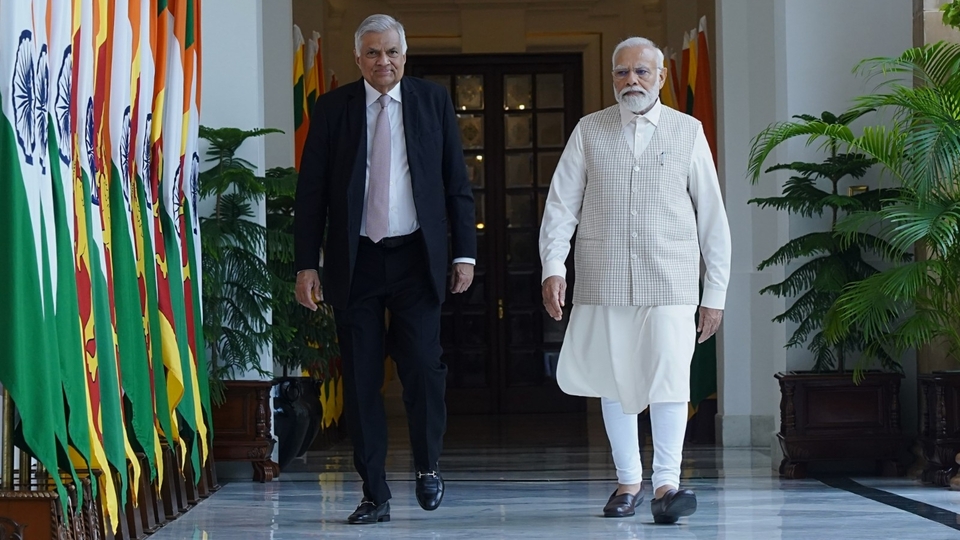
It is understood that President Wickremesinghe agreed that Sri Lanka will be sensitive to India’s strategic and security concerns. As PM Modi and President Wickremesinghe had one-on-one private lunch extending over an hour, it is not difficult to assume that China was the elephant in the room as Beijing has been assiduously engaging Colombo under the Belt Road Initiative (BRI) with the island nation currently under a mountain of Chinese debt.
It was during the 2022 economic crisis that while the world including China hesitated, India came out with full financial, food and oil support to bail out the island nation from the deep political crisis.
While PM Modi made it known that India will stay its course in helping out Sri Lanka in times of economic crisis, the two leaders decided to take a long term view of the bilateral relation with focus on digital, oil, power, road and perhaps railroad connectivity in future.
It was President Wickremesinghe who suggested a land bridge between India and Sri Lanka on 27 kilometer long possible Rameswaram-Talai Mannar alignment, which was immediately agreed to by PM Modi. The depth of sea in this particular area of Palk Straits is also conducive as there is only one to three meters of water and a bridge could be easily constructed in the region.
The two countries have decided to cooperate in development of ports and logistics infrastructure at Colombo, Trincomalee and Kankesanthurai with mutual understanding as part of maritime connectivity. Besides this there was agreement on air connectivity, energy and power connectivity as well as renewable energy.
While the land bridge proposal was mooted for the first time, there is a strong possibility of having an oil, gas, power pipeline along with the bridge connecting the two countries. There is also a possibility to have a railroad bridge between the two countries as Rameswaram is connected with railroad just as Talai Mannar is on the Sri Lankan side.
According to experts based in Colombo and New Delhi, the two countries will have to play their cards carefully to implement the long term vision on ground as China has deep penetration into Sri Lankan polity and Beijing will do its utmost not to allow India to regain its past heft with the island nation.


