Last week, after
about how lies and conspiracy theories were masquerading as “unknown truths about Jawaharlal Nehru”, the Congress leader and author Shashi Tharoor tweeted the piece describing it as “The truth about ‘the truth about Nehru’”.
In the light of the recent attempts to edit Nehru’s Wikipedia page, I wrote about how unverified and slanderous information about the former prime minister did the rounds on the internet – for instance, it was being said that Nehru was born in a red-light area of Allahabad and his grandfather, Gangadhar Nehru, was a Muslim.
Soon after, Anuj Dhar, author of India’s Biggest Cover-up – a book on the mystery surrounding Netaji Subhas Chandra Bose’s apparent death in a plane crash in 1945 – wrote an article, rebutting certain arguments I had made in my piece.
Dhar, a journalist-activist known for his extensive research on Netaji’s life, was recently in the news for his pivotal role in bringing declassified documents on the freedom fighter to public light. I had spoken to Dhar once while researching for an analysis piece on the controversy surrounding the alleged snooping on Netaji’s family, and his confidence in his research and for the cause had impressed me.
Dhar’s main disagreement with my piece stems from what Mridula Mukherjee, professor of history at Delhi's Jawaharlal Nehru University, had told me.
"All serious biographies of Nehru have referred to his relationship with Edwina Mountbatten and Padmaja Naidu. Most books have called the relationships platonic, but even if such relationships were not platonic, then what? They were consenting adults. Was he cheating on his long-dead wife? No. Did it affect governance? No," Mukherjee had said.
In the light of the recent attempts to edit Nehru’s Wikipedia page, I wrote about how unverified and slanderous information about the former prime minister did the rounds on the internet – for instance, it was being said that Nehru was born in a red-light area of Allahabad and his grandfather, Gangadhar Nehru, was a Muslim.
Soon after, Anuj Dhar, author of India’s Biggest Cover-up – a book on the mystery surrounding Netaji Subhas Chandra Bose’s apparent death in a plane crash in 1945 – wrote an article, rebutting certain arguments I had made in my piece.
Dhar, a journalist-activist known for his extensive research on Netaji’s life, was recently in the news for his pivotal role in bringing declassified documents on the freedom fighter to public light. I had spoken to Dhar once while researching for an analysis piece on the controversy surrounding the alleged snooping on Netaji’s family, and his confidence in his research and for the cause had impressed me.
Dhar’s main disagreement with my piece stems from what Mridula Mukherjee, professor of history at Delhi's Jawaharlal Nehru University, had told me.
"All serious biographies of Nehru have referred to his relationship with Edwina Mountbatten and Padmaja Naidu. Most books have called the relationships platonic, but even if such relationships were not platonic, then what? They were consenting adults. Was he cheating on his long-dead wife? No. Did it affect governance? No," Mukherjee had said.
A search for "Nehru" on Google throws up results galore, with at least two conspiracy websites coming up on the first page of results. (Getty Images)
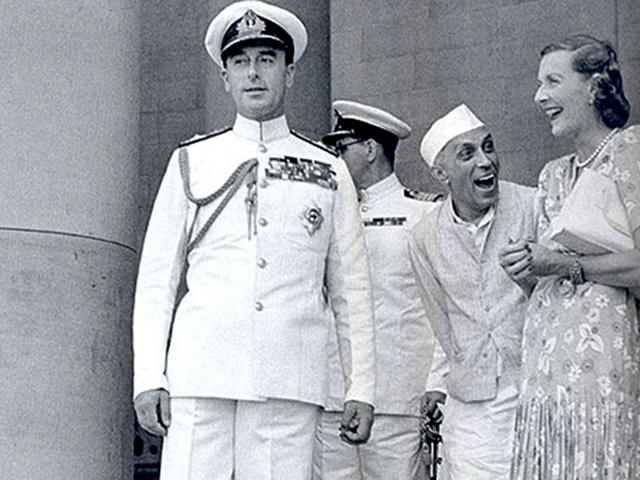
The conspiracy theory articles I quoted in my piece tried to malign Nehru saying he was a "playboy" and had "multiple affairs" with several women including Sarojini Naidu’s daughter Padmaja Naidu and Edwina Mountbatten, the wife of the last British viceroy of India, Lord Mountbatten.
Dhar showcases a few declassified documents from England and attempts to prove that Nehru and Edwina indeed had a thing going and in a few cases it affected governance. But, I find his arguments far from compelling.
When I shared Dhar’s article on my Facebook wall, Amit Rahul Baishya, an assistant professor at the department of English of the University of Oklahoma, US, : "I read the response. It seemed to me that he began by talking about your "core idea" which fell by the way. If his real gist begins after that quote from Mridula Mukherjee, is he trying to disprove 1) that the relationship was not platonic, and 2) that it came in the way of governance?"
"Either way, the evidence provided does not convince us of 1 or 2. Seems like a nudge nudge wink wink style of argumentation asking you to connect barely evident dots," he added.
Columnist Sankar Ray wrote to me on Dhar’s article, "Edwina's daughter said the relationship was platonic. Documents, shown (by Dhar) are all conjectural, with no concrete proof. This is slanderous."
The first document which Dhar refers to and is "file no PREM 11/340 is available to the researchers at the National Archives at Kew in London" is completely of no consequence. It merely documents, "…that an Indian diplomat close to Nehru suspected that British influence came in the way of the Indian statesman getting a Nobel Peace Prize." Dhar provides us with no other information with regards to this document, though he has published a picture of the file.
Secondly, Dhar mentions a letter in which "the private secretary of Queen Elizabeth is seen informing prime minister Winston Churchill that, ahem, ‘time has come when it should be pointed out to Edwina by one of Her Majesty's ministers that these visits of hers to the Indian capital do not further the general interests of the Commonwealth’.
In the next paragraph, Dhar highlights that the letter says, "... Edwina Mountbatten is again involved in a political skirmish in New Delhi"." He calls it "British wit".
Now, the question is, as online activist Pratik Sinha asked me when I shared Dhar’s article – "Skirmish is the British wit for an affair?"
It’s too much of an extrapolation, isn’t it?
Then, Dhar cites that "at a ceremonial Palace party before Elizabeth's coronation in 1953, Edwina had turned up with Nehru, not her hubby - the handsome Lord Louis Mountbatten about whom it used to be said that he could charm a vulture off a corpse" and that the Playboy magazine had carried an interview with Nehru.
How can that be a factor to draw any conclusion regarding Nehru’s relationship with Edwina, especially on the grounds on which Professor Mukherjee was speaking?
Dhar’s last "evidence" for his argument is a document which he says show that "egged on by Nehru by her side, Edwina is seen giving a tongue-lashing to Oliver Lyttelton, the colonial secretary, over some instance of atrocity in Kenya".
In this case too, as Shoaib Daniyal, a writer with the news website Scroll.in wrote to me, the question remains, "Edwina argued with a British babu over violence in Kenya and since Nehru was in the same room, ergo, they were having an affair (duh)."
(The views expressed by the writer are personal. He tweets as @saha_abhi1990)