A woman makes allegations of sexual harassment and victimisation against the powerful head of her former institution. The allegations are detailed, and supported by audio and video evidence. The head of the institution convenes a special sitting the next morning, along with two of his colleagues. He indulges in character assassination of the Complainant, and alleges a conspiracy against the institution itself. In this, he is supported by two very senior officers of the institution. A few days later, three other colleagues convene another sitting, where they vouch for the character of the head of the institution, hint at getting the police and investigating agencies involved into looking for the “conspiracy”, and finally settle upon a probe by a retired senior colleague — all the while insisting that this has nothing to do with the allegations themselves. Meanwhile, three more colleagues of the head constitute themselves into an “in-house enquiry committee”, where one of them is immediately forced to recuse himself, because it turns out that he has already made a public statement in favour of the head of the institution. The In-House Committee goes ahead with a replacement member — another colleague. At the hearing, the Complainant is told that this is an “informal committee”, which is not required to follow existing legal procedures, or best practices for dealing with sexual harassment complaints. The proceedings are not videographed, the Complainant is not provided with records of her testimony, and she is not granted access to a lawyer. The Complainant withdraws from the proceedings, stating publicly that she does not believe that she will get justice. Various organisations write to the institution, urging that for justice to be done, some basic procedures need to be followed, such as the existence of an external member, formal processes of evidence taking, and so on. It is argued that this is of special importance, given the vast difference of power that exists between the Complainant and the accused. The “informal” In-House Committee goes ahead with its “informal” procedures — now ex parte — and grants an (informal?) “clean chit” to the head of the institution. The report is not disclosed. From beginning to end, the case takes less than three weeks.
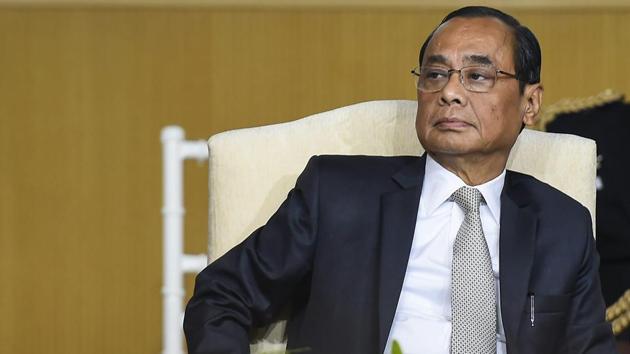
What are we to make of all this? One thing is clear: if this process was to be challenged before a court, the court would require no more than ten seconds to discard the entire process, and order a fresh enquiry. Among the things that would weigh with the court would be the following: the head of the institution (and his senior colleagues’) public questioning of the Complainant’s character and motives; the “informal” character of the enquiry committee, which seemingly believed that it was above all constraints of due process; denial of basic rights to the Complainant; and the complete absence of any acknowledgement — or mitigation — of the imbalance of power that existed between the two parties.
But what are we to do when the accused happens to be the Chief Justice of India, his colleagues judges of the Supreme Court, the senior officers the Attorney General and the Solicitor General of India, and the investigating agencies the Delhi Police, the Central Bureau of Investigation, and the Intelligence Bureau? What are we to do when the highest guardian of the law acts as if it is above the law? To whom lies the appeal and to whom the recourse against a deeply flawed process? It is this that makes the conduct of the Supreme Court in these proceedings even starker: the imbalance of power between the Chief Justice of India and a former employee, the fact that the Supreme Court was enquiring against one of its own, and the fact that there could be no further appeal from its procedures, all provided powerful reasons for the court to be even more careful of due process, equity, and the rights of the Complainant, something recognised by one judge of the Supreme Court, Chandrachud J, who, in a letter to the In-House Committee, specifically pointed out some of these issues, and asked that they be addressed. Instead, what we got can only be described as a sham.
But there is an even deeper consequence of the In-House Committee’s (secret) report exonerating the Chief Justice. For the last 20 years, the law on sexual harassment in India has made slow, incremental, steps forward. From the Vishaka Guidelines in 1997 to the POSH Act in 2013, certain basic principles about the imbalance of power, procedural justice, and protecting the rights of survivors, have been fought for, and partially won. As #MeToo — with its spate of defamation complaints — showed us recently, the battle is far from over. But what the Supreme Court has done is to undermine the gains of the last two decades in one fell stroke. The Supreme Court has told us that when it comes to one of its own, imbalances of power don’t matter, due process doesn’t matter, and basic norms of justice don’t matter. The ripple effect that this will now have across the board can well be imagined: if the guardian of the rule of law, and the institution that is supposed to be a moral exemplar to the nation, acts in this way, then why should anyone else act differently? And with what face can a court tell them to act differently, given its own conduct?
{{/usCountry}}But there is an even deeper consequence of the In-House Committee’s (secret) report exonerating the Chief Justice. For the last 20 years, the law on sexual harassment in India has made slow, incremental, steps forward. From the Vishaka Guidelines in 1997 to the POSH Act in 2013, certain basic principles about the imbalance of power, procedural justice, and protecting the rights of survivors, have been fought for, and partially won. As #MeToo — with its spate of defamation complaints — showed us recently, the battle is far from over. But what the Supreme Court has done is to undermine the gains of the last two decades in one fell stroke. The Supreme Court has told us that when it comes to one of its own, imbalances of power don’t matter, due process doesn’t matter, and basic norms of justice don’t matter. The ripple effect that this will now have across the board can well be imagined: if the guardian of the rule of law, and the institution that is supposed to be a moral exemplar to the nation, acts in this way, then why should anyone else act differently? And with what face can a court tell them to act differently, given its own conduct?
{{/usCountry}}But that is for another day. What matters today is that the Supreme Court was called upon to do justice in a case involving claims of sexual harassment. And it has failed, in every possible way, to do that.
Gautam Bhatia is an advocate in the Supreme Court
The views expressed are personal