Dear Reader,
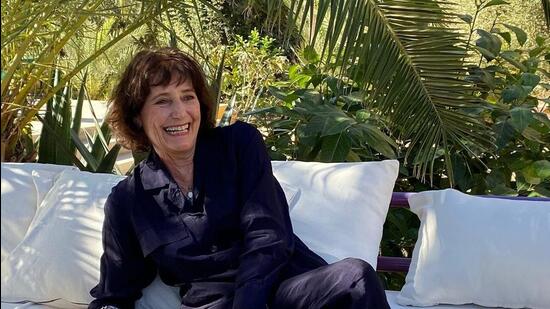
It is the second evening of a writing masterclass, and Alexandra Pringle and I are sitting by a pool at Jnane Tamsna, talking under an African sky strewn with stars. Soft light pools around the palm trees, and a slight desert chill creeps in as we talk about the strange alchemy that turns drafts into literature.
Pringle, the former Editor- in- Chief of Bloomsbury, has spent a lifetime nurturing writers: as a publisher, a literary agent, and now
Dear Reader,
It is the second evening of a writing masterclass, and Alexandra Pringle and I are sitting by a pool at Jnane Tamsna, talking under an African sky strewn with stars. Soft light pools around the palm trees, and a slight desert chill creeps in as we talk about the strange alchemy that turns drafts into literature.
Pringle, the former Editor- in- Chief of Bloomsbury, has spent a lifetime nurturing writers: as a publisher, a literary agent, and now a writing coach and mentor, teaching in London from her Chelsea houseboat and here in Morocco.
Here are edited excerpts from our conversation.
Were you always a reader?
I learned to read very late, last in my class, in fact.
My mother would say, “Don’t you want to learn to read?” and I’d say no. Then suddenly it happened, and it was the great gift of my life.
I became obsessed. I’d walk alone to the local library, this was London when children still roamed, and pick up books by chance: Patricia Lynch’s The Turf-Cutter’s Donkey, all the classics like A Little Princess, The Secret Garden, C.S. Lewis, Little Women, and rarer finds like an old Victorian copy of Louisa May Alcott’s An Old-Fashioned Girl that I found in a shop and adored. I read my brothers’ “boy” books too, Jennings, Just William. My mother sent me to bed absurdly early, so I read under the covers by torchlight.
I was a failure at school because I was too busy reading, but in truth I was preparing for the rest of my life.
Were your parents readers? How did they shape your literary tastes ?
Both were passionate readers. My father taught English at a boys’ school and gave me Pride and Prejudice at 11, then the whole of Jane Austen, then the more obscure Thomas Hardy novels, Two on a Tower, The Trumpet-Major, The Hand of Ethelberta. My mother loved fiction and passed on books that had changed her life, like Rosamond Lehmann’s Dusty Answer. As a teenager, we swapped books, especially women writers of the 1960s such as Beryl Bainbridge, Margaret Drabble, Nell Dunn. Later, at Virago, I ended up reprinting many of those writers.
Without knowing it, I was rehearsing for my publishing career.
You’ve worked at Virago, at Hamish Hamilton, as an agent and then at Bloomsbury Publishing. Which books from those years feel especially pivotal?
At Virago, two novels that came to me directly from their authors were especially precious: Eliot Bliss’s The Luminous Isle, rooted in Jamaica, and Atiya Hosain’s Sunlight on a Broken Column.
The first original novel I published at Virago, Sweet Desserts by Lucy Ellmann, was crucial. I’d seen her art reviews in the Times Literary Supplement, and I simply said, “Why don’t you write a novel?” We gave her £1,000 and time; she wrote through her father’s illness and death, and the book won the Guardian Fiction Prize.
That experience taught me almost everything I know about launching a new voice.
At Hamish Hamilton, Hideous Kinky by Esther Freud was the first novel I took on, beautifully set in Morocco, utterly itself. Barbara Trapido’s Juggling came soon after, and we worked together for years. Those early books cemented my sense of how to nurture a writer over a career.
As a literary agent, I travelled with a little “caravan” of writers, Esther, Barbara, Lucy. Amanda Foreman’s Georgiana, Duchess of Devonshire was a highlight; it became a film with Keira Knightley. I also worked editorially with Maggie O’Farrell on her first novel before leaving the agency.
At Bloomsbury, Helen Oyeyemi’s The Icarus Girl, written when she was still a teenager on the cusp of Cambridge, felt magical and uncanny. Madeline Miller’s The Song of Achilles was particularly special: I fell violently in love with the voice. I remember being on a train to Paris thinking, “If I don’t get this book by Friday, my weekend is ruined.” We pre-empted it just as the train pulled in. It went on to win the Women’s Prize and later explode on TikTok, selling over five million copies worldwide.
And many of your authors have gone on to win the biggest literary prizes?
Yes, there was Susanna Clarke’s Piranesi, which won the Women’s Prize. There was George Saunders’ Lincoln in the Bardo winning the Booker Prize. We were stuck with his short stories when they didn’t sell, and then the Booker Prize finally came.
The most emotional moment was Abdulrazak Gurnah winning the Nobel Prize. I’d worked with him for 20 years; he was consistently admired but under-recognised. I remember there was an article in The Guardian called “Rediscovering the Canon of African Literature”, and I thought he’s going to be in it. And it was writers like Bernardine Evaristo and Ben Okri talking about Black literature, African literature, and nobody mentioned him.
I was furious. I don’t rant on social media, but that day, I did. And then, literally, a week later, he won the Nobel. Going to Stockholm with him, which happened just as I was leaving Bloomsbury, was an absolute pinnacle, and the greatest, greatest joy.
What do you look for in a manuscript?
Above everything, voice, tone, rhythm, the particular way this writer sees and says things. Each time I find that, it feels like falling in love. Your heart speeds up; you think, “If I don’t get this book, I’ll be devastated.” That’s how I felt with books like The Song of Achilles and Eat, Pray, Love.
You left Bloomsbury at 70 and chose to wake up in the desert on your birthday. Why?
I believe institutions need renewal; people shouldn’t cling on forever. So I chose to leave just before my 70th birthday. Closing the door of Bloomsbury after 40 years was enormous.
For my birthday, I had this obsession: I didn’t just want to visit a desert; I wanted to wake up there. My son came with me to Tunisia, somewhere neither of us had been. We travelled hours into the dunes to a tented camp.
That night, under a sky thick with stars, as a huge moon rose over the dunes, he gave me a small package: a string of blue glass Roman beads, 2,000 years old. Only later did I realise the resonance: about 2,000 years earlier, my mother’s family had travelled from Palestine to Morocco, becoming Berber Jews, trading across the Sahara.
That night in the desert unlocked the book I’m writing now.
What has the transition from editor to writer been like?
Writing Caravan has been the hardest, and most exhilarating, experience of my life. It’s been a journey into myself and areas of my life I’ve not previously examined. It’s taken me to new landscapes, both physical and metaphysical; to journeys through Morocco and Mauritania to Timbuktu, where my family’s caravans began.
Growing up in England, for years I didn’t fully understand where I came from. Only later did it slowly come to me that my mother’s family was from a long line of Berber Jewish Moroccan traders.
Writing my own book helped me understand the process of writing in ways I didn’t before, even with all those years of working closely with authors. It’s actually made me a better teacher, which is lovely.
And finally, coming to your latest creative venture, the Silk Road Slippers, how did it begin?
The idea grew out of Faiza’s celestial brain. I’d first hired her to run Bloomsbury’s trade list in Delhi; later she came to London, then went freelance and dreamed up this project. She recruited me and Alex, and I thought, “I’m leaving full-time publishing, this speaks to everything I care about.”
None of us is quite English in the conventional sense: Faiza isn’t; my own family roots are in Morocco and the Middle East; Alex has Russian and New Zealand heritage. My publishing life has always looked outward, beyond Britain. So “Silk Road”, routes, crossings, exchanges, felt right.
We also loved the literal slipper, khussa, as a playful, tactile image. (She gestures to the silk slippers she’s wearing, a pair from Karachi.)
Silk Road Slippers hosts writing courses in London and Marrakech. The masterclasses also feature guest literary stars like Colum McCann, Samantha Harvey, and Maggie O’Farrell.
Everyone is talking about AI. You’ve experimented with it—what is your take?
What strikes me is how competent and utterly characterless it is. There’s a tone you start to recognise: very smooth, slightly bland, a kind of slippy language that lacks a human edge. Could it churn out formulaic genre fiction? Possibly. But that mysterious combination of voice, risk, and deep feeling? I don’t believe AI can reach that. Not yet, and perhaps not ever.
Do you read books about the craft of writing?
I’ve deliberately avoided most “how to write” books. That’s how I’ve built my editorial “muscles”, by going inward and trusting my own responses. That said, I always recommend George Saunders.
His Substack, Story Club with George Saunders, and his book A Swim in a Pond in the Rain, where he walks readers through Russian short stories, are superb. He has a rare ability to articulate what matters in fiction without flattening the magic.
Finally, 3 Tips for Writers ?
Write only if you must. Don’t do it for money or fame; that way lies heartbreak. It has to come from necessity.
Find your voice. Dig until you discover how you uniquely sound. That is what an editor listens for.
Read greedily. Read across time, place, and genre; it will feed everything you do on the page.
Our conversation concludes as another begins - Author Nadifa Mohammed has just arrived, and it is time for dinner. Here, by this pool, the “caravan” of writers she has always travelled with grows a little longer. In the coming days at Jnane Tamsna, this advice will be put to the test as writers face their drafts around the workshop table and a new generation begins the exhausting and exhilarating process of finding their voices.
----------------------------
(Sonya Dutta Choudhury is a Mumbai-based journalist and the founder of Sonya’s Book Box, a bespoke book service. Each week, she brings you specially curated books to give you an immersive understanding of people and places. If you have any reading recommendations or suggestions, write to her at sonyasbookbox@gmail.com. The views expressed are personal.)
One Subscription.
Get 360° coverage—from daily headlines
to 100 year archives.
Archives
HT App & Website