“I want to write a sentence that shakes. I want there to be blood in the line, and on the floor beneath it,” writes British-Indian poet Bhanu Kapil, winner of the 2020 TS Eliot Prize for How to Wash a Heart (Pavilion), in a note to her collaborative performance, along with her artist sister Rohini Kapil for London’s Institute of Contemporary Arts Theatre in 2019. The performance, which gave the collection its title, was commissioned on the occasion of an exhibition, I, I, I, I, I, I, I, Kathy Acker, UK’s first to celebrate the late-20th century American avant-garde writer Kathy Acker (1947-1997), and her written, spoken and performed work. Acker explored how language could be a site of contestation from which meaning and identity could be constructed. The polyvocal project aimed to showcase how she located the central concerns of her work — identity, sexual desire, mythology, piracy and the body —within “layers of intertextuality and mutability”.
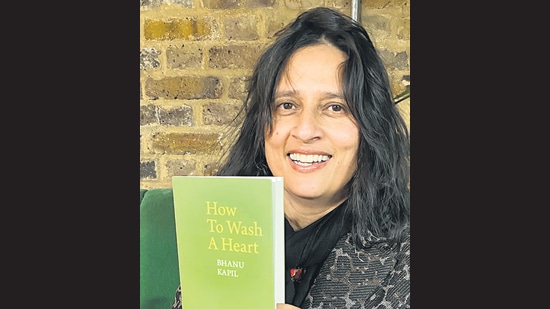
How to Wash a Heart, a slim collection, heaves with the weight of the world migrants carry on their shoulders, away from their home and hearth, in faraway lands. The poems are deeply-felt reflections on the lived experiences of a brown guest in the house of her middle-class, liberal, white host. Attuned to the agony and anxieties, the horrors and humiliations of an immigrant life, the poems in the collection explore how hospitality can border on hostility, and lay bare the hollowness of inclusion and care. The guest is an artist, who is constantly trying to readjust to the ways of her host, and yet seen by the latter as the Other. The poems, told in the voice of the guest, flit between past and present. They are laced with memory and the nostalgia for the life left behind. The artist-narrator, naturally, seems to be interested in the ideas of spatial boundaries — of nationhood, home and the human body. Each poem is an episode, an event in the life of the migrant — it chronicles her emotional response to an excess or the transgression of her host.
The first poem begins with a simple question: “Like this?” What do we make of this question? We soon know. It’s “inky-early” and the artist-narrator, wearing a knitted scarf, who likes to “go outside straight away” and bask in the brisk air, just like John Betjeman (1906-1984) — Britain’s best-loved poet whose works echo a deep sense of nostalgia — and finds herself awakened to a “fleeting sense of possibility”. And, also, filled with gratitude to her host: “You made a space for me in your home, for my books and clothes/and I’ll/Never forget that.” She also remembers how her host had introduced her adopted daughter to the guest as an “Asian refugee”. There is a context to this: Bhanu had come to read a newspaper story about a white couple in California, who identified as progressive/liberal, and had adopted a daughter from the Philippines a few years earlier. “I was so struck by the facial expression of the mother in the newspaper photograph, the taut muscles around her mouth as she smiled,” she writes in the Note on the Title in How to Wash a Heart. It had also set her thinking about her own experience in American academia. “It made me think of my experience in university settings: an outward-facing generosity or inclusivity that has not, always, matched the lived experience of moving through corridors and faculty meetings of the “mostly white” spaces that a private, liberal arts college in the United States so often is. And how the discrepancy between the two is often felt and fleeting, rather than seen,” writes Bhanu, for whom these poems are an attempt to “work out” the relationship between the immigrant guest and the citizen which, so rapidly, begins to go wrong.
{{/usCountry}}The first poem begins with a simple question: “Like this?” What do we make of this question? We soon know. It’s “inky-early” and the artist-narrator, wearing a knitted scarf, who likes to “go outside straight away” and bask in the brisk air, just like John Betjeman (1906-1984) — Britain’s best-loved poet whose works echo a deep sense of nostalgia — and finds herself awakened to a “fleeting sense of possibility”. And, also, filled with gratitude to her host: “You made a space for me in your home, for my books and clothes/and I’ll/Never forget that.” She also remembers how her host had introduced her adopted daughter to the guest as an “Asian refugee”. There is a context to this: Bhanu had come to read a newspaper story about a white couple in California, who identified as progressive/liberal, and had adopted a daughter from the Philippines a few years earlier. “I was so struck by the facial expression of the mother in the newspaper photograph, the taut muscles around her mouth as she smiled,” she writes in the Note on the Title in How to Wash a Heart. It had also set her thinking about her own experience in American academia. “It made me think of my experience in university settings: an outward-facing generosity or inclusivity that has not, always, matched the lived experience of moving through corridors and faculty meetings of the “mostly white” spaces that a private, liberal arts college in the United States so often is. And how the discrepancy between the two is often felt and fleeting, rather than seen,” writes Bhanu, for whom these poems are an attempt to “work out” the relationship between the immigrant guest and the citizen which, so rapidly, begins to go wrong.
{{/usCountry}}Coming back to the poem, the artist, addressing her host, remembers how she had felt happy and “less like a hoax” when her daughter had come in with her coffee and “perched” on the edge of her cot. The poem ends with the remembrance of the artist showing her host’s daughter how to drink water from “the bowls on the windowsill” — like birds do, taking a break from flying in the open sky, unfettered and not tied down by identity. What follows next are sentences that shake, providing answers to that simple question — “like this?” — evoking the emotional complexities and conundrums of a life in exile, and dissecting power, both ethnic and economic. The subsequent poems across five sections weave in the artist’s back story, memories of home, her fragile quests for love, her refuge in art and literature, her broken sense of self, and the great betrayal by her host. While announcing the prize, poet Lavinia Greenlaw, chair of the TS Eliot Prize’s three-member jury, which also included poets Mona Arshi and Andrew McMillan, said the voice Kapil has created “manages to fuse vulnerability, rage, humour, desire, incredible incisiveness about their own state and nature and the other’s state and nature.” Greenlaw added: “This is a unique work that exemplifies how poetry can be tested and remade to accommodate uncomfortable and unresolvable truths.”
Last year, How to Wash a Heart won the Windham Campbell Prize. Its citation read: “Through transgressive, lyrical language Bhanu Kapil undoes multiple genres to excavate crucial questions of trauma, healing, immigration, and embodiment at the outskirts of performance and process.”
The collection drips with the guest’s anguish, her sense of hurt and loss, her response to violence of different hues, her visceral shame, her vulnerability and exhaustion: “It’s exhausting to be a guest/In somebody else’s house/Forever.” In one poem, she begins by stating how she doesn’t want to “beautify our collective trauma”. And then succumbs: “As your guest, I trained myself/To beautify/Our collective trauma.” Elsewhere, she sees her host as “a wolf capable of devouring/My internal organs/If I exposed them to view.” When she had left home, though she had “lost all our possessions”, she had felt a “strange relief” to see her home “explode in the rearview mirror”. Her current reality in a foreign land seems to explode, too, albeit in a different fashion. The line of questioning, introduced in the opening sentence, continues elsewhere too: “Is a poet/An imperial dissident, or just/An outline/Of pale blue chalk?” In another poem, she asks: “How do you live when the link/Between creativity/And survival/Can’t easily Be discerned?”
There is also a reference to the work of Aurora Levins Morales, the Puerto Rican Jewish feminist poet and essayist, whose work straddles the interwoven social and natural histories of our landscapes and bodies and explores identity and social justice. Edvard Munch, the Norwegian painter best-known for The Scream finds a mention, too — “An artist in transit/Between loves, colors, afternoons.” Perhaps Bhanu is hinting that an immigrant’s life is a quiet scream, too. By displacing the heart from its context in the title, she seems to be trying to foreground the incongruity and unease of uprootedness, an experience central to a migrant’s journey. In How to Wash a Heart, “blood” drips off the poet’s sentences — the bad blood between the migrant guest and the citizen host.
Nawaid Anjum is an independent journalist, translator and poet. He lives in New Delhi.