I planned a family trip to Wales because of a bridge.
I had seen Devil’s Bridge in a brooding Welsh-language crime drama: dark, atmospheric, wrapped in mist. Three ancient bridges spanning the Afon Mynach gorge, each built upon the last. We arrived there by steam train, on the narrow-gauge Vale of Rheidol Railway that has linked Aberystwyth and Devil’s Bridge since 1902, winding through wooded valleys and past rushing streams.
Devil’s Bridge was every bit as haunting as I’d imagined.
I planned a family trip to Wales because of a bridge.
I had seen Devil’s Bridge in a brooding Welsh-language crime drama: dark, atmospheric, wrapped in mist. Three ancient bridges spanning the Afon Mynach gorge, each built upon the last. We arrived there by steam train, on the narrow-gauge Vale of Rheidol Railway that has linked Aberystwyth and Devil’s Bridge since 1902, winding through wooded valleys and past rushing streams.
Devil’s Bridge was every bit as haunting as I’d imagined. But it wasn’t the bridge that stayed in my mind; it was Aberystwyth. Like most visitors, I’d treated the seaside town as a base. I wasn’t expecting much, I confess, but I was wonderfully surprised.
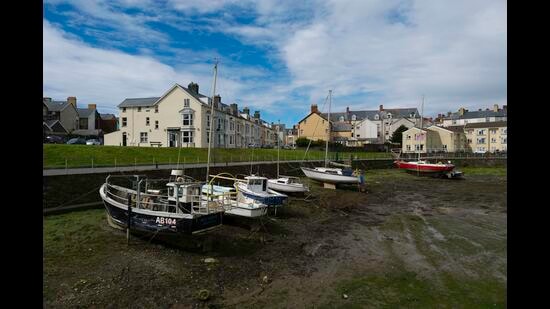
Aberystwyth, which translates to “the mouth of the River Ystwyth” sits where the river meets the Irish Sea, almost midway along Ceredigion’s rugged coastline. Victorian terraces line the mile-long promenade. Waves crash against the sea wall even on calm days. Beyond the harbour, a 13th-century castle seems to stand guard over the bay.
On my first day, I noticed the easy relationship people had with language. Locals typically switched between Welsh and English. I head the musical lilt of the Celtic language in cafés and restaurants, saw the script on shop signs and menus.
In 2025, UNESCO named Aberystwyth-Ceredigion Wales’ first City of Literature, making it part of a global network that includes Dublin, Barcelona, and Seattle.
At first glance, it seems an unlikely choice. Aberystwyth isn’t even a city. Fewer than 20,000 people live here, and it’s better known for its university and sea views than literary fame. But UNESCO wasn’t recognising size; it was acknowledging a way of life, a county-wide literary heritage, thriving bilingual culture, and a concentration of institutions.
“It’s a testament to the vibrancy of the literary scene, in both Welsh and English, throughout the county,” said Eluned Morgan, Wales First Minister, after the announcement.
A library that holds a nation’s memory
Standing on Penglais Hill since 1916, the National Library of Wales dominates the skyline without dominating the town. The pale stone façade leads to a hushed interior: here, readers turn pages in silence, researchers look for reading rooms, and visitors explore multiple exhibitions that tell the story of Wales through books, maps, archives, and art.
I pause at a tall window before heading into the reading rooms. Cardigan Bay shimmers in the afternoon light and I catch sight of students crossing the hillside, with backpacks and takeaway coffees.
One of Britain’s legal deposit libraries, the National Library holds around eight million books and periodicals, along with manuscripts, maps, photographs, films and archives. Its treasures include the Black Book of Carmarthen, the oldest surviving manuscript written entirely in Welsh; medieval texts linked to Geoffrey Chaucer’s scribe Adam Pinkhurst; and the Nanteos Cup, a wooden bowl local legend associates with the Holy Grail.
A slow afternoon in the library reveals that literature has never been separated from language in Wales. Welsh and English exist side by side, not in competition but in conversation. That bilingualism runs through Aberystwyth’s schools, publishers, festivals and bookshops – perhaps one of the reasons UNESCO looked past the town’s modest size.
The county is also home to an unusual concentration of literary institutions: the Books Council of Wales, Aberystwyth University, the University of Wales Centre for Advanced Welsh and Celtic Studies, Literature Across Frontiers, and Wales Literature Exchange. Aberystwyth, the first town in Wales to appoint a Town Poet, also claims connections to more than 300 poets.
Professor Mererid Hopwood of Aberystwyth University’s Department of Welsh and Celtic Studies, called the designation an opportunity “to reinforce the vibrant literary heritage that we enjoy right here as we share it with the world”.
But what impressed me most wasn’t found inside a library. It was outside, beneath my feet. Along the Victorian promenade, poetry has been set into the pavement. Slate inserts carry specially commissioned couplets by town bards Dr Eurig Salisbury and Dr Hywel Griffiths, celebrating the sea, the landscape, and the community that has walked this coastline for generations. “Aberystwyth is a place where land, sea and people meet in a constant, yet ever-changing dialogue,” they wrote.
In many places, poetry lives inside books and book stores; here, it’s part of the ground you walk on.
That spirit runs through the county, with literary trails winding through woodlands and festivals celebrating everything from crime writing to classical music.
Where stories find a home
I didn’t have to search hard for books in Aberystwyth. They’re piled high in indie bookshops, tucked into café corners, and can always be seen under the arms of students heading across town.
The most enchanting was Bookshop by the Sea, a few minutes’ walk from the promenade. It’s become a social media favourite, and it’s easy to see why when I step inside. Warm lamps cast an inviting glow over worn armchairs. Packed shelves run floor to ceiling. Downstairs, another maze of books invites slow browsing. The shop hosts book clubs, poetry evenings, author talks, children’s story sessions, and writing workshops.
Founder Freya Blyth, a literature graduate, poet and former librarian, arrived from England’s Lake District to study and stayed because she found a community she didn’t want to leave. During the pandemic, with libraries closed, she began imagining something different. At a time when libraries weren’t allowed to open, but commercial spaces were, she had a thought. “What if I could open a bookshop by the sea that felt like a library, a living room, a place to gather again? The sea influences everything I do: the books I choose, the poetry I write. It connects places, people and stories. It reminds me we’re all part of something bigger.”
Aberystwyth’s other indie bookshops include Ystwyth Books, which has shelves overflowing with books across two floors and staff who happily switch into Welsh mid-recommendation. Siop Inc celebrates Welsh-language publishing alongside local art and music. Gayberystwyth is an inclusive space for queer literature, poetry readings, and community conversations.
Getting a coffee at a café overlooking Cardigan Bay, I asked the server why Aberystwyth seemed to attract so many readers. She smiled, glanced towards the sea, and shrugged. “People don’t rush here. You can sit with a book for hours and nobody minds. The sea slows you down.”
By the time I left, I realised she was right. I hadn’t spent my visit ticking attractions off a list. I’d wandered through one of the world’s great libraries, browsed bookshops and eavesdropped on conversations that shifted between two languages, and walked over poetry set into the promenade.
UNESCO chose Aberystwyth as Wales’ first City of Literature on October 31, 2025. After spending an afternoon wandering its streets, book in hand, it is clear that Aberystwyth has always been a city of literature.
Teja Lele is an independent editor and writes on books, travel and lifestyle.
One Subscription.
Get 360° coverage—from daily headlines
to 100 year archives.
Archives
HT App & Website