Finally, Chintu celebrated his birthday! How do you feel now?
I feel at ease. I feel like a proud parent. I feel proud of the choices I made on this film. I feel glad that I gave it my best. But having said that, I feel grateful to the hundreds of people who believed in the film and the lakhs of people who have watched it and continue to send love every other day. The 13-year-old journey doesn’t end up surprising me.
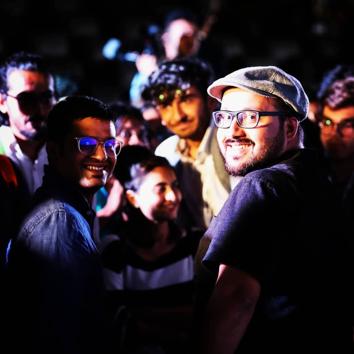
Growing up in Bihar, when did it occur to you to move here?
I must have been 15 when Satyanshu made a wish - or should we call it a prophecy - that we would make films someday. It stuck with me. I really believed him. Much like Chintu believes his father in the film. But we took it easy. Satyanshu went on to study medicine at the Armed Forces Medical College in Pune. It was in my 11th class when I realized that directing was something I was good at and wanted to pursue. My friends and teachers would keep telling me that I was meant to do something in the entertainment industry. Satyanshu and I kept nurturing our dream.
Would you say you’re a writer first and a filmmaker second?
The opposite. A filmmaker first. I wouldn’t dare call myself a writer because I do not write every day. I do it only when I need to express on paper. Satyanshu is more of a writer. He writes everyday and he is bloody good at it.
Would you say you’re a writer first and a filmmaker second?
The opposite. A filmmaker first. I wouldn’t dare call myself a writer because I do not write every day. I do it only when I need to express on paper. Satyanshu is more of a writer. He writes everyday and he is bloody good at it.
It’s such struggle, waiting for years for a film to be made and released. What did it teach you?
This entire process has taught me a lot. But among the few most important things, I think I have learnt not to worry about the end result. It used to be very important to me. Not anymore. Because, no matter how hard you may try, it will all turn out the way it’s planned. And because I have seen it so closely with my first film, and I know that things will pan out the way they’re destined to, I have become more ziddi in a way. Like, I will never give up. I will keep protecting my vision because things may fall apart. I strive to work harder expecting things to go wrong. It also makes me feel that what I am doing is special and that I must serve my profession and give it all that I have.
Why cinema and not, say, literature?
All art forms are great. But I strongly believe that cinema is the confluence of the greatest art forms – music, art, literature, dance, poetry. And so much more happens when the various art forms fuse together in the audio-visual medium of cinema. To me, the impact of cinema is far greater than that of literature or music, or dance or drama alone.
Who are the writers and filmmakers that influenced you?
I am a huge fan of Ruskin Bond and Gulzar. I love they way they look at life. Their writing is simple and effortlessly charming. I love accessible and relatable emotions of inaccessible people, people who go on to be characters of a film. I love Khaled Hosseini a lot. I admire Satyajit Ray, Bimal Roy, Vijay Anand, Hrishikesh Mukherji, Gulzar, Mani Ratnam, Mira Nair and Vishal Bhardwaj. In the international arena, I love the masters like Alfred Hitchcock, Akira Kurosawa, Billy Wilder, Stanley Kubrick, David Fincher etc. But I admire Yasujiro Ozu, Martin Scorsese, Asghar Farhadi, Richard Linklater, Alexander Payne, Charles Chaplin and Steven Spielberg more. Their work stays with me for longer. Like a Life is Beautiful and a Cinema Paradiso and Hugo and ET will stay with me forever.
Your work is now getting the attention it deserves. What is the importance of fame in the life of a writer, creator?
It’s for the creator to figure that out. I remember that while screening my films across 16 cities at the Jagran festival last year, no one in the audience knew me while my film played. I would walk in the aisles and request them not to record the film as if I was a volunteer at the festival. Watching them react strongly to the film is what I seek. As long as I can make movies, I do not care about fame. It does help you no doubt. After I received my National Award, people in the industry did take me more seriously. But the joy of capturing your audience and making them laugh and cry is the biggest high. No fame can ever touch that.
There’s something refreshingly honest about Chintu Ka Birthday. Did it happen automatically?
I guess so. Because, we did not know so many things. All we knew was the story we wanted to tell and what we wanted to do with our script as directors. I mean, the same film could have been a dark, gory, depressing tale about a family trapped in a war zone. But we felt we needed to say something much more through the experience of the film. We wanted to present our voice. We felt it was fairly original and needed to be told. I mean, the film is set in 2004. The US army left Iraq in 2009. 11 years later, the film still appears relevant. It’s so unfortunate. In the ideal world, our story should have been outdated. But look what’s happening around the world. Coming back to our film, the characters and their spirit is lifted straight from my family. So yeah, it was not so difficult.
You and your brother, Satyanshu, write together. One pair that got that right was the Coen brothers. Is the process always smooth?
Well, there are many others too: Dardennes Bros, Wachowski Bros and six other sibling pairs who direct together. Most of them write together as well. Writing with Satyanshu is like playing under Mahendra Singh Dhoni. Even if I am writing something on my own, I will reach out to him to guide me and at times lead me. He is an exceptionally hard working writer; a self-taught, well-read writer who is super objective about his work. His sense of judgement and his understanding of storytelling is impeccable. He is very harsh on you but he is equally harsh on himself, maybe more. So it is very easy to partner with him. He has all the best things you would want in your partner. He communicates well. There is a structure, a road map, a method to madness and no room for ego. It has definitely evolved over so many years, but it is amazing. I know that my co-writer is not going to pull me down. And the film is more important than us. Creative arguments happen. We are two passionate people but since we are tied with the same values and shared the same womb, we know that we love each other unconditionally. Our equation becomes more important and takes care of the creative differences. I am blessed to have him as a mentor, as family as well as a partner.
The casting is impeccable in Chintu. How did Vinay Pathak and Tilottama Shome come on board?
It was a lot of hard work. It took us months. We never settled for anything that was easy or mediocre. Travelled cities; reached out to the right people - DM Stars in Delhi, Yash Nagarkoti in Mumbai, and Kumar Vivek and Iftikhar Ahmad Dar in Kashmir are the people and setups that helped us. I conducted the auditions of actors myself, especially of the child actors. Spent days and days with the kids and with their parents before officially selecting them. Actually, I started my filmmaking career in the casting department and hence casting is sacred for me. The script helped us get mavericks like Vinay Pathak, Tillotama Shome, Nate Scholz, Reginald Barnes and Khalid Massou. I remember asking the legendary Seema Pahwaji about what made her choose such a small role in a small film with newbie directors. She said it was the writing, the script. Her nod gave us such a boost. It’s unforgettable.
You told me you want to write two books as well. What kind of books?
I want to pen down my experiences of making Chintu Ka Birthday because I want to keep reminding myself about the journey and also because I cannot part ways with it. The second one would definitely be a collection of poems and/or short stories for children. Inshallah.
What was it like growing up where you did?
I come from Munger in Bihar. Much like my film Chintu Ka Birthday I have had the pleasure of being surrounded by amazing people in my joint family. My father used to have visions (the divya-drishti that Chintu’s papa gets); my mother always stood for what is right and held the fort much like Chintu’s mother. My elder brother is creative, responsible and an achiever much like Chintu’s sister. I was doted on; loved by my grandparents and the extended family; grew up on Ramayan, Mahabharat, Jungle Book and good movies.
In today’s polarized world, how important is it for art to be political?
It depends on your personal choice, political leaning and agendas. For example, I could have set Chintu Ka Birthday in Kashmir. I could have chosen to show Indian soldiers in a certain way. The theme of the film would stay the same, but the setting wouldn’t remain as unique as it is now. For me, the story is the most important thing. For a film like Chintu Ka Birthday, an Indian family trapped in the US-Iraq war was the best setting. As an artist, my sole purpose is to serve art and keep myself as neutral as I can. It is difficult, but this is how I choose to operate. I choose humanity over politics.
It’s said that how you handle a difficult phase determines your success. Tell me about the tough times in your journey.
Your success is what you determine. For me, I chose a dream that was never easy to realize. I knew I had to work hard and it would mean sacrifices. But how dare I call them my struggles when I was following my passion. I had left my family, my parents to fulfil this dream. I was being selfish. I was chasing my dreams. How could I complain? I don’t call it a struggle. It’s a phase that teaches you. I chose to not give in because I love it so bloody much. And also because of my loved ones who have been supporting me unconditionally. From where I see it, it was an impossible dream to become a filmmaker starting from Munger. But I am here because I never saw struggle as struggle. And I am not going to give up. I am here to stay!
Your next film, 14 Phere was announced a few days ago. How has the process for this film been different from the one with Chintu?
Well, 14 Phere is written by Manoj Kalwani. He is a very promising writer trained in Satyanshu’s six-month-long screenwriting residency programme called First Draft. It is a special programme that trains writers for free. AIB Boys (Tanmay, Rohan, Ashish & Khamba) started this venture with Satyanshu. So far, we have 20 writers trained in this programme. Manoj came up with the idea and wrote the screenplay right in front of us. He is a special writer. Satyanshu has given his heart to the script. All I did was falling in love with it and visualise it into a shooting script.
How do advertising and filmmaking interact or interfere with your filmmaking journey?
I love advertising. And I love it so much more after having made my first film. It is such a challenge and so much fun! The shorter format pushes you. The strict timelines bring the best out of you. It is like an amazing riyaaz. I treat it like net practice. It also empowers me to wait for the right feature film. I can choose to sit at home and not work until I get the best script. This is a big deal for me. It makes me meet so many technicians and helps me hone my directorial abilities. But the best part is that I have learnt to empathize with my crew. Unlike in feature films, which is a director’s medium, while directing ad films, I am serving a vision. I work as a technician and the day I realized that, I felt so empathetic towards the hundreds of people who serve me and help me in protecting my vision. It’s humbling and inspiring at the same time.
Do you write on schedule? How important is discipline in film writing?
Oh, I never write on schedule. I never want to write for hire. I want to write only when I am inspired. It’s not my job or my hobby. It is love. If I don’t feel like writing at a particular time, I choose to watch a film or shut down and daydream. God, I am so lazy! Film writing is all about rewriting. Film writing is all about discipline.
You have now entered a phase of much-deserved success. Let me borrow my last question from Sahir: Yeh duniya agar mil bhi jaaye toh kya hai?
I am yet to find that out, brother. Let me try to answer Sahir’s question with Sahir’s lines:
Main pal do pal ka shayar hoon, Pal do pal meri kahaani hai.
Pal do pal meri hasti hai, pal do pal meri jawaani hai.
This is what I believe in. I do not want the world. I don’t want to change the world with my work. I simply want to make my audience smile and move them to tears. I want my work to live through generations and forever. I want to go smiling. My work will hopefully stay and that’s all I wish for. Cinema is forever. Life is temporary.
To sum up, as Gulzar sahab said:
Zindagi kya hai jaan-ne ke liye,
Zinda rehna bahut zaroori hai.
Aaj-tak koi bhi rahaa to nahin!
Mihir Chitre is the author of two books of poetry, School of Age and Hyphenated. He is the brain behind the advertising campaigns ‘#LaughAtDeath’ and ‘#HarBhashaEqual’ and has made the short film Hello Brick Road.