...
...
Next Story

Report: Ghazipur Literature Festival

The stimulating event included many excellent discussions on Bhojpuri language and literature and the culture of eastern UP

Updated on: Feb 04, 2026 11:56 AM IST
By
Prefer HTon Google
Advertisement

Often when we imagine the setup of a literature festival, we automatically place ourselves in some busy metro city where the attendees are trying to find their own pace. But do we really need to limit ourselves to an urban setup when many of our renowned writers come from villages or much smaller cities? What stops us from taking literature to the very people who are regularly written about? With these questions in mind, co-founders of Bharat Dialogues writer-translator Pooja
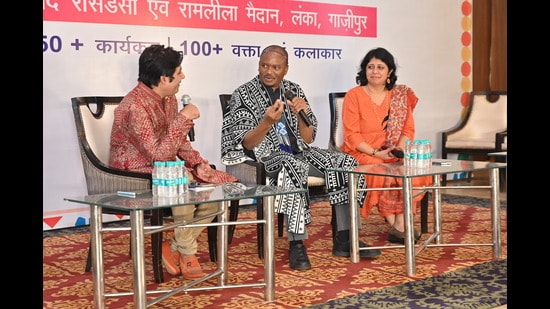
PREMIUMVivek Satya Mitram, Zolani Mkiva and Pooja Priyamvada at the festival. (Courtesy Ghazipur Literature Festival)
Vivek Satya Mitram, Zolani Mkiva and Pooja Priyamvada at the festival. (Courtesy Ghazipur Literature Festival)
Rati Saxena, Priyadarshan, Neerja Madhav and Kamila Junik at the event. (Courtesy Ghazipur Literature Festival)

The festival was inaugurated at The Clarks in Varanasi with a recorded message from the Deputy Chairman of the Rajya Sabha, Harivansh Narayan Singh. He welcomed participants and congratulated the team for thinking of this unique event. Emphasizing on the great works that emerged from the region he said, “after reading Rahi Masoom Raza’s Aadha Gaanv (Half Village) you wouldn’t need to read any sociological study of that area.” Afterwards, Pooja Priyamvada addressed the gathering and said that many had questioned the decision to hold such an event at a “backward” place like Ghazipur. Introducing the chief guest Anil Sooklal, High Commissioner of South Africa in India, she spoke about his ancestral connection to the place. “Even though the British uprooted us as girmitiyas (indentured labourers), they could never succeed in taking Bharat out of us,” Sooklal said.

The first panel consisting of Vivek Satya Mitram, Bhojpuri poet Manoj Bhawuk, actor Aanjjan Srivastav, writer Neerja Madhav and poet Mrityunjay Kumar Singh discussed “Why Ghazipur matters? Why discovering roots is essential?” Mitram stated that people working elsewhere often do not reveal that they are from Ghazipur and added that there was a need to improve things. Manoj Bhawuk, who spoke about the importance of local culture, provided the historical context. He explained that the strengthening of Hindi during the freedom struggle led to the marginalization of languages like Bhojpuri.

The next session was a presentation by Yashwat Deshmukh, the founder of C-Voter, about “Poorvanchal: The Pulse of Indian Democracy”. He stressed that the people of the region were politically aware and therefore had always influenced the entire country.

The keynote address titled “In A Global World, Looking at Regional Identities” by Kayshav Tewari, a diplomat at the High Commission of Guyana in New Delhi, was enlightening. He spoke about his ancestors enriching the existing culture of Guyana by seamlessly merging it with their own.

Vivek Satya Mitram, Manoj Bhawuk, Aanjjan Srivastav, Neerja Madhav and Mrityunjay Kumar Singh at the festival (Courtesy Ghazipur Literature Festival)

The next panel on “The Eternal Batohiyas (travelers)” featured South African poet Zolani Mkiva, academic and diplomat Nelistra Sooklal, Hindi scholar from Poland Kamila Junik, Dutch-Surinamese singer Raj Mohan, and veteran theatre artist MK Raina in conversation with Pooja Priyamvada about the continuous quest for a home. Raina sounded a note of caution and asked everyone to be careful about getting stuck in the past and carrying its baggage. Raj Mohan underlined how his songs tend to focus on the emotive structure of words and how, through this, he is able to narrate the realities of people like him. Junik took the conversation towards translation and how it can bridge the quest for a home. The day ended with a brilliant performance by singer Raj Mohan and Dutch-Surinamese guitarist Remon Bhagwandin.

The party then travelled to Ghazipur where the literary festival continued for two more days.

Day two began at Hotel Nand Residency, which hosted an exhibition showcasing literature from the region. The Chief Guest for the day was former Ghazipur MP and current lieutenant governor of Jammu and Kashmir, Manoj Sinha. He spoke about how girmitiyas helped build the world and named several literary personalities from the region.

The first session moderated by editor and poet Priyadarshan had literary personalities like Rati Saxena, Kamila Junik and Neerja Madhav talking about “Women in Poorvanchal Consciousness”. Saxena, who is also a Vedic scholar, spoke about how stories of women were narrated in the Vedas and how the condition of women worsened in Puranic times. Madhav, on the other hand, criticised feminism and wondered, “Who do we want freedom from? The father who loves us and provides for us or the brother who protects us?” To which the moderator clarified, “Women want freedom from such fathers who are ready to kill their daughter just because she chose a partner of her own liking, not the ones who support their children”. Junik took the conversation forward by emphasizing on the need to centre rural women’s voices.

Another interesting session moderated by Shivendra Kumar Singh, journalist and founder of Raaggiri, and featuring poet Sadanand Shahi, journalist Devendra Nath Tiwari and author Bhavtosh Pandey on the panel looked at why Bhojpuri hasn’t yet been recognized as a language. Tiwari believes many Bhojpuri-speaking people have themselves played a part in limiting the language. Singh wondered why Maithili was able to get recognition but Bhojpuri hadn’t. Shahi responded that people from the Ghazipur region were largely working class and “hence, due to the stratification of language and portrayal in the media, Bhojpuri got marginalized.”

The next session took this conversation forward by discussing Bhojpuri literature. Moderated by cultural researcher Nirala Bidesiya, it had poet and former IPS officer Mrityunjay Kumar Singh in conversation with Bhojpuri writer Suman Singh and author Rakesh Srivastava. Srivastava spoke about how people are now making content in Bhojpuri and reconnecting with their roots. Singh elaborated on how women have been taking the language forward through folk songs and revealed that a few young people are also pursuing PhDs on Bhojpuri.

Samir Chatterjee, Vibhuti Narain Chaturvedi, Anu Shakti Singh and Manoj Rajan Tripathi at GLF. (Courtesy Ghazipur Literature Festival)

The programme ended with beautiful Bhojpuri songs by Chandan Tiwari, poetry and shayaris by MD Singh, Manoj Bhawuk, Vinay Rai Baburang, Nomaan Shauque, Azhar Iqbal, Rati Saxena, Suman Singh and Himanshu Upadhyay.

The concluding day’s programme began with an interesting session titled Africa and India: Reclaiming a Heritage. Pooja Priyamvada and Vivek Satya Mitram had a deeply moving conversation with Zolani Mkiva, who spoke about being born on the margins and having to overcome several difficulties, which are evident in his art. “In any given society poets articulate voices of the voiceless and weave experiences into an artistic piece which can indeed bring a change,” Mkiva said. Later, senior journalist Samir Chatterjee had an engaging session on Poorvanchal in Media: Fitting a Mould or Breaking it? with authors Manoj Rajan Tripathi, Anu Shakti Singh and veteran journalist Vibhuti Narain Chaturvedi. Chatterjee spoke about how the media presented Poorvanchal as a region famous only for poverty, casteism and hooliganism. “Ye sab dikhne aur bikne wali baat hai (Its all about what we can show and sell as a story), since the region is basically a factory of poor workers for the entire country it suits the narrative,” Tripathi said adding that in reality “the Purabiyas have spread our culture all over the world, for example Chhath is a global festival now.” Chaturvedi said that Delhi media thought of the region only when they needed some spicy news about crime. “Journalists who cover real news are targeted, for example the guy who exposed the midday meal scam in Mirzapur, what happened to him?” Singh also echoed the same.” The festival concluded with a moving speech by organizers Pooja Priyamvada and Vivek Satya Mitram about the hardships and ridicule they had to face for organizing a literature festival in a place like Ghazipur. The brilliant performance by Raj Mohan and Chandan Tiwari and her team that followed was a fitting finale to an event that was both enjoyable and enlightening.

Chittajit Mitra (he/him) is a queer writer, translator and editor from Allahabad. He is co-founder of RAQS, an organization working on gender, sexuality and mental health.

Often when we imagine the setup of a literature festival, we automatically place ourselves in some busy metro city where the attendees are trying to find their own pace. But do we really need to limit ourselves to an urban setup when many of our renowned writers come from villages or much smaller cities? What stops us from taking literature to the very people who are regularly written about? With these questions in mind, co-founders of Bharat Dialogues writer-translator Pooja Priyamvada and brand consultant Vivek Satya Mitram got together to come up with the first edition of the Ghazipur Literature Festival (GLF) held from 7th to 9th November, 2025.

PREMIUMVivek Satya Mitram, Zolani Mkiva and Pooja Priyamvada at the festival. (Courtesy Ghazipur Literature Festival)
Vivek Satya Mitram, Zolani Mkiva and Pooja Priyamvada at the festival. (Courtesy Ghazipur Literature Festival)

Ghazipur, a district and city in eastern UP, often ends up in the news for all the wrong reasons. Sadly, only a few people know that it is also the land which gave the world luminaries like Rahi Masoom Raza, Vishwanath Singh Gahmari and Kuber Nath Rai, among others.

Rati Saxena, Priyadarshan, Neerja Madhav and Kamila Junik at the event. (Courtesy Ghazipur Literature Festival)

The festival was inaugurated at The Clarks in Varanasi with a recorded message from the Deputy Chairman of the Rajya Sabha, Harivansh Narayan Singh. He welcomed participants and congratulated the team for thinking of this unique event. Emphasizing on the great works that emerged from the region he said, “after reading Rahi Masoom Raza’s Aadha Gaanv (Half Village) you wouldn’t need to read any sociological study of that area.” Afterwards, Pooja Priyamvada addressed the gathering and said that many had questioned the decision to hold such an event at a “backward” place like Ghazipur. Introducing the chief guest Anil Sooklal, High Commissioner of South Africa in India, she spoke about his ancestral connection to the place. “Even though the British uprooted us as girmitiyas (indentured labourers), they could never succeed in taking Bharat out of us,” Sooklal said.

The first panel consisting of Vivek Satya Mitram, Bhojpuri poet Manoj Bhawuk, actor Aanjjan Srivastav, writer Neerja Madhav and poet Mrityunjay Kumar Singh discussed “Why Ghazipur matters? Why discovering roots is essential?” Mitram stated that people working elsewhere often do not reveal that they are from Ghazipur and added that there was a need to improve things. Manoj Bhawuk, who spoke about the importance of local culture, provided the historical context. He explained that the strengthening of Hindi during the freedom struggle led to the marginalization of languages like Bhojpuri.

The next session was a presentation by Yashwat Deshmukh, the founder of C-Voter, about “Poorvanchal: The Pulse of Indian Democracy”. He stressed that the people of the region were politically aware and therefore had always influenced the entire country.

The keynote address titled “In A Global World, Looking at Regional Identities” by Kayshav Tewari, a diplomat at the High Commission of Guyana in New Delhi, was enlightening. He spoke about his ancestors enriching the existing culture of Guyana by seamlessly merging it with their own.

Vivek Satya Mitram, Manoj Bhawuk, Aanjjan Srivastav, Neerja Madhav and Mrityunjay Kumar Singh at the festival (Courtesy Ghazipur Literature Festival)

The next panel on “The Eternal Batohiyas (travelers)” featured South African poet Zolani Mkiva, academic and diplomat Nelistra Sooklal, Hindi scholar from Poland Kamila Junik, Dutch-Surinamese singer Raj Mohan, and veteran theatre artist MK Raina in conversation with Pooja Priyamvada about the continuous quest for a home. Raina sounded a note of caution and asked everyone to be careful about getting stuck in the past and carrying its baggage. Raj Mohan underlined how his songs tend to focus on the emotive structure of words and how, through this, he is able to narrate the realities of people like him. Junik took the conversation towards translation and how it can bridge the quest for a home. The day ended with a brilliant performance by singer Raj Mohan and Dutch-Surinamese guitarist Remon Bhagwandin.

The party then travelled to Ghazipur where the literary festival continued for two more days.

Day two began at Hotel Nand Residency, which hosted an exhibition showcasing literature from the region. The Chief Guest for the day was former Ghazipur MP and current lieutenant governor of Jammu and Kashmir, Manoj Sinha. He spoke about how girmitiyas helped build the world and named several literary personalities from the region.

The first session moderated by editor and poet Priyadarshan had literary personalities like Rati Saxena, Kamila Junik and Neerja Madhav talking about “Women in Poorvanchal Consciousness”. Saxena, who is also a Vedic scholar, spoke about how stories of women were narrated in the Vedas and how the condition of women worsened in Puranic times. Madhav, on the other hand, criticised feminism and wondered, “Who do we want freedom from? The father who loves us and provides for us or the brother who protects us?” To which the moderator clarified, “Women want freedom from such fathers who are ready to kill their daughter just because she chose a partner of her own liking, not the ones who support their children”. Junik took the conversation forward by emphasizing on the need to centre rural women’s voices.

Another interesting session moderated by Shivendra Kumar Singh, journalist and founder of Raaggiri, and featuring poet Sadanand Shahi, journalist Devendra Nath Tiwari and author Bhavtosh Pandey on the panel looked at why Bhojpuri hasn’t yet been recognized as a language. Tiwari believes many Bhojpuri-speaking people have themselves played a part in limiting the language. Singh wondered why Maithili was able to get recognition but Bhojpuri hadn’t. Shahi responded that people from the Ghazipur region were largely working class and “hence, due to the stratification of language and portrayal in the media, Bhojpuri got marginalized.”

The next session took this conversation forward by discussing Bhojpuri literature. Moderated by cultural researcher Nirala Bidesiya, it had poet and former IPS officer Mrityunjay Kumar Singh in conversation with Bhojpuri writer Suman Singh and author Rakesh Srivastava. Srivastava spoke about how people are now making content in Bhojpuri and reconnecting with their roots. Singh elaborated on how women have been taking the language forward through folk songs and revealed that a few young people are also pursuing PhDs on Bhojpuri.

Samir Chatterjee, Vibhuti Narain Chaturvedi, Anu Shakti Singh and Manoj Rajan Tripathi at GLF. (Courtesy Ghazipur Literature Festival)

The programme ended with beautiful Bhojpuri songs by Chandan Tiwari, poetry and shayaris by MD Singh, Manoj Bhawuk, Vinay Rai Baburang, Nomaan Shauque, Azhar Iqbal, Rati Saxena, Suman Singh and Himanshu Upadhyay.

The concluding day’s programme began with an interesting session titled Africa and India: Reclaiming a Heritage. Pooja Priyamvada and Vivek Satya Mitram had a deeply moving conversation with Zolani Mkiva, who spoke about being born on the margins and having to overcome several difficulties, which are evident in his art. “In any given society poets articulate voices of the voiceless and weave experiences into an artistic piece which can indeed bring a change,” Mkiva said. Later, senior journalist Samir Chatterjee had an engaging session on Poorvanchal in Media: Fitting a Mould or Breaking it? with authors Manoj Rajan Tripathi, Anu Shakti Singh and veteran journalist Vibhuti Narain Chaturvedi. Chatterjee spoke about how the media presented Poorvanchal as a region famous only for poverty, casteism and hooliganism. “Ye sab dikhne aur bikne wali baat hai (Its all about what we can show and sell as a story), since the region is basically a factory of poor workers for the entire country it suits the narrative,” Tripathi said adding that in reality “the Purabiyas have spread our culture all over the world, for example Chhath is a global festival now.” Chaturvedi said that Delhi media thought of the region only when they needed some spicy news about crime. “Journalists who cover real news are targeted, for example the guy who exposed the midday meal scam in Mirzapur, what happened to him?” Singh also echoed the same.” The festival concluded with a moving speech by organizers Pooja Priyamvada and Vivek Satya Mitram about the hardships and ridicule they had to face for organizing a literature festival in a place like Ghazipur. The brilliant performance by Raj Mohan and Chandan Tiwari and her team that followed was a fitting finale to an event that was both enjoyable and enlightening.

Chittajit Mitra (he/him) is a queer writer, translator and editor from Allahabad. He is co-founder of RAQS, an organization working on gender, sexuality and mental health.

All Access.
One Subscription.

Get 360° coverage—from daily headlines
to 100 year archives.

E-Paper
Full
Archives
Full Access to
HT App & Website
Games
 
SHARE THIS ARTICLE ON
Hindustantimes wants to start sending you push notifications. Click allow to subscribe