The thing about Atal Bihari Vajpayee was that he was not only a political leader but a good human being. It was this combination that made him a statesman. In the avalanche of fast-moving events, the vivid memories of recent history often fade away into sepia tones of collective amnesia, recalled only in the tokenisms of annual commemorative events. Vijay’s book is an antidote to this eclipse. He has painstakingly collected photographs from multiple sources to build a rich visual gallery of the life and times of a truly great son of India.
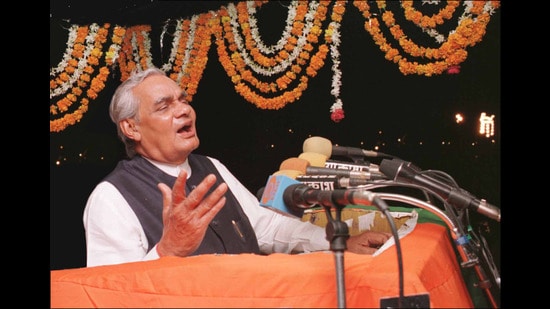
Vajpayee’s political journey is graphically brought about in the book. Born in a humble teacher’s family in Gwalior and making his debut as a parliamentarian in the 1950s, he distinguished himself not merely as a representative of a political ideology, but as an orator of rare grace. Even his ideological adversaries acknowledged the magnetism of his speeches — imbued with poetic cadence, intellectual depth, humour and often withering sarcasm.
Vajpayee was one of the few leaders who commanded respect across party lines, and, indeed, had genuine friends across the political spectrum, as is convincingly portrayed in this book. A plethora of photographs show his camaraderie at a personal level with leaders opposed to him politically. Goel reinforces this point when he quotes Jawaharlal Nehru as saying that Vajpayee — then a young MP — would be PM one day. This was said after Vajpayee had delivered a blistering speech critical of Nehru during the India-China war of 1962. Similarly, however opposed he was to the Congress, Vajpayee had the grace to effusively praise Indira Gandhi for her leadership in the 1971 war with Pakistan and the creation of Bangladesh.
{{/usCountry}}Vajpayee was one of the few leaders who commanded respect across party lines, and, indeed, had genuine friends across the political spectrum, as is convincingly portrayed in this book. A plethora of photographs show his camaraderie at a personal level with leaders opposed to him politically. Goel reinforces this point when he quotes Jawaharlal Nehru as saying that Vajpayee — then a young MP — would be PM one day. This was said after Vajpayee had delivered a blistering speech critical of Nehru during the India-China war of 1962. Similarly, however opposed he was to the Congress, Vajpayee had the grace to effusively praise Indira Gandhi for her leadership in the 1971 war with Pakistan and the creation of Bangladesh.
{{/usCountry}}In later life, several key moments define Vajpayee’s career. His brief 13-day tenure as Prime Minister in 1996, though numerically fragile, was morally robust. His resignation speech in Parliament remains a masterclass in democratic propriety, affirming that power must rest on legitimacy, not expediency. When he returned to office in 1998, leading a coalition government, Vajpayee displayed an extraordinary ability to harmonise divergent political interests — a skill that is increasingly rare today.
The nuclear tests at Pokhran in 1998 illustrated Vajpayee’s political resolve; but he did not shy away from an outreach for peace. His bus journey to Lahore in 1999, seeking reconciliation with Pakistan, revealed not naivety but courage —the courage to hope against history. There were mishaps during his tenure, such as the intelligence failure of Kargil, the attack on the Indian Parliament, and the unedifying capitulation that led Jaswant Singh, his foreign minister, to escort dreaded terrorists and hand them over to Pakistan. But he bore these stoically, seeking to combine military resolve with diplomatic restraint.
Several voluminous biographies have been written on Vajpayee. But the advantage of a picture book is that a photograph tells a thousand stories. Goel’s text is minimal, a short introduction, captions, and quotes from Atalji’s speeches. However, even this textual brevity says it all. Certain words occur repeatedly: warmth, wit, grace, laughter. They provide a stark contrast to the politics of our times. Take for instance, this quote from Vajpayee on page 206: “I am contesting elections since 1952. But never did I throw mud”. Another quote on page 168 says: “For me, power was never an attraction”. Such a statement could be considered a cliché, but in the case of Vajpayee, he showed that he practised what he said. In 1996, when his government lost by one vote, he proclaimed in Parliament — again a statement highlighted in the book — that if by breaking a party and forming a new coalition he could retain power then he “would not touch this power even with tongs”. What a contrast from the routine devaluation of political ethics today.
One of the reasons why Vajpayee was more than just a politician was that he had interests outside politics. He was fond of reading, of culture, of some of the good things of life, and, above all, he was a poet. Goel has a slim chapter on his poetry, but this aspect I can reinforce from a personal anecdote. Atalji asked me to translate his poetry into English. When we met at the PM’s residence, I told him that I had three conditions: one, that I would not translate his political poetry; two, that even the selection from his personal poetry would be mine; and three, that he defers the final decision until he saw some of my translations. With that ever-infectious smile, he said: “Manzoor hai: Agreed”.
I think back now on the asymmetry of the situation. I was a lowly Joint Secretary, and he was the Prime Minister, and I was laying down conditions to his request, to which he took no umbrage but gracefully agreed! It was the same democratic temperament that made him a darling of the media. He was accessible, forthcoming, and often dismissive of journalistic sycophancy. In contemporary India, where ideological positions often harden into inflexible dogma, Vajpayee’s example suggests that strength need not become hubris, nationalism need not become exclusionary, and India’s pluralism need not become homogenous. In fact, on page 220, Goel highlights this quote: “Let no one challenge India’s secularism”.
Beyond politics, however, it is Vajpayee, the person, who comes alive in this book. His wit — often self-deprecating — softened the harsh edges of political contestation. He could disarm critics with humour, disagree without being disagreeable, and valued the legitimacy of dissent. In an era where political opponents are often vilified, Vajpayee’s civility stands out as an ethical benchmark.
To mark the 100th birth anniversary of Atal Bihari Vajpayee, Vijay Goel’s book is a befitting tribute.
Pavan K Varma is an author, diplomat, and former Rajya Sabha MP. He is the author of 21 Poems, a translation into English of Atal Bihari Vajpayee’s Hindi poems.