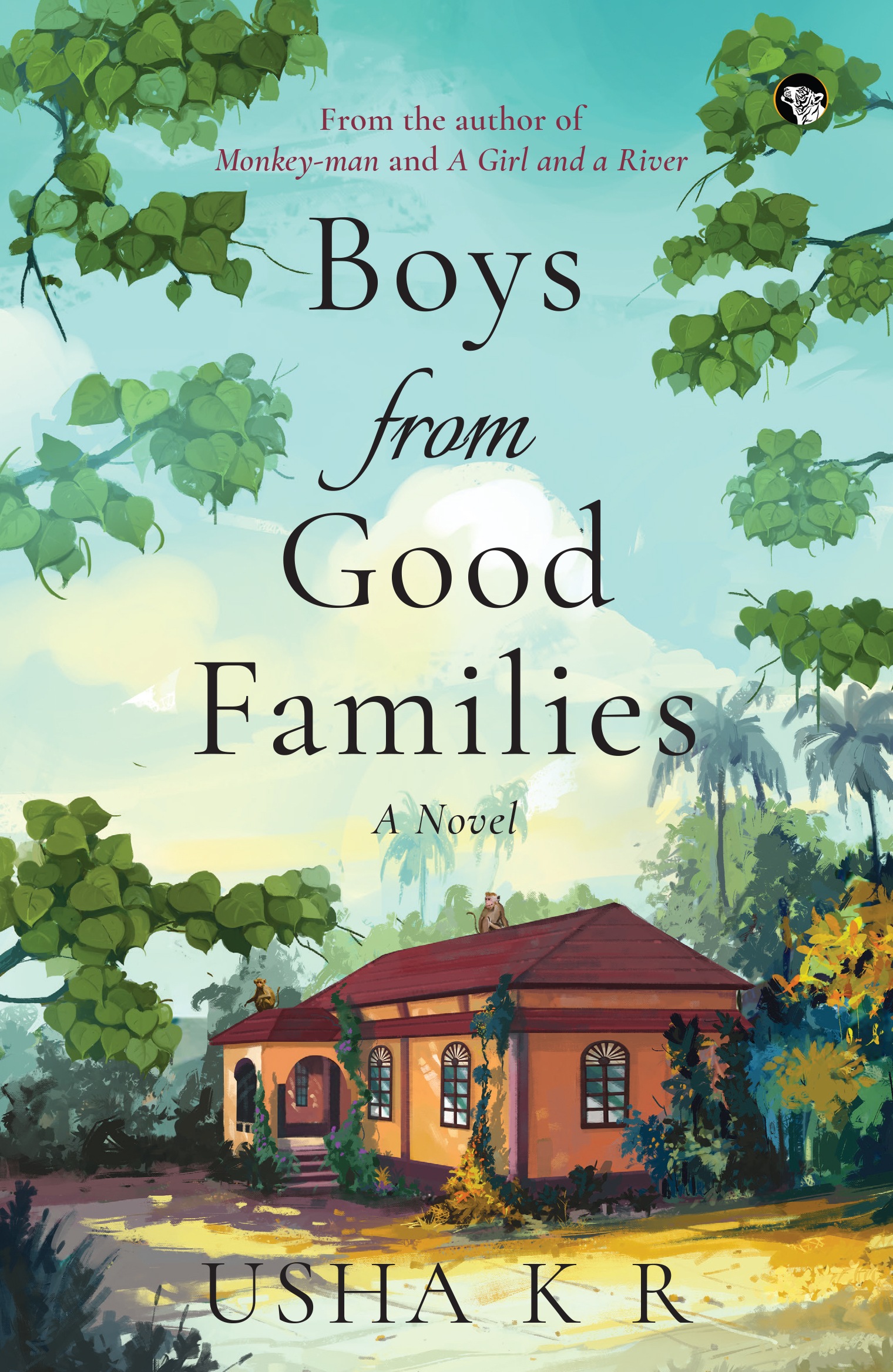
A boy shuns his chosen destiny, escaping to a very different life as his nascent attraction for the “wrong” girl is nipped in the bud. A household devolves slowly over the years, just as its outer shell, the house itself fights against the ravages of time. At a macro level, a city burgeons, the rise and fall of economies takes a toll on personal fortunes, and globalisation makes its presence felt in the lives of the characters. There is so much that happens in Usha KR’s Boys From Good Families that it feels like the reader is digging into a well-made thali but one that is crammed with too many bowls filled with all sorts of concoctions.
Usha, whose earlier books have been listed for the Commonwealth Writers’ Prize, the Man Asia and the DSC Prize for South Asian Literature, is a consummate writer. A Girl and a River won the Vodafone Crossword Award in 2007, and a short story, Sepia Tones was awarded the Katha Award for Creative Writing in 1995. Her command over language and provincial nuances is apparent. She often laces her writing with dry wit. Elaborate descriptions are infused with detailing that runs into pages, capturing the ethos of places and people, transition and stasis.
The prologue to Boys From Good Families is promising. A man returns to his dusty legacy, to the city where he grew up, after being away for 25 years. It is a striking anomaly in a country where familial ecosystems and umbilical cords do not relinquish their hold easily. Usha chooses to place the story in Bengaluru, a city she knows well. Her 2010 novel Monkey Man was also set in the city. In the Bangalore of the 1970s, there were houses amidst gardens, lots of quiet tree-lined bylanes. People cycled everywhere and a few coins could buy a plate of idlis and a coffee. The stately family home, Neel Kamal, part of this landscape, is steeped in traditionalism with a strict adherence to roles, rituals and routines. “Anything outside the sanction of convention, an original thought, an exhibition of individual style, was taboo.” In such a milieu, being attracted to the daughter of the family living in the outhouse is a transgression of the highest order. Ashwath, the boy and inheritor, the one named after the peepal, ficus religiosa, is the transgressing protagonist, on whose shoulders lie the expectations of his conservative father. Stifled by convention and disillusioned by what potentially lies ahead for him, he flees, in the guise of education, to a life on the other side of the world, desperate to submerge himself in the great American Dream.
The narrative follows Ashwath, or Ash’s assimilation, his naiveté and wonderment of the new way of life. Like a child let loose in Willy Wonka’s Chocolate Factory, he embraces it, stocking up on Hostess Twinkies and Jell-O from gigantic supermarkets. “I am here, he told himself, here in America, ordering French fries and coke in a cafe. I am here, one with this happy hub; I am not answerable to anybody but myself. I don’t have to eat and leave immediately, I can stay as long as I like, and I can come again tomorrow to this warm room and no one, no person, not a thought to bother me.” For readers well into the second decade of the 21st century, these come across as dated sentiments. As a student, he steers clear of other Indian students, warms up out of curiosity, to Paula Petersen, a fading librarian, who was once part of the anti-establishment Tom Hayden-led Students for a Democratic Society of the 1960s that decried the Vietnam War, and shares a more intimate attachment with Amy, the student-choreographer who waits on tables. Ashwath learns that the land of equal opportunity rewards merit. Prakash, the son of the family’s domestic help back home, who has also migrated, is an “unmitigated success story”, an analyst at “one of the Big Four financial auditors.”
{{/usCountry}}The narrative follows Ashwath, or Ash’s assimilation, his naiveté and wonderment of the new way of life. Like a child let loose in Willy Wonka’s Chocolate Factory, he embraces it, stocking up on Hostess Twinkies and Jell-O from gigantic supermarkets. “I am here, he told himself, here in America, ordering French fries and coke in a cafe. I am here, one with this happy hub; I am not answerable to anybody but myself. I don’t have to eat and leave immediately, I can stay as long as I like, and I can come again tomorrow to this warm room and no one, no person, not a thought to bother me.” For readers well into the second decade of the 21st century, these come across as dated sentiments. As a student, he steers clear of other Indian students, warms up out of curiosity, to Paula Petersen, a fading librarian, who was once part of the anti-establishment Tom Hayden-led Students for a Democratic Society of the 1960s that decried the Vietnam War, and shares a more intimate attachment with Amy, the student-choreographer who waits on tables. Ashwath learns that the land of equal opportunity rewards merit. Prakash, the son of the family’s domestic help back home, who has also migrated, is an “unmitigated success story”, an analyst at “one of the Big Four financial auditors.”
{{/usCountry}}Usha painstakingly describes change, a major leitmotif. When Ashwath returns to his hometown, it is a city with a metamorphosed skyline and character with new malls, McDonalds, and unisex salons, among other things. Ashwath’s teenage niece gifts him a haircut on his birthday in one. Ever muddling, he puffs to catch up with the new India. While the reader travels with him, it is difficult to entirely empathise with his character; it may seem that the writer has chosen it that way. “He had come of age in Reagan’s America. If a claim on its country were too grandiose, he would say in more famous words, he had been a contender.” Although initially he makes the right moves and ticks all boxes that bring him the three Cs - a condominium, car and credit card, it remains a broken dream. Along with him, at the core of the narrative also stands the house which sees decrepitude. Time is unkind to both of them.
One of the lovelier aspects of the book is the writer’s almost sentimental preoccupation with trees; their nuanced descriptions make for vivid imagery. “He recognised the handsome interloper all right - the pipal, the ashwattha, after which he was named, flushed a tender March red, the branches spreading from a strong torso into an even umbrella, bearing perfectly shaped leaves. The tree shimmered in the morning sun, a red beacon, a call to the faithful, as beautiful as a peacock on display.”
Much like the protagonist, the story lumbers along. At times, it rambles off into tortuous subplots: like the story of his sister Savithri’s marriage or the chapters on her subsequent life in Neel Kamal. Also at odds with the main plot is the thread that traces the transformation of the girl from the outhouse, Thippy into Tripura Sundari Amma, a godwoman running a spiritual fiefdom called Nivarana Ashram. She remains a shadowy figure.
In the end there are too many loose ends. Brevity and a certain crispness of narrative would have made this a well-rounded book from a good writer.
Sonali Mujumdar is an independent journalist. She lives in Mumbai.