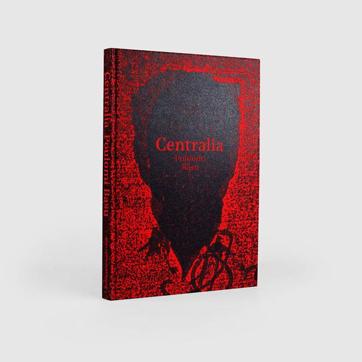
“In war, truth is the first casualty,” says Poulomi Basu, a transmedia artist, photographer, and activist, of her photo book Centralia, which she worked on for nearly a decade. A work of docu-fiction, this narrative in contemporary photography is reminiscent of the ideas in French writer and poet André Breton’s Surrealist Manifesto (1924). Photographed in the jungles of central India and based on the layered conflict between the tribal communities, Maoist guerrilla forces, and the State, Centralia is unsettling to even just hold. An interesting size for a photo book, it is like a tall journal of official records with a rough, textured cover, the colour of a blood stain running around the silhouette of an unidentifiable face. The jungles hide everything that the cover screams.
If you stare at a fire too long, your eyes begin to lose perspective of what’s beyond the flames. From its beginning, Centralia presents images of fires consuming expanses of land, especially as night sets in. This is nuanced visual editing paving the way for a non-linear narrative that draws not just from the reality of what Basu documents on ground, but also from the fluidity of science fiction. The narrative begins with the text of a serious conversation between an activist, a reporter and a police commissioner about some villagers allegedly murdered by the police. The photograph that follows is a complete departure from this conversation and features a man with his back to the viewer, posing like a king at a waterfront. The landscapes are introduced with as much beauty as the devastation that engulfs them, especially where relentless mining is being carried out. A striking centre spread visual of rifles left hanging on the barren branch of a large tree in the middle of a dense forest shows the impact of civil war on nature. Basu is concerned with the destruction of the environment as much as she is with the erosion of the rights of the tribal communities that inhabit these lands.
Centralia also pushes the boundaries of the physical form of a photo book comprising different sizes and stocks of paper -- some bound, some loose as documents and photo pull-outs with impeccable print quality and varying colour tones. The physical form of the book seems to illustrate the fragmented nature of the truth. Take the description of events by the wife of a murdered villager who claims the police were behind his death. The police, in turn, claim the villager was killed by Maoist rebels. Cut up, individual photographs divide full pages for the reader to turn flap after flap, literally unraveling the scene of the crime in the dense forest exactly how the locals did. This is evidence photography at its best, and yet, it seems to be of no use for there is no way to establish the truth. Collaborating with journalists, academics and activists in the book, Basu weaves an authenticity of narrative that holds its own against the magical shape shifting quality of the photographs that trace the contours of several contested realities.
{{/usCountry}}Centralia also pushes the boundaries of the physical form of a photo book comprising different sizes and stocks of paper -- some bound, some loose as documents and photo pull-outs with impeccable print quality and varying colour tones. The physical form of the book seems to illustrate the fragmented nature of the truth. Take the description of events by the wife of a murdered villager who claims the police were behind his death. The police, in turn, claim the villager was killed by Maoist rebels. Cut up, individual photographs divide full pages for the reader to turn flap after flap, literally unraveling the scene of the crime in the dense forest exactly how the locals did. This is evidence photography at its best, and yet, it seems to be of no use for there is no way to establish the truth. Collaborating with journalists, academics and activists in the book, Basu weaves an authenticity of narrative that holds its own against the magical shape shifting quality of the photographs that trace the contours of several contested realities.
{{/usCountry}}Basu’s work is also a feminist commentary on the conflict between tribal communities, Maoist guerrillas, and the State. Scattered throughout on wafer-thin paper are eight pixelated, full-page portraits of women fighters accompanied by stirring text from the publication Women Martyrs of the Indian Revolution brought out by the Revolutionary Writers Association, also known as Vipalava Rachayitala Sangham. The text highlights how each of the women fought patriarchy, educated themselves in different languages, worked to reclaim tribal land, joined the ranks of the rebel armies, and finally succumbed in brutal battles. The conflict, with its several actors, motives, elements and landscapes is shot through with an irreparable, encompassing sense of the loss of truth and justice. The non-linear narrative might confound those used to consuming hard news in its most literal, undemanding and informative form. However, Basu’s storytelling in Centralia lets the reader become the editor of what they witness, imagine, and choose to believe.
In the dense forests where fires burn, the truth might be stranger than fiction, but it cannot remain unseen.