
 E-Paper



Review: Searches by Vauhini Vara
This book explores the intersection of meaninglessness and meaning-making in an age of information overload

 Prefer HTon Google


The internet can mess with your real life. It’s funny that I’m making this distinction because, for most people surfing it, the ‘reel’ and the ‘real’ inform each other, blurring boundaries, birthing truths, and forming identities.

But in 2007, when there wasn’t a ‘reel’ life, the difference between the real and the digital was significant. Leave alone the Internet, even an understanding of computers was rudimentary where I grew up. Naturally, Orkut was a discovery. Without even using it once, it changed my life. A classmate, aged 14, created a poll on who was the dumbest person in our class. The cover was a picture of a dog; all four poll options were the same: ‘Saurabh Sharma’.
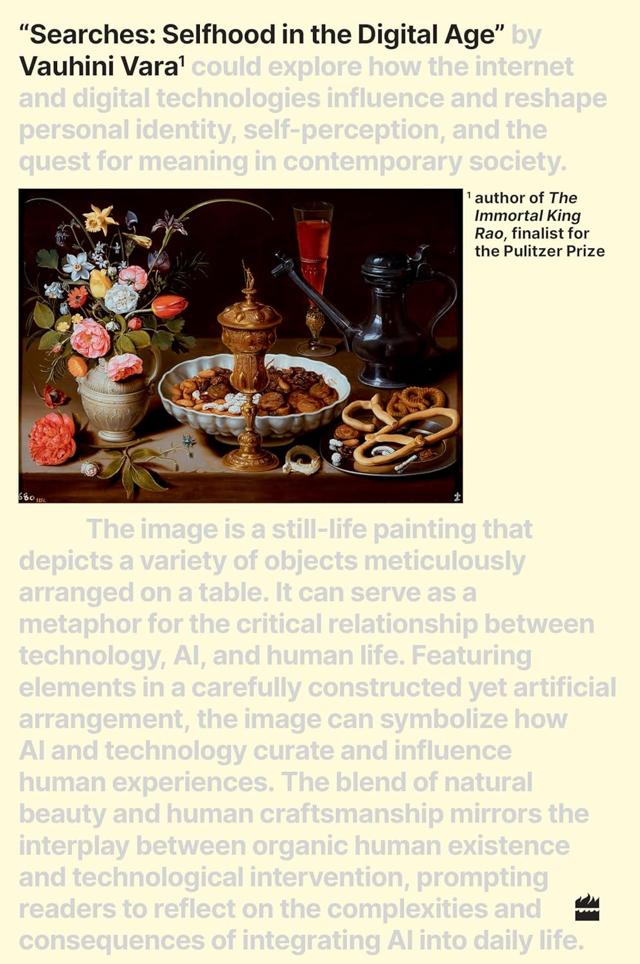
When I became aware of digital footprints, like the American writer Jia Tolentino, I started “hunting for early traces of myself on the internet.” One of the first searches I made was to learn whether a part of me exists as a poll in the gutters of the Internet. Soon, I began keying in queries about what being gay meant, if it was okay to be one, if it could be cured, the death of Divya Bharti etcetera. Whatever I couldn’t ask elsewhere, I asked Google, which answered without judgment. Perhaps like many, I considered this to be a sacred relationship. I was excited because I was being me. Unapologetically. Whether you discovered it early or late, this sense of having personal relationship with Google can’t be ignored. But can it be fully comprehended?
It’s difficult to say, but Pulitzer-finalist journalist and novelist Vauhini Vara effectively investigates the self in the digital age in Searches. Vara worked with OpenAI’s GPT-4 Omni and Dall-E to co-create Searches, exploring the intersection of the meaninglessness and meaning-making in this age of information overload.
Comprising 16 chapters, Searches begins with an exchange the author has with GPT-4o, asking if it can share feedback on the chapters of this book, the first of which is Your Whole Life Will Be Searchable – it’s a reference to a Larry Page quote on the real purpose of Google. Vara quotes John Battelle: “Link by link, click by click, search is building possibly the most lasting, ponderous, and significant cultural artifact in the history of humankind: The Database of Intentions.” - The Search: How Google and Its Rivals Rewrote the Rules of Business and Transformed Our Culture (Portfolio, 2006)
You would expect the author to share her searches and you do get several lists of Vara’s enquiries — all the whos, whats, whens, wheres, whys, and hows. Before the reader can anticipate what’s coming up, GPT-4o is ready with its response to Vara’s inputs in Thank You for Sharing. According to it, Vara’s writing “highlights the paradox of the internet as both a deeply impersonal force and a potentially intimate space for discovering and confronting personal truths.”
‘Personal truths’ is what the internet is interested in, so that it can generalise and repurpose them. In 12 Bytes: How We Got Here. Where We Might Go Next (2021), Jeanette Winterson writes, “Personalising the web is where the money is.” Now, try answering this: By providing you with targeted ads, is the Internet thinking on your behalf about what you may need or be needing soon, making things easier for you, or does it annoy you, seeing the control it’s exercising in your life? It may seem like an easy question to answer — almost as easy as it is to select ‘Saurabh Sharma’ in that Orkut poll. However, a seemingly simple ‘search’ has far-reaching consequences, ranging from Facebook’s (now Meta) role in the Rohingya genocide in Myanmar to Google being infamously called an ‘Ideological Echo Chamber’.
This is the ugly truth. The uglier truth, however, is the role the individual plays in helping such platforms exist and thrive. This is what subsequent chapters of Searches hint at through dialogues. Supported by anecdotes, the conversations between Vara and her friend Sanam Emami on choosing (or not) to shop from Amazon is an example. A Great Deal further accentuates Vara’s point. “Social media is not meant to be a site of revelation; it’s meant to be a site of performance,” she writes in We Can All Connect and Share, centralising the feeling that founders of several social media platforms capitalised on — the need to be validated. A performance, however, demands a transformation of a kind. Often, all actors involved in it undergo one. So do the spectators. But rarely does the medium get transformed except in the case of the digital revolution — how and the speed at which language is evolving is baffling. While Google presents itself as a conduit of communication between two disconnected worlds (re: Google Translate), it’s clear that it is also controlling communication and building a superfluous Godlike layer. The chapter titled I Am Hungry to Talk rightly concludes with this submission: “Perhaps what makes life easier is not always better.”
LISTEN: Only connect; an interview with Vauhini Vara on the Books & Authors podcast
So, for example, if AI is fed with existing matter that is largely casteist, racist, ableist, heteronormative, and male-appeasing, can it be trusted? Creators can’t be dismissive of anything without trying it. Vara’s book is crucial as it’s a result of an active engagement with generative AI. Often, at a great personal cost. For example, it reproduces an essay which was first published in Believer magazine. Titled Ghosts, this nine-part piece is an attempt to reconstruct memories of the author’s deceased sister, Deepa, using AI. What Vara felt incompetent to do — engage with this unexpressed grief, “Sam Altman’s machine” did for her.
I remember reading this essay in 2021 much before ChatGPT was rolled out for the public. The sentence I stumbled on while reading it in the book is the same one that struck me years ago: “This is the hand she held: the hand I write with, the hand I am writing this with.” So far, nothing AI-generated can even come as close to exuding warmth and feeling as this sentence does. I felt validated as a reader and critic when the author reflects on this very sentence in Thank You for Your Important Work: “If it could write that sentence, what else could it write?”
That’s precisely what makes Vara’s book accessible. All her experiments are rooted in curiosity. She also offers new questions to engage with and the reader experiences exhilaration, horror, shock, and numbness as Searches begins to mull on what else could be transformed by AI.

In the end, Searches achieves a rare clarity in the tangled conversation around technology and identity. Vara’s willingness to expose her own vulnerabilities—through candid personal search histories, essays on grief, and direct engagement with AI—grounds her ambitious cultural critique in lived experience. Rather than scolding or comforting, Vara invites readers to notice the paradoxes we inhabit: how tech corporations both empower and exploit us, how we critique platforms even as we rely on them, and how AI can be at once profound and nonsensical. With journalistic precision and creative openness, she crafts a work that is, at its heart, a call to attention: in an era of infinite connection and data, how we reckon with the digital traces of our lives shapes not only our individual selves, but the collective future we imagine—and invent—together.
I did not write the previous paragraph. Like the author of Searches, I too was tempted to collaborate with AI. Perplexity wrote it on my behalf when I prompted it with this command: “I am writing a review of Vauhini Vara’s Searches. Write the concluding paragraph on my behalf.” It’s a nice but cold conclusion that lacks humanistic engagement. Like Vara notes, though the possibilities of what AI can generate are endless, the question is always personal, unique to each creator — does it satisfy you as an artist, writer, musician, creator? Searches is an important work on identity formation in the age of techno-capitalism.


