
 E-Paper



Review: Smoke and Ashes by Amitav Ghosh
The author’s new non fiction volume unravels the close ties between the colonial opium trade and the emergence of modernity

 Prefer HTon Google


Earlier this summer, while visiting my mother in Kolkata, my wife and I debated on what I should gift her parents. I suggested Darjeeling tea, but my wife demurred: her parents, being north Indian, preferred their tea “cooked” with milk and spices, a beverage very different from the one derived by soaking leaves in hot water that is more common in my house.
Tea is so essentially a part of Indian and South Asian identity that it inspires the most passionate debates about how one should make it. It also provokes a million memes on social media ridiculing Starbucks’ “chai tea”. But we hardly imagine that very few people in the Indian subcontinent consumed the beverage before the early-20th century. Most of us would also find it difficult to believe that this quintessentially Indian drink originated in China.

Novelist Amitav Ghosh, too, arrives at this epiphany while drinking a cup of tea at his Calcutta home soon after a trip to Guangzhou. “When I looked into my cup of tea — or ‘cha’ as it is called in Bengali — I suddenly remembered a word that I had recently used in Guangzhou: ‘chah’,” he writes early in his new non-fiction book, Smoke and Ashes: A Writer’s Journey Through Opium’s Hidden Histories (Fourth Estate India). Suddenly the world of Chinese influence in his life opens up — the porcelain cup in which he drinks the tea, the sugar in the tea, the peanuts to go along with it, and even the lacquerware tray, everything has some relation to China. “In my mental universe China almost didn’t exist; in my material world China was everywhere.”
In recent years, China has loomed large and belligerent on India’s geopolitical horizon. After the border conflict in the summer of 2020, the Indian government banned several Chinese imports, including the social media site TikTok and the online game PUBG. The two countries have also competed for influence in their neighbourhood, and in the South China Sea, where China’s territorial claims in Taiwan are predicted by security experts to be potentially the next global flashpoint after Ukraine.
But trade between the two countries has also continued to balloon during the Covid-19 years. In the first half of this year, China exported goods and services worth $56.53 billion to India, while India’s exports to the country stood at $9.49 billion. This is second only to India’s largest trading partner, the US. Yet, China features very low on the global imagination of most Indians.
This is a result, as Ghosh shows, of a few centuries of colonial propaganda and histography. In this book, Ghosh challenges the narratives made popular by the texts of colonial administrators and historians, most of whom were deeply influenced by Enlightenment ideas. Instead, he focuses on objects and creatures who have influenced human history in mysterious ways, very often unacknowledged. One of these is tea, which till about the middle of the 19th century, made China the biggest importer into Britain.
The other is opium.
Through much of human history, opium circulated only in small quantities and was usually consumed by the upper classes because of the expense and difficulty of processing it. But in the late 18th and early 19th centuries, European colonizers opened up the Asian market — with lip service to free-market principles and generous quantities of gunpowder — for the cultivation, processing, and trade in opium in newly found colonies. “(I)t was the Dutch who led the way in enmeshing opium with colonialism, and in creating the first imperial narco-state, heavily dependent on drug revenues,” writes Ghosh. “But it was in India that the model of the colonial narco-state was perfected by the British.”
Those familiar with Ghosh’s epic Ibis trilogy would have some idea about the effect opium cultivation had on the lives of farmers living in the Gangetic basin, many of whom left their homes and were taken as indentured labourers to the Caribbean. They would also know about Britain’s wars with China to force the rulers of that country to allow the import of opium. “In 2005, when I started writing Sea of Poppies, it was difficult to get a granular sense of how opium was produced in Bihar in the early nineteenth century,” writes Ghosh.
Since he published his novels from 2008 to 2015, there has been a rapid growth in scholarship on the subject, perhaps somewhat inspired by his books. Ghosh uses some of these in his new book, while constantly challenging the colonial rhetoric about opium. Not only does he reveal the Orwellian nature of the narco-state — George Orwell’s father was one of the employees of its vast network — that forced reluctant farmers to cultivate poppy seeds, but also challenges textual and visual representations of order and development that colonial officials produced to justify their work.
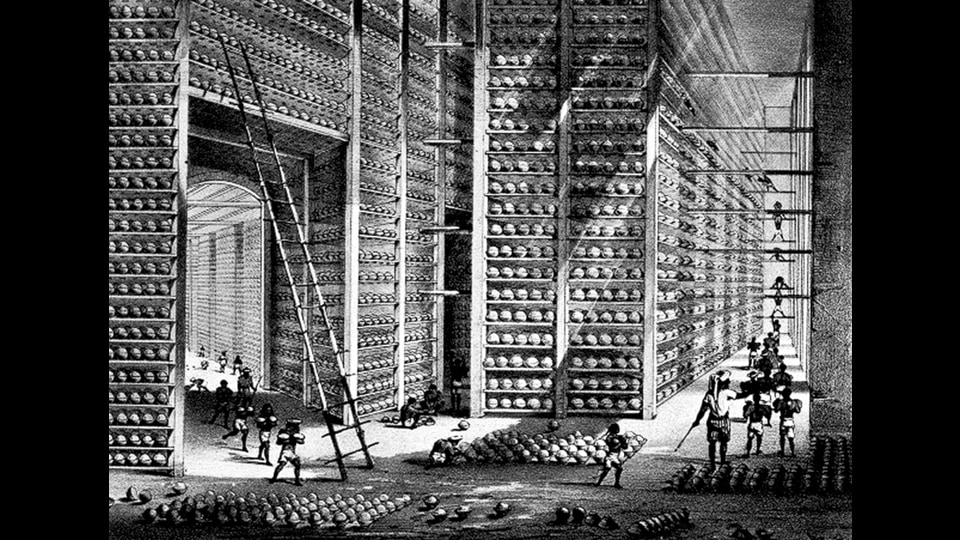
Take for instance, his critique of the coloured lithographs of the opium factory in Patna produced by Captain Walter Stanhope Sherwill, an officer of the British colonial army, in the mid-19th century. “(T)he prints gave the Patna factory the monumental dimensions of a cathedral, or an Egyptian temple, with towering ceilings, majestic columns, and long shelves that converged upon the perspectival vanishing point,” writes Ghosh, adding that they intended to give the impression of progress and growth. But they do not reveal anything about the working conditions of the Indians employed at the factory, who laboured under intolerable conditions and were subjected to constant surveillance. This is something Ghosh does with great empathy.

The vast canvas of this book brings the narrative up to the present day. Ghosh claims that as conflict undermines nation-states around the world, “poppy, having been a major force in the making of modernity, will also be instrumental in its unmaking.” In this, fossil fuel and climate change will be opium’s most able comrades.
The book, however, ends on a positive note. “These sinister portents notwithstanding, the history of opium also offers an important augury of hope for global environmental movements,” writes Ghosh towards the end of the book. “(T)hey could look to the example of the transnational, multi-ethnic, multiracial coalition of civil society groups that was eventually able to drastically curtail the opium trade despite the determined and skill resistance of the British Empire.”
Since the publication of The Great Derangement (2016), Ghosh has devoted his literary energies to the fight against global warming. It might seem like a David-and-Goliath encounter to most of us — but that is the very reason why one must jump in.
Uttaran Das Gupta is a New Delhi-based writer and journalist. He teaches journalism at O P Jindal Global University, Sonipat.


