
 E-Paper



Review: The Case of the Mysterious Witches by Mallika Ravikumar
A crisp, clear and fast paced novel for young adults that shows how the social injustice of witch hunting can be combatted through the law

 Prefer HTon Google


On a trekking trip with elders in the woods of Maulsauri, Meera, her brother Malhar, their friend Mirchi and his pet dog Munna (M4) spot a group of villagers attacking a woman violently. The trekking group find an unconscious woman, Mayawati and admit her to the hospital and inform her two young daughters. The police refuse to file an FIR citing jurisdiction. However, an army colonel in the trekking group files a zero FIR at the police station forcing the police to forward it to whichever police station has the jurisdiction. The attackers claim Mayawati is a witch and justify their act. The villagers blame Mayawati for any misfortune that happens to them – if a goat dies or even if anyone catches a cold. So, the widowed Mayawati and her two young daughters, Gauri and Bhavani were forced to leave behind the only property they have, their home and land in the village and live with relatives. But who declared Mayawati a witch in the first place? What was the motive? This is left to the M4 to find out and save the family by exposing those behind the conspiracy. But will the children succeed? Enter Aparjita, a college student and the daughter of Mrs Ghosh, a family friend, who rubbishes her educated mother’s claims that witches do exist. Together, they work on saving Mayawati and her daughters who are humiliated at school and ostracised. That even the local police believe this adds to the horror.
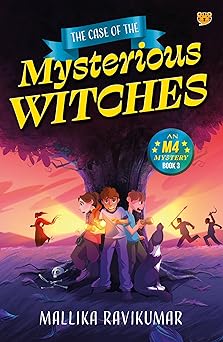
The writing is crisp, clear and fast paced. Many readers might think that a children/ young adult novel is not for adults but the author proves them wrong. A lawyer-turned-author Mallika Ravikumar attempts to mix Erle Stanley Gardner with Enid Blyton in this legal series that tackles socially relevant issues.
What is a zero FIR? Are there laws to protect people accused of practising witchcraft and black magic in the new criminal laws or is it still left to individual states to enact such laws? What does one do to break the vicious network of superstition, fear and greed which leads to many women being branded as witches? Why is it so tough to file a complaint in police stations in such cases?
Ravikumar answers these questions and much more in The Case of the Mysterious Witches. The book is dedicated to the Maharashtra Andhashradda Nirmoolan Samiti, an NGO whose volunteers work not only to fight superstition and promote rational thinking but have also successfully ensured that Maharashtra state enacted a law to stop people being branded as witches. Unfortunately, there is no law at the national level. Its founder, Narendra Dabholkar, once stated: “Mental slavery is the biggest horror that emanates from superstition.” Dabholkar was murdered for fighting superstition and four days after his death, the state of Maharashtra passed the “Anti-Superstition and Black Magic Bill” criminalising attacks based on superstition and fear.
Ravikumar explains the sections of law that are applicable and the difference between criminal and civil offences, among other things, somewhat like a Perry Mason novel does. As this information is worked into the story, learning about legal rights and police procedures doesn’t feel forced. While this novel may be targeted at young adults, is it a book for adults too as it takes a hard look at India’s class and caste politics.
This reviewer was shocked to learn, through the author’s note at the end, that witch hunting is still prevalent in the country and happens even in highly literate states like Kerala. Most of the cases go unreported as only a few states have enacted specific laws criminalising witch-hunting. Neither the IPC nor the new criminal laws have such sections. This means complaints are filed under assault, rape or murder.
Unlike in the magical world of Harry Potter, those accused of witchcraft in Indian villages are assaulted, ostracised, and killed. Their families too experience trauma but there is no government support in such circumstances. Witches are called different things in different states – daakin, daayan, ghowli etc. According to the National Crime Register Bureau, over 2500 women were killed in India because they were branded as witches. In many of these cases, the real reason they were victimised was because they were protesting against a liquor store or against land grabbing. According to NGOs, these are just the cases that are reported; most are unreported. This could mean that 70,000 to 1,00,000 women have been killed in the last 25 years. Most were widows, poor, or belonged to lower castes. The horrific murder of Bhavi Singh in Jharkhand in August 2025 is the most recent case, one that makes this book more relevant than ever.
Deepa Kandaswamy is an independent journalist.


