
 E-Paper



Review: You People by Nikita Lalwani
Told through the perspective of Shan, a young Sri Lankan Tamil refugee, You People is set around the nightmares of asylum seekers in UK in the early aughts

 Prefer HTon Google


Nikita Lalwani’s You People is about the tangled, precarious lives of asylum seekers and other runaways working in a pizzeria in south-west London. Stragglers play chess by candle light, Bach plays on the stereo, wine flows. Plates of sticky giant olives rolled in a blood chilli sauce and other Italian dishes are prepared mostly by undocumented Sri Lankan Tamils hiding in the kitchens.

Shan, the newest among them, fled Sri Lanka after his journalist father was killed by the government forces. He left quietly and quickly, without a word, hoping he would be able to bring his wife and son soon after — “a decision that is now soaked in regret. An ugly incendiary petrol bomb of a memory.” In London, unable to get in touch with his family, he is tormented by grief. The novel is told through Shan’s perspective and his colleague Nia’s. Nia, a young Indian-Welsh waitress, had planned her escape from her alcoholic temperamental mother, younger half-sister and their “little squashed triangle of dependency” to go to Oxford only to get thrown out of college and end up at the pizzeria. Tuli, the mysterious owner of the restaurant, goes to great lengths, taking big personal risks, to help people out — the pizzeria is open to all sorts of “waifs and strays” he is committed to protect.
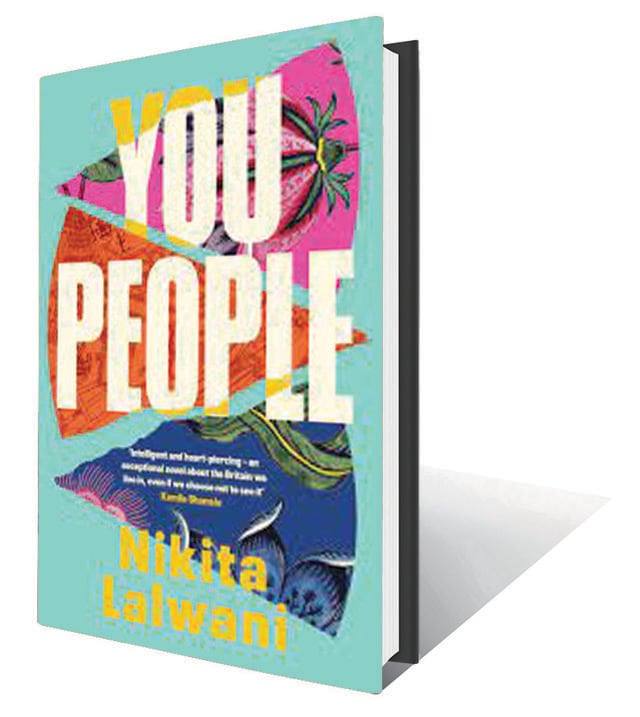
Lalwani’s first novel Gifted (2007) — about a maths prodigy child of Indian immigrants — was longlisted for the Man Booker Prize. You People, her third, is set up almost like a film. The scenes are vivid and evocative. I was unsurprised — even somewhat excited — to learn that a screenplay is in development. Shan and Nia’s lives, especially the sections told through flashes of memories, were so poignant, I had to pause reading several times just to let the intensity of emotion pass. I was moved by even minor characters like Shan’s wife and Nia’s mother who barely make appearances. Lalwani zooms in on the minutest of feelings with precision. I got goosebumps reading about Nia’s guilt after failing college: “No one wants to look in a mirror that is cracked with their own failure, but it felt like she had fractured a dream that belonged to all of them.”
You People is set around the nightmares of asylum seekers in the early 2000s when the UK did not consider Tamils a persecuted group in Sri Lanka. Now, a decade after the end of the civil war, Sri Lanka continues to be unsafe for Tamils, according to international human rights’ reports. But immigration authorities elsewhere have been pushing for their return to Sri Lanka. I read You People while the Murugappans, a Tamil family in Australia made global headlines. An outpouring of local support against their deportation and detention eventually forced the Australian government to grant the Murugappans temporary visas in June.
Lalwani lays out — through meticulous research — the complications around the credibility of the claims of persecution. The Tamils at the pizzeria know their stories are “considered to be part of the smokescreen.” This smokescreen is created by them to avoid detection — it is made not with lies but borrowed wisps of truth. Telling their own stories in their case files could result in their families being tracked down and persecuted back home. Shan practices entire afternoons perfecting his story made up of other people’s stories. “He has heard from enough people how important it is to remember things — the ones who travelled with him and those who he has met in this country who couldn’t make their stories patch up exactly the same way every time. And he knows that he is like the rest of them, that pain has cut small holes through his thoughts so that key facts are missing. Boring, obvious, concrete facts that have disappeared through these gaps, making him seem suspicious and cagey to the observing eye.”

Tuli helps Shan prepare his case, look for his family, loans him money — as he does for everyone else. Nia views him with a kind of suspicious gratitude. Until about halfway through the novel, this adds a layer of suspense: why is Tuli everybody’s benefactor? What does he actually do? Where does the money come from to help all these people? Who is this man and what is his deal? There are little easter eggs — Tuli is Tamil by way of Singapore. His parents had grown up in Malaysia. I knew that Tamil plantation workers had been displaced by the British from India to Sri Lanka and many of them to Malaysia, so I wondered if his generosity had something to do with his own sense of intergenerational displacement.
The pivot of the novel, it ultimately turns out, is the motivation for altruism: why do people do good things at all? Unfortunately though You People offers no real answers — its moral underpinnings end up only flattening the exquisite build up. This is a pity — but like Tuli, Lalwani’s novel is trying to do the good thing.
Saudamini Jain is an independent journalist. She lives in New Delhi.


