
 E-Paper



Review: A Woman of No Consequence by Kalpana Karunakaran
A memoir that includes her grandmother’s writing, Kalpana Karunakaran’s A Woman of No Consequence traces the evolution of women’s education in Madras

 Prefer HTon Google


Many writers transform familiar folk into characters in their novels. Writers’ families especially supply complex and rich characters that surpass anything the imagination can create. Permissions and consent enter the scene in the context of memoirs, autobiographies and biographies. Even if the goal is self-expression and reflection, how much can be revealed? How much of a risk is the writer willing to take with their family relationships? What is at stake in the creative and often cathartic process of writing about one’s life?
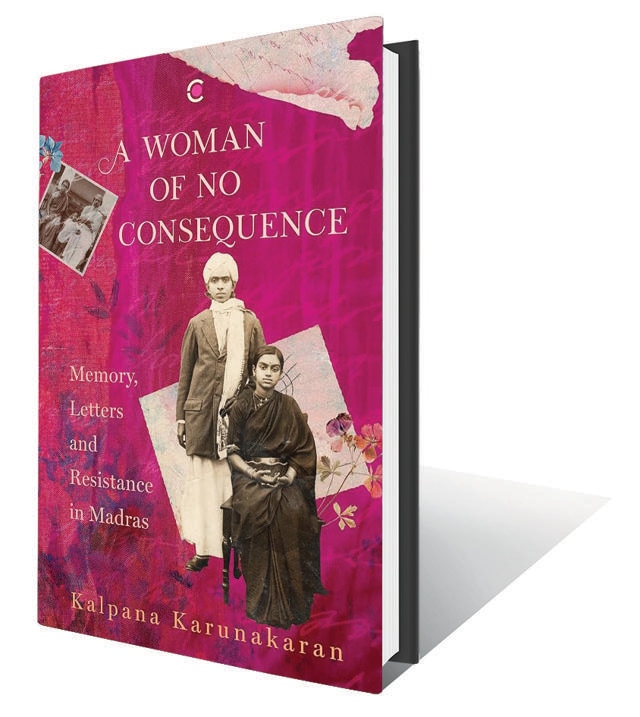
Pankajam, the subject and, in a sense, co-writer of Kalpana Karunakaran’s A Woman of No Consequence, reflects on these and the additional question of “washing dirty laundry in public” in the fully quoted preface to her autobiography written in 1949. Karunakaran’s book, written 68 years later, weaves together these autobiographical extracts with letters, fiction, poetry and diary entries. Containing biographical notes, personal and historical insights and information, A Woman of No Consequence is a memoir crafted from materials directly bequeathed to a granddaughter by her grandmother.
While Kalpana chose to write about Pankajam, her maternal grandmother, her mother, Mythily Sivaraman, wrote a biography of her own maternal grandmother (Pankajam’s mother), Subbalakshmi. References and reflections from the latter also make their way into Kalpana’s book. This layering of women’s voices and lived accounts, the deft manner in which Kalpana spotlights her grandmother’s writing even while writing about it, the candid voices of the author and subject who clearly shared a nurturing connection – all of it make this a significant work.
In the beginning, Pankajam disclaims her right to write by saying she’s neither “a poet, a writer, a great social worker or even a society lady” but “a humble housewife tied to mundane work, which always keeps the soul fettered down.” Yet, she hopes her writing can be “a torch to those who may... be groping in the dark, seeking light and understanding of this world.” While she frankly states that she will not “lay bare everything,” she promises to expose “the great merciless Truth” that pursued her till “very unwillingly,” she learnt the lessons it sought to teach her. Along the way, Pankajam focuses on the machinations of patriarchy that leaves family members dehumanized, disconnected, unhappy and unwell, and scars those women and girls whose path it blocks through the generations.
Born in 1911, Pankajam, the self-proclaimed “woman of no consequence,” broke this chain of oppression and exclusion by claiming space through her writing and reading, her dogged pursuit of becoming “equal to the educated,” and her style of mothering and educating her children so they grew beyond the boundaries of gender, caste and nationality. An avid birdwatcher, nature lover, reader, writer, learner and traveller, she rejected the taboos placed on women even while negotiating the restrictive domestic lines drawn around her and her mother. She wrote essays, poems, stories and travelogues in Tamil and English and questioned the sanctioning of marital rape, domestic violence and other forms of female oppression within the home. Her writing presented gender as a cage that restricted everyone, even if men were more favoured inside it.
Pankajam, daughter, wife, mother of five children, nurse, caregiver and assigned culture-keeper of an orthodox Tamil Brahmin family, managed to receive a school education thanks to her mother’s rebellion. Advised by his brother against getting his daughter formally educated in English, her father, a salt inspector in colonial India, decreed that Pankajam would take Sankrit lessons at home. Subbalakshmi, her mother, who later became a freedom fighter and social activist despite severe health challenges, defied her husband. She plotted an escape to her mother’s home when her husband was away on work so her daughter could join a good school in Madras.
The best parts of the book are in the descriptions of Pankajam’s school life that lasted all of six years. At Lady Willingdon School and Training College, Madras, she came to be known as “Drama Pankajam”. There, she cemented her lifelong relationship with learning, not just from books but also from nature, the arts, sports and people. Karunakaran draws from the personal accounts of her grandmother to trace the history of Madras and the evolution of women’s education there. This anchoring in the subjective is the book’s greatest strength.
A Woman of No Consequence is about the girl who was denied an education and pulled out of school to be groomed for marriage, and who later became a guide and an inspiration to more than just her children. A solo world traveller, a champion of human rights, a nurturer of friendships with people across nationalities, she was a writer and documenter whose progressive ideas shone well beyond the boundary walls of her home and her times. Not just feminists, this memoir should be read by anyone who takes their rights, education and family history for granted.
The second wave Western feminists of the 1970s coined “herstory” in response to the male-dominated narratives that filled history books. While history describes world events through sequences of dates, years and war accounts, “herstory” describes life, connection, daily events and people at the intersection of the personal and political. Pankajam would have been in her sixties when the word was coined. Had she known those feminist neologists, she would most certainly have befriended them, writing them long letters agreeing that history definitely needed to be recorded from a feminine perspective.
Charumathi Supraja is a writer, poet and journalist based in Bengaluru.


