Prisons in India still operate under the 1894 Prisons Act. That the Act has not yet been updated tells you much about the way prisons are governed, or not. Post Independence, the key moments of prison reform came nearly 40 years ago when Sunil Batra, an inmate with a chequered record, filed a series of petitions in the Supreme Court. One of the outcomes of that was the Anand Narain Mulla committee on jail reforms, and the Justice Krishna Iyer committee on women prisoners and the reform of women’s jails. No inquiry or committee of that magnitude has appeared since then. Such is our condescension for criminals that people, including inmates, are surprised when they hear that prisoners have rights and deserve dignity and wages for their labour. Given that one of the editors, Sanjoy Hazarika, is the international director of the Commonwealth Human Rights Initiative, and the other, Madhurima Dhanuka, heads the international NGO’s prison reforms programme, this book could have made a more forceful assertion of that claim.
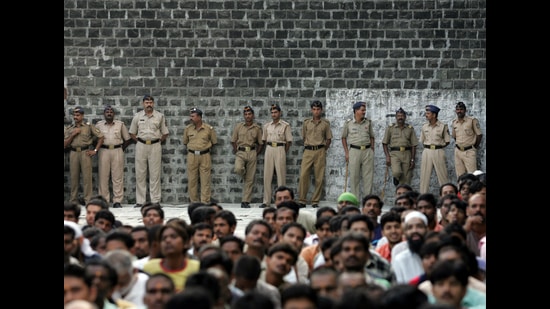
Hope Behind Bars is a compilation of essays dealing with a variety of topics, some of which are purely prescriptive. Although it claims that “this essential collection brings prisoners lives and liberties to the heart of public debate and policies,” in fact it mostly rehashes some old pieces. Amrita Paul’s Voices from Detention about Rohingya refugees in detention, researchers Sugandha Shankar and Sabika Abbas’s reflexive essay about working in prisons, and KR Raja’s statistical study of the fate of children with parents in jails in Tamil Nadu are the redeeming essays in this otherwise pallid collection. The best survey in the book, nearly 15 years old now, comes from Chaman Lal, a former police officer who worked for 10 years until 2007 with the National Human Rights Commission as Coordinator of the Criminal Justice Cell. His profile states he is the only police officer in the country to be awarded the Nani Palkhiwala Award for Civil Liberties. If true, this is a telling comment on the regard for civil liberties among police officers.
As part of his work, Lal conducted surveys on several aspects of prisoner’s lives in different jails across India. Although these findings too are over 15 years old they are still relevant as they have been ratified by a constitutional body mandated to protect prisoners’ rights. His report shows in detail how stipulations for accommodation, toilet, food and health remain unfulfilled across jails. As per the provisions of Sections 328 to 339 of the Criminal Procedure Code, the trial of a mentally-ill prisoner is suspended because of his inability to defend himself. However, Lal found several mentally-ill under-trials languishing in neglect. There were many who had completed more than 14 years of incarceration but their trials had remained suspended. In one startling case an inmate called Lalung Machung of Arunachal Pradesh, who was first admitted in 1951, remained in prison for 54 years. As for deaths inside prisons — nearly five inmates die every day in prisons across India. Lal finds that the NHRC has “totally failed in ensuring punishment to the negligent or corrupt jail officials held responsible for these deaths.” The jail manuals of different states provide the setting up of a Board of Visitors comprising official and non-official members and headed by a district collector. A properly-functioning Board can play a vital role in improving prisons, as observed by the effect of vigilant judicial authorities and the positive correlation between the “seriousness and regularity of such visits and the efficient working of the jails”. Predictably, Chaman Lal found conditions to be better in the southern states, especially Tamil Nadu. However, most jails in India do not have a working Board of Visitors. Similarly, vocational training suffers even in places that run thriving factories because of delays in the supply of raw material. Wages owed to inmates are often not paid in full. 25 to 50 percent of a convict’s wage is deducted towards a Victim’s Compensation Fund whereby the state is supposed to compensate the families of victims. But in an affidavit submitted to Delhi High Court, the Delhi jail department admitted that “out of a total amount of 15 crores collected from the prisoner’s wages under rule 96 of the Delhi Prison Rules, 2018, only 1 crore has been utilised and 14 crore is lying unspent.”
{{/usCountry}}As part of his work, Lal conducted surveys on several aspects of prisoner’s lives in different jails across India. Although these findings too are over 15 years old they are still relevant as they have been ratified by a constitutional body mandated to protect prisoners’ rights. His report shows in detail how stipulations for accommodation, toilet, food and health remain unfulfilled across jails. As per the provisions of Sections 328 to 339 of the Criminal Procedure Code, the trial of a mentally-ill prisoner is suspended because of his inability to defend himself. However, Lal found several mentally-ill under-trials languishing in neglect. There were many who had completed more than 14 years of incarceration but their trials had remained suspended. In one startling case an inmate called Lalung Machung of Arunachal Pradesh, who was first admitted in 1951, remained in prison for 54 years. As for deaths inside prisons — nearly five inmates die every day in prisons across India. Lal finds that the NHRC has “totally failed in ensuring punishment to the negligent or corrupt jail officials held responsible for these deaths.” The jail manuals of different states provide the setting up of a Board of Visitors comprising official and non-official members and headed by a district collector. A properly-functioning Board can play a vital role in improving prisons, as observed by the effect of vigilant judicial authorities and the positive correlation between the “seriousness and regularity of such visits and the efficient working of the jails”. Predictably, Chaman Lal found conditions to be better in the southern states, especially Tamil Nadu. However, most jails in India do not have a working Board of Visitors. Similarly, vocational training suffers even in places that run thriving factories because of delays in the supply of raw material. Wages owed to inmates are often not paid in full. 25 to 50 percent of a convict’s wage is deducted towards a Victim’s Compensation Fund whereby the state is supposed to compensate the families of victims. But in an affidavit submitted to Delhi High Court, the Delhi jail department admitted that “out of a total amount of 15 crores collected from the prisoner’s wages under rule 96 of the Delhi Prison Rules, 2018, only 1 crore has been utilised and 14 crore is lying unspent.”
{{/usCountry}}When Jean Paul Sartre had a character in No Exit proclaim that hell is other people, he perhaps didn’t know how especially true this was for prisons. Given the overcrowding in Indian prisons, it is literally the mass of people upon an inmate that make her life unbearable. In a prison in Jharkhand, barracks that are supposed to house 60 inmates actually contain 300 people so inmates have to sleep in shifts of four hours each. India has the highest pre-trial detention rate in the world, which means that nearly 70 percent of inmates are doing time — often more than a decade — even before they have been pronounced guilty. Since most inmates are poor, the state is supposed to provide them legal aid but despite Supreme Court directives, most legal aid lawyers are insincere or incompetent, usually both. In the majority of places, inmates are not even produced in court during their trials because of lack of transport or “escort” personnel. As a result, despite being in judicial custody, many are effectively tried and sentenced in absentia. Chaman Lal found the case of someone whose court dates always fell on a Sunday for years, simply because a negligent court clerk had mentioned his first admission on Sunday. For years subsequently the clerks following him had kept unthinkingly extending his date by two weeks. One woman inmate told her interlocutor that she was not able to distinguish between judges and lawyers as they all wore black coats!
The Kolkata lawyer Deepan Kumar Sarkar unwittingly lets slip a bias that infects even well-meaning supporters of prison reform. He mentions his interaction, for a number of years, with a cordial and well read middle aged convict sentenced to life imprisonment for murder. “Whether he had reformed himself in custody over the years or whether he was a man whose mind’s construction could not be found on his face remains a mystery to me,” he says. The assumption here is that since the convict had perpetrated the act of murder, he must be possessed of a depravity of character which, if not reformed, would show on his face. He might have benefited from reading the two researchers’ experience of jail in this book where their mentor, a jail official, asked them the question that goes to the nub of the injustice underlying the modern criminal justice system: are all perpetrators behind bars; or are all those who are behind bars perpetrators? People who have been confined to prisons end up there because they have perpetrated an act, in greed, anger, envy or lust. But greed, anger, envy and lust are failings that define all human beings. We don’t necessarily expect all of them to be reformed. Why then do we always expect convicts to be reformed? Especially as it is not always some essential flaw in character that lands men in prison but circumstances beyond a person’s control.
Take the case of children whose parents are in prison, especially for the murder of a spouse. KR Raja’s study of the educational status of children with parents imprisoned in the southern districts of Tamil Nadu demonstrates that children with parents in jail are much more likely to become CCL or Children in Conflict with Law. Children under the age of six are allowed to live with their mothers inside jail but after that they are sent to foster homes, which are hardly confidence inspiring. As has been documented a number of times, women tend to suffer much more in prison than men. Emotionally they are often cut off from family and abandoned by relatives; socially they suffer greater ostracization, and within prisons, they have far fewer facilities. Women with children bear an even more terrible burden.
The prison officer who comes most in contact with inmates is the ordinary warder who sees inmates as an unruly population to be kept in check. It is he who is in more need of reform than the inmate. Most inmates are poor and depressed. As Sugandha and Sabika point out, most inmates never even get to tell their side of the story to anyone. They restate the truth that “It is possible for a person to be arrested, tried, sentenced and imprisoned without anyone specifically asking how he or she feels about these issues.” In this circumstance, the role of the warder is of paramount importance. He/she could double up as counsellor too, the professional that is most needed in jail. The marvel is that some actually do. S Ramakrishnan writes about training for correctional officers in West Bengal and the difficulties involved. While his efforts are laudable, he does not actually describe the results of the programmes on the warders. How receptive were they? What attitudinal changes could one observe among them? And are there takeaways for other prisons? Therefore, his essay leaves one dissatisfied.
The slang for prison in America is “doing time”. It is an apposite description of what inmates do inside. They do time as they have little else to do. Occupation in prison, whether as instructor, clerk or manual worker is the prerequisite for survival because that is how one tackles time and therefore, many are willing to work free for their prison. Prison time is empty time. Unlike us, inmates make no accumulation through time — they get no increment in income, status or wealth as time progresses. Time usually expands one’s possessions; but in prison, time is the thing that has to be devoured, expended, conquered. Undertrials, the majority of inmates in India, live in an indeterminate time. They don’t know whether they will be acquitted or convicted; therefore, they don’t know when their ordeal may end, or become permanent. They have to face the uncertainty of trials, their irregularity and outcome and therefore, for years, they are unable to plan any future. Convicts have the consolation of knowing how long their sentence will last, unless they are Lifers. But they are unsure about their appeal and how long it may take to resolve. Jail time, therefore, is eternal wait time and the ancient Arabic proverb for waiting sums up their torture — Intezar Al Ashd Min Al Maut, an endless wait is more tortuous than death! While undertrials wait for bail, convicts wait for their parole or furlough applications to be processed. It is a highly cumbersome process. First, they must prevail, by whatever means necessary, upon the convict office to prepare and forward their application. Then, the local police authorities have to verify their address, particulars and character each time they go on parole. It can take months, and you are back before you know it. These are areas that can easily be improved with a little focus by a dedicated overseer of prisons.
Freedom is sometimes not an option that long-term convicts enjoy. The Rohingyas who have been freed from prison in India only to be deported back home are free and yet not free. The essay on their detention falls short because it doesn’t describe their actual experience in detention. I knew inmates who dreaded going out on parole for fear of the ostracism and alienation they faced, even from their families. They were now nowhere men. Jail at least provided a recognised place for them, a place and a room of their own where they had a definite role to play. Oxymoronic as it may sound, there is such a thing as an Open jail, as well as a semi open jail and they work well. Paar, an organisation spearheading advocacy of Open prisons, has been active in the Rajasthan open jail in Sanganer and reports tremendous conformity with rules. Nobody escapes, families live together and people usually return from work or home visits without dereliction. It has been my experience that if the right opportunity is provided for employment or education, prisons can become productive. Tihar has produced several painters, musicians and yoga teachers who learnt and honed their skills there.
We know about overcrowding, violence, and lack of facilities in jail, none of which evoke any surprise. But here is the Indian prison conundrum in a nutshell: most inmates inside begin their punishment long before their trial concludes. Many of them are first time offenders who don’t need to be incarcerated for long periods and could be easily sent out on bail while their trial proceeds. But the magistrates don’t know them at all and, outside of the big cities, hardly ever see them. The prison authorities, who have a better understanding of their character and personality, have no say in their bail, except for a formal and inconsequential conduct report. Most inmates also don’t know how to kill time inside. If we could make educational or skill improvement compulsory and hitch their bail to the attainment of a certain proficiency in a life skill, it might help us make prisons more productive. It would also provide an incentive to an inmate to work hard on himself, and make jail a less dismal and more meaningful experience for all. Or it could just be an inmate’s fantasy.
Mahmood Farooqui, writer, performer and reviver of Dastangoi, ran the Tihar Drama Club for a number of years.