
 E-Paper



Suvir Saran: “Loss rearranges the furniture of the soul”
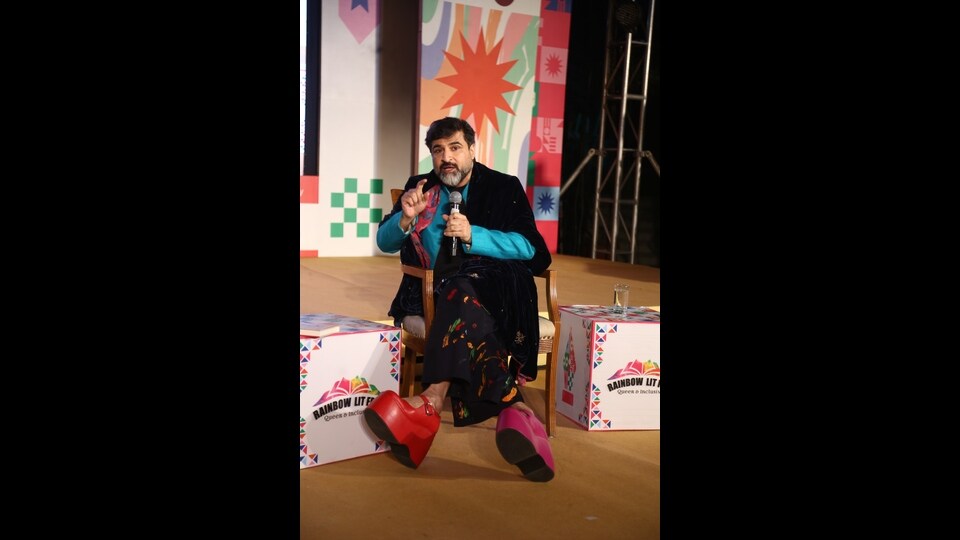
At the Rainbow Literature Festival, the celebrity chef and author of Tell My Mother I Like Boys spoke about belonging, identity, self-censorship, and food as both archive and anchor

 Prefer HTon Google


You begin your book by sharing the pain of losing a loved one. How did the loss change the way you see yourself and your journey?
Loss rearranges the furniture of the soul. It doesn’t just take someone away; it alters the acoustics of your inner life. When you lose a parent, a partner, a pillar, you don’t merely grieve a person — you grieve a version of yourself that existed in their gaze.
In my case, grief stripped me of urgency and replaced it with attentiveness. I stopped racing toward outcomes and began listening to pauses. I became less interested in achievement as spectacle and more invested in presence as practice. Loss taught me that love is not proven by longevity alone, but by how deeply it changes the way you stand in the world after it’s gone.
The book doesn’t begin with pain for drama, it begins there because everything honest that followed had to pass through that fire. Loss made me porous, and in that porosity, I found a quieter courage.

What was it like navigating queer identity in India when you were growing up, and how does that contrast with the realities of queer life today?
Growing up queer in India was not about visibility; it was about vigilance. There were no mirrors, only windows and fleeting reflections of possibility that belonged elsewhere. Desire existed, but language did not. You learned early how to edit yourself in public and exhale only in fragments of privacy.
Leaving India was not just about ambition or opportunity; it was also about breath. In a foreign country, distance gave me definition. It allowed me to test parts of myself that had no room back home not because India lacked love, but because it lacked permission. Migration, for me, was a form of quiet self-preservation. I could be unnamed and yet more myself.
Today, the contrast is striking but not simple. There is visibility now, vocabulary, volume. There is also performance. Young queer Indians have access to platforms we couldn’t imagine, but they are also navigating a culture that often confuses freedom with speed, and expression with exhaustion.
What has improved is choice. What remains unresolved is safety: emotional, social, familial. My generation learned to survive quietly; the next is learning how to live aloud. Both require bravery. Just in different keys.
Othering can happen on many levels. Having experienced it, what did those encounters teach you?
Othering is rarely loud. It’s often polite, perfumed, and perfectly well-meaning. It arrives as exclusion masquerading as concern, or curiosity tinged with condescension. I’ve been othered for my queerness, my profession, my refusal to fit neatly into boxes — sometimes all at once.
What it taught me is discernment. Othering clarified where I do not belong — and in doing so, helped me recognise where I do. It taught me that assimilation is not belonging, and approval is not acceptance.
Most importantly, it taught me tenderness. When you know what it feels like to be made peripheral, you become gentler with other people’s edges. You learn to make space — not as charity, but as kinship.
Did you have to self-censor while writing your memoir?
Self-censorship is unavoidable; self-betrayal is not. The line between the two is where craft lives. I wasn’t interested in confession as spectacle or intimacy as provocation. I was interested in truth that could breathe.
There were moments I held back — not out of fear, but out of respect; for people who did not consent to be characters; for memories that were still healing; for silences that said more than disclosure ever could.
What stayed in the book earned its place by refusing to be ornamental. If a detail didn’t deepen understanding or expand empathy, it didn’t belong. Vulnerability, for me, is not exposure — it is precision.
Food carries history and culture. In your life, how has it shaped memory and connection?
Food has always been my first language of love. Long before I learned how to articulate longing or loss, I learned how to feed it. A meal is a memory you can return to with your hands.
In New York, food became survival as much as sustenance. When homesickness arrived unannounced and it often did, I cooked my way back to myself. I recreated flavours not for accuracy, but for anchoring. The act of cooking gave my loneliness a task. It turned exile into ritual, and nostalgia into nourishment.
Food, for me, has been an archive and anchor. It carries the scent of my mother’s kitchen, the echo of shared tables, the intimacy of cooking for someone you cannot yet name as family but already is. It creates a place where stories sit down together, where differences soften, where time briefly behaves.
In the book, food is never just nourishment. It is a witness. It remembers what we forget, and forgives what we fail to say.
Professional kitchens have often been criticised as spaces of toxic masculinity. How did you navigate that world?
Professional kitchens are theatres of intensity — hierarchy sharpened by heat, urgency mistaken for authority, aggression often passed off as excellence. When I entered them, I quickly realised that toughness was expected but tenderness was treated with suspicion.
I learned early that I did not want to win by becoming someone else. I navigated kitchens by refusing to confuse cruelty with competence. That didn’t always make things easy, but it made them honest. I chose consistency over intimidation, curiosity over bravado, and discipline over dominance.
Being queer in that environment added another layer; you become hyper-aware of posture, tone, presence. But it also gave me an advantage. I wasn’t invested in performing masculinity; I was invested in building mastery. Over time, respect followed not because I shouted the loudest, but because I stayed.
The kitchen taught me that leadership doesn’t need to bruise to be effective. It can be quiet, exacting, generous and still command the room.
When someone from the Indian queer community picks up your book, what do you hope they take away?
I hope they feel less alone without being told they were ever lonely. I hope they recognise that there is no single way to be queer, successful, loving, or whole.
More than anything, I hope they understand that having a place — emotionally, physically, spiritually is not about possession. It is about permission. Permission to rest. To return. To change.
If the book offers anything, I hope it offers companionship. Not answers, but assurance. That our lives, in all their mess and magnificence, are worthy of being told slowly, honestly, and in our own voices.
Chittajit Mitra (he/him) is a queer writer, translator and editor from Allahabad. He is co-founder of RAQS, an organization working on gender, sexuality and mental health.


