
 E-Paper



The fate of Hindi at JLF 2018: Can it be made the language of the elites?
A session on Hindi, titled Hindi medium: Language and elitism at the Jaipur Literature Festival, featured some hand-wringing about its status.

 Prefer HTon Google


There is deep irony in a session about the Hindi language and elitism being reported on in English by someone whose parent tongues are from south of the Vindhyas. But that wasn’t the end of it. As the session titled Hindi Medium: Language and Elitism was winding up, someone in the audience earnestly beseeched the panellists do something to make Hindi the language of the elites. This was so that corporate employers would begin conducting interviews in Hindi thus enabling students who didn’t speak English to do well. Another audience member bemoaned the fact that so much of the work of government was carried out in English, and how something urgently needed to be done to change the language of governance and governments to Hindi. The Rest of India that doesn’t speak Hindi had suddenly been othered.
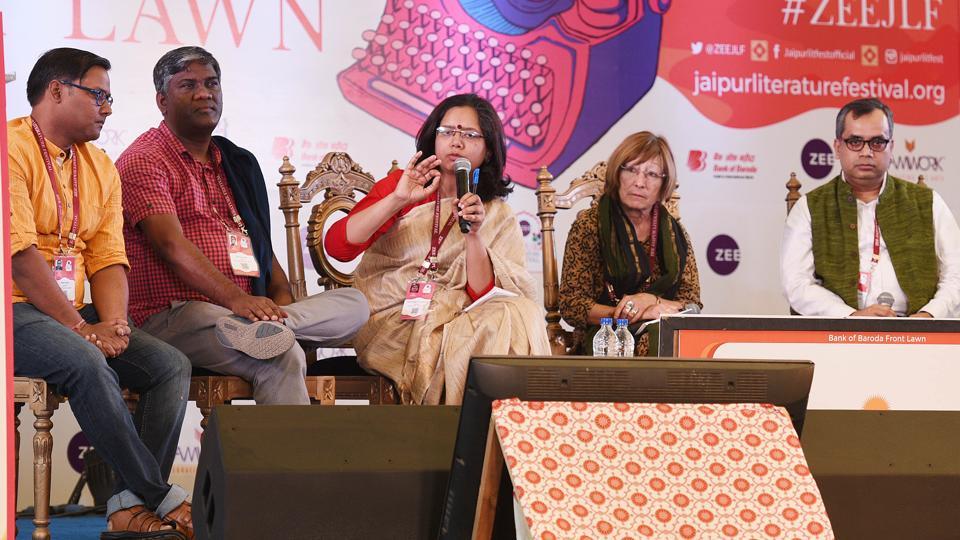
For Jaipur Literature Festival full coverage, click here
But the session, conducted brilliantly by Anu Singh Choudhary, was not at all tone deaf. There was no hand wringing about the fate of the language, and there was acknowledgement that the gulf between English and Hindi was as wide as the gulf between Hindi and local dialects such as Bhojpuri or Awadhi. The panellists – Annie Montaut, Professor Emeritus of Hindi at INALCO in Paris; journalist and filmmaker Avinash Das, writer Satya Vyas, publisher Satyanand Nirupam, writer and academic Vineet Kumar, and writer, translator, and filmmaker Anu Singh Choudhary – never let the discussion become boring, or worse, pedantic.
A nuanced discussion on several interesting questions including why is it that even as Hindi thrives as a spoken language, the market for literature is shrinking; whether young people – with their Hinglish and emojis – are destroying the rich legacy of Hindi, and why journalists writing in English are paid more than those who write in Hindi, drew a large crowd on a warm Monday afternoon.
Even as Nirupam mourned the lack of good Hindi writing and speech (“saaf zubaani”), writer Satya Vyas countered that the only important thing was his connection to his audience, and the elitism of language was misplaced. He was not interested in saving the sanctity of language, he insisted. All he cared about was communicating with his readers. Vineet Kumar, speaking of Hindi in the media, warned of the presence of sponsors in the spoken language of the media. He cited the example of the word ‘fukrey’ which had suddenly come into mainstream Hindi from the dusty forgotten corners of Old Delhi after the movie had released.
Speaking of Hindi cinema, Avinash Das provided some interesting context to Bollywood. While the language of their cinema might be Hindi, he pointed out, the language of communication between members was decidedly not. Many who work in the industry (including actors) even preferred reading Hindi movie scripts transcribed in English. He saw this as no problem at all. “I write in Hindi because it’s my language,” he said, “but my cinematographer is from South India. I got the script translated for him.” A visual medium, cinema did not need to be faithful to the Devnagari script, he pointed out.
Follow @htlifeandstyle for more


