
 E-Paper



Vinod Sharma picks his favourite read of 2022
A book that is a celebration of Urdu periodicals and of Hindustani which was the lingua franca of our Talkies

 Prefer HTon Google


A time capsule that’s now a compendium of memoirs, narratives, essays and recollections from the golden period of Indian cinema... What exactly does one call a book that includes it all and more?
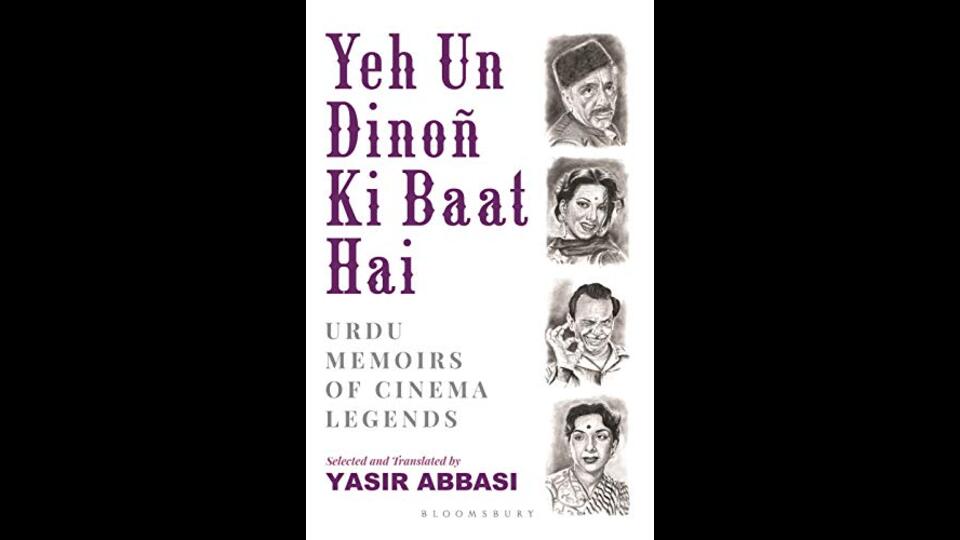
What first draws the Hindi (Hindustani) film aficionado to Ye Un Dinon Ki Baat Hai, Urdu Memoirs of Cinema Legends, is the testimonial from iconic lyricist-film maker, Gulzar: Iss Kitab ne mujhe eik zamaana tohfe mein diya hai, mere haathon mein dua ki tarah rakha hai (This book has gifted me an era, placing it in my hands like a blessing).” Still a prolific writer, Gulzar, 88, first wrote for Bimal Roy’s Bandini (to the music of SD Burman) and never looked back.
Much of the material used by the author, Yasir Abbasi, a professional cinematographer, has been culled from Urdu film magazines he accessed from private collectors. Most of those periodicals that ceased publication two decades ago were discarded as “filmy stuff” instead of being catalogued in libraries for their rich literary sections. The only exception to the rule was Patna’s Khuda Baksh Library. “The out-of-print Urdu magazines I sourced were with private collectors who were unwilling to lend. I worked out of their homes to prise out texts for the book,” recalled Abbasi.
It’s hard to fathom why regular libraries in Urdu-speaking areas couldn’t spot archival value in the magazines they junked. For instance, by what stretch of the imagination could a write-up by Kaifi Azmi on Sahir Ludhianvi or the one by Raja Mehdi Ali Khan on Sa’adat Hasan Manto be considered less than a work of literature? The same holds true of Khwaja Ahmad Abbas’s impressions of Prithiviraj Kapoor and his son, Raj, character actor Iftikhar’s take on his much-celebrated friends Ashok and Kishore Kumar, and the legendary music composer Naushad’s engrossing story on the equally accomplished K Asif, who directed Mughal-e-Azam.
The book also carries perspectives and reminiscences by Dev Anand, Balraj Sahni, Kamal Amrohi, Nasir Husain, IS Johar, Dharmendra, Talat Mahmood, Johny Walker, Ajit, Javed Akhtar, and Shakeel Badayuni. It opens with Nargis’s moving tribute to Meena Kumari (who died of alcoholism at age 39) under the caption: “Meena, Maut Mubrak Ho (Meena, congratulations on your death).” She goes on to write: “Your baaji (elder sister) congratulates you on your death and asks you to never step into this world again. This place is not meant for people like you.”
Many of the riveting passages in this book are at once a celebration of Urdu periodicals and the language (Hindustani) which was the lingua franca of our Talkies. Translated to English from Urdu, the write-ups barring a few, were done in the lifetime of the protagonists. In his recollections of K Asif (1924-71) and Mughal-e-Azam, published in 1984, Naushad, arguably the best composer of his generation, recalled the making of the music and the dialogues of the film that set it apart as a work of cinematic excellence. In the scene where Anarkali is to be entombed (for being the love of the prince), she is asked to state her last wish. She desires to be made the queen for a night. That outrages Akbar (played by Prithviraj Kapoor). What could possibly be Anarkali’s (enacted by Madhubala) response to the king’s rage? This was the subject of discussion in one of the film’s many story sessions. Scriptwriter Vajahat Mirza declared that Anarkali would deliver one sentence: “She’d offer salaam and say: This menial slave-girl forgives Jalaluddin Mohammad Akbar for her murder.” And that’s how the story panned out on the screen.
In another piece, Kaifi Azmi indulgently portrays the young Sahir as a restless man incapable of hiding his emotions: “He’s quick to identify the positive and negative aspects but arriving at a conclusion is not his strongest point. Leave aside life’s greater problems, it’s not easy for him to decide which shirt to wear along with which pair of trousers.” At another point he observed: “He hasn’t written a shoddy verse till now. As long as anarchy exists, he won’t either.” Sahir died in 1980, aged 59. His work proved how prophetically Kaifi had judged his boundless talent.
If Sahir wrenched hearts with Jinhe naaz hai Hind par wo kahan hain (Pyaasa), Kaifi had us weep with Ab tumhare hawale watan saathion (Haqeeqat). Such were the men and women whose many gifts, ideas and work journeyed with India in her early years. As the country turns 75, they’re remembered for what they bequeathed.


