
 E-Paper



300 minutes of contemporary European literatures


What is it like to attend an evening of literary speed dating? Read on to find out
What is it like to attend an evening of literary speed dating? Read on to find out
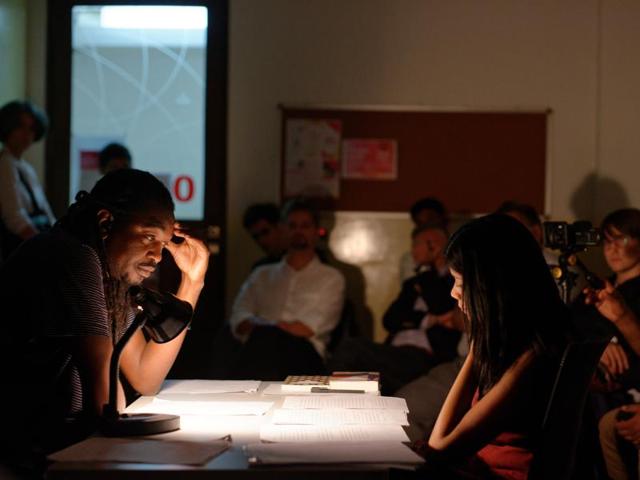
The Salsa dance music that signalled recess has now died down and the room has fallen silent. All eyes are on the one source of the light in the dark room and the man reading aloud sitting next to the table lamp.
Polish writer Jacek Dehnel is reading an excerpt from his novel Saturn (2011) based on the life of 18th century Spanish painter Francisco de Goya and his troubled relationship with his son Javier. According to a controversial hypothesis, Goya’s Black Paintings are the work of his son Javier who was also a painter and a disappointment to his father.
Dehnel’ voice rises and falls as he reads out the excerpts – first person narratives of the father and son (first in English and then, to give us a little flavour of the original, in Polish) – emotions flitting across his expressive face.
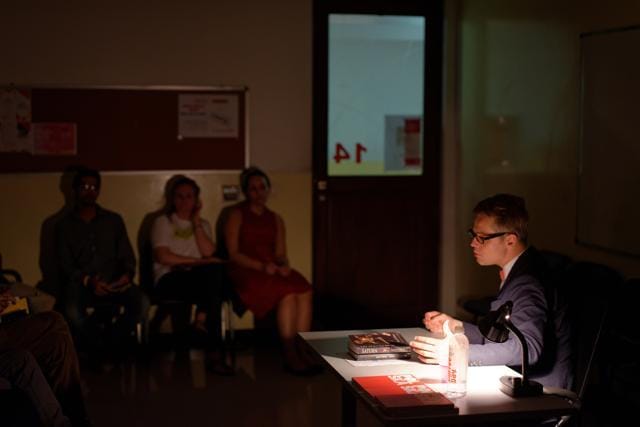
Later, during the 10-minute interaction with the audience, Dehnel explains what drew him to the story of Goya. “I wanted to look at patriarchy and difficult father-son relationships where they cannot communicate emotions,” he says. “It still is the case in Poland and I’m sure it is also in India. Historical novels should be written only if they can tell us something about the modern condition.”
The music blares again and our time is up. We pick up our bags and set out to locate the next room and our next date, the fifth author, on our printed schedule. It is literary speed dating night at Instituto Cervantes in New Delhi on September 23, and we (some 220 of us divided into eight colour-coded groups of 20-25) have been set up with ten authors from all over Europe.
Earlier we met Johan Harstad from Norway (who read an excerpt from his latest novel Max, Mischa and the Tet Offensive (2015) – the story of a homesick Norwegian working in America as a stage director), and soon after Laila Wadia. An Indian-Italian translator-writer, Wadia speaks eight languages yet, she says, she prefers to “write down pictures. I do not think in language.”
Mumbai-born Wadia, who calls Rumi and Pablo Neruda her inspirations, read several poems from her new collection Kitchensutra (2016) – erotic, divine, fun trans-lingual poetry about food and love (“love” which “is not a period. It is a full stop.”). This was followed by a session with Belgian writer Jean-Pierre Orban who read excerpts from his novel Vera (2014) about an Italian immigrant woman in England during World War II.
Austrian novelist Vea Kaiser performed a dramatic reading from her first novel Blasmusikpop (2012), the story of a boy who hates his small mountain village and wants to move to Vienna to study and see the world. Spanish writer Gabriela Ybarra read from her 2015 debut novel El Comensal (The Dinner Guest), an autobiographical exploration of grief.
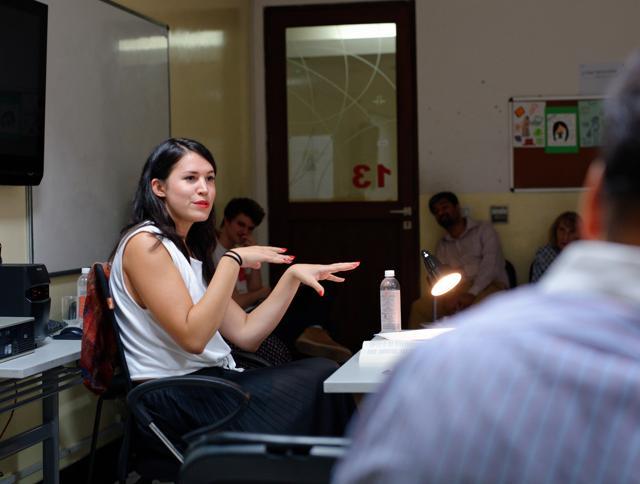
This was the second edition of The Long Night of LiteratureS, a collaborative presentation by various European cultural bodies and embassies and supported by the European Union. The event sets literary readings in the speed dating format with 20-minutes assigned for reading, 10 for questions and a 10-minute break between each session. Of course, things did not play out with such clockwork precision -- a longer reading sometimes eating into the interaction time and vice versa. By the time, we trooped into Hungarian poet Roland Orcsik’s room (date number six for group brown), we (our numbers significantly reduced) were exhausted.
The sessions which stood out were the ones where the authors broke the monotony with dramatic readings and audio-visuals aids, and had figured out how to squeeze in more content within the limited time. Our last author of the evening (it was past 11pm) was Line Hoven, a German graphic novelist, who narrated the story of her origin and her family through the pages of her graphic novel Liebe Schaut Weg (Love Looks Away) displayed on a screen and set to sound and music.
Two authors, French novelist-poet Markenzy Orcel and graphic novelist-poet Markus Kirchhofer from Switzerland, spoke no or very little English. Their sessions were held via translators, making the readings (especially when Orcel read out from his 2011 novel Les Immortelles in his deep, rich voice and his translator interpreted it into English with just the right amount of emotion) performances in themselves.
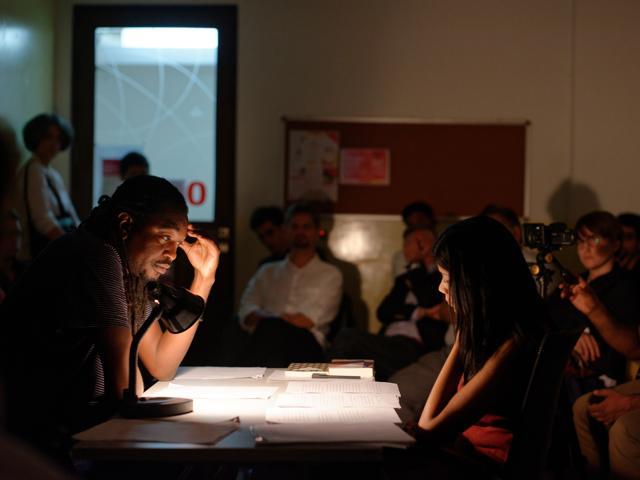
The idea, undoubtedly, is fantastic and could have worked out better with fewer authors or the ten sessions split over the course of a day instead of five hours at a stretch. Half-way through, it became a test of your love for literatures with certain participants jettisoning the colour-codes all together to attend whatever interested them.
From HT Brunch, September 25, 2016
Follow us on twitter.com/HTBrunch
Connect with us on facebook.com/hindustantimesbrunch


