Now that the Uttarpara factory in West Bengal has shut down, it looks like the Ambassador's journey is finally over.* Time to get all fuzzy and sentimental about this iconic car that has been a symbol of India since Independence. Three journalists and writers, two business-persons, a bureaucrat and a cab driver tell us why they still love this round, comfortable, gracious (but sometimes maddening!) vehicle.
(* However an official mail from Hindustan Motors says the suspension of work is “temporary” and that the company is looking at “viable options to restructure” the brand.)
"Everyone asks me 'kaunsa model hai' & 'kitna deti hai?"
I always really liked the Ambassador, I liked the look, style, shape of the car. When I moved back from the US to India in 1995, I drove my mother's Ambassador for six months before buying my own model, the DSZ. It had an Isuzu engine, and chasing the chimera of fuel economy, I bought the diesel version, though it was very noisy. Other colleagues were buying the Zen or the Matiz or the Santro and I did become the butt of office jokes. In fact, when I went to Rajeev Motors in Connaught Place to buy the car, the salesman told me that I was the first 'civilian' (I guess he meant the first 'non-government' person) who wanted to buy an Ambassador. He tried to dissuade me but I had made up my mind. I liked the height of the car - you didn't have to stoop to get in and out. And I always found it easy to drive. I didn't find it too heavy or anything.
Yes, it did have some problems. It would overheat all the time and we once had to buy water from those water thelas to cool it down. We would also have to keep giving it dhakkas to make it start!
{{/usCountry}}Yes, it did have some problems. It would overheat all the time and we once had to buy water from those water thelas to cool it down. We would also have to keep giving it dhakkas to make it start!
{{/usCountry}}Since the car was giving me so much trouble, my father-in-law, who was getting rid of his Peugeot 305 at the time, lent me his car. I sold the Ambassador - I remember, two sardarjis from my local taxi stand almost came to fisticuffs because both of them wanted to buy the car!
Then I changed jobs in 2005 and the following year, I bought a retro model of the Ambassador called the Avigo for Rs 5.5 lakhs. I always thought that this model was central to what the Ambassador could have been. Take the case of the Beetle. It too ran into difficult times in the Eighties and Nineties but then they turned it from a goofy, Sixties kind of car into an upmarket, yuppie car. Hindustan Motors tried to take a leaf out of that with the Avigo. It had a minimalist dashboard, the front was more rounded and harked back to the Fifties and Sixties Ambassador, but it came with modern trappings - leather seats, CD player, floor gear. I was really happy with the car. But the company discontinued the model, which I believe was a big missed opportunity in the history of Hindustan Motors. It was a hugely popular car with foreign diplomats too.
I moved to Chennai and my office gave me a Skoda Octavia which I didn't like. So I bought a petrol 1954 Landmaster from a guy in Palghat for Rs 3.5 lakhs. He was a car fanatic and had upgraded the engine and fixed the body. He had moved to Dubai and so had to sell the car. I met him through an online automotive group, an Indian site for classic cars.
When I saw the Landmaster, I liked it immediately. It had a chrome grill in front, and was very comfortable to drive. I drove the car from Palghat to Chennai, a 12-hour journey. The car behaved itself perfectly. I enjoyed the drive, and yes, by then you could say I was bitten by the vintage Ambassador bug!
Meanwhile, there was a gentleman in Hyderabad who had an even older model - the Hindustan 14. He was a cement salesman and he wanted to sell the car. So I flew to Hyderabad and bought it for Rs 2.5 lakhs. He had unfortunately installed a diesel Matador engine and the car was very noisy. Anyhow, I caught hold of a local driver and the two of us set off for Chennai. On the way, at 1am, the car spluttered to a halt. We were in the middle of nowhere and it simply refused to start. So we slept in the car and managed to get a mechanic at eight in the morning. He fixed it and we did the rest of the journey without any trouble.
In Chennai I abandoned the Skoda and used these two cars in turn. I always drove them myself. The Landmaster didn't have a working fuel gauge and you had to guess how much fuel was left in the tank! I remember I was meeting my wife and father-in-law for lunch one day and I ran out of petrol. She had to come to the road with a jerry can of petrol!
I returned to Delhi last year in November and the two cars came on a truck. Now I rotate all the three cars every two weeks - you have to drive them or they go to seed. I want to restore the Hindustan 14 to what it was like in the old days - I want to put in the original side valve petrol engine. I've found a guy who restores Ambassadors.
I will never sell the cars, even though I guess their value will shoot up. You still see Landmasters sometimes, but I've never seen the Hindustan 14 on the road. Now I want to buy the 1948 Hindustan 10, though I'm told it's quite hard to find.
Since I drive the cars regularly, I am aware of the risks - in Chennai somebody bumped my Hindustan 14. But what can you do? Fortunately in India these kind of repairs are easy to do. Whenever I take the Landmaster or Hindustan 14 out, there's plenty of curiosity. Everyone wants to know 'kaunsa model hai?' and 'kitna deti hai?' I'd gone once to visit my dad in Noida and there was a big traffic jam. I had to drive in first gear for 20 minutes and so of course, the car stalled. I ended up adding to the already big jam. But though the other motorists could see that I was blocking the traffic, no one yelled at me. Some people slowed down and asked me 'kaunsa model hai?' and 'kitna deti hai?'
It saddens me that the Ambassador - so closely associated with the history of urban spaces and roads across the country - is now disappearing. It's been taken over by other cars like the Innova, even in places such as Ajmer and Ranikhet. The government too has defected from the Ambassador. Bureaucrats are abandoning the car, just the way taxi fleets have abandoned it.
Hindustan Motors should recognize the iconic value of the brand and contemporize it, they should retain the charm of the car and improve the machinery under the hood. The Isuzu engine is anyway very good and doesn't give any trouble. I would stretch the chassis by a foot, so that there is even more room at the back. Because otherwise, if you push back the front bucket seats, there's not much room at the back. Maybe bureaucrats and politicians might still be attracted to the car if it had more space. They might like the additional comfort and style of an upgraded Ambassador.
I'm conscious of what my three Ambassadors represent. The Landmaster and Hindustan 14 are 50-60 years old and they're still functioning. They're a piece of history. Someone laboured over these cars once. They represent the values and hopes of Nehruvian India -- with all its flaws. But those were gentler, less aggressive and less violent times. And the Ambassador reflects that, in its shape and comfort, its lumbering grace.
So yes, I guess I'm an Ambassador romantic. As the car fades into history, it represents a certain India. It says something about the country we were once upon a time.
Siddharth Varadarajan is a journalist
"Our daughter loves the car"
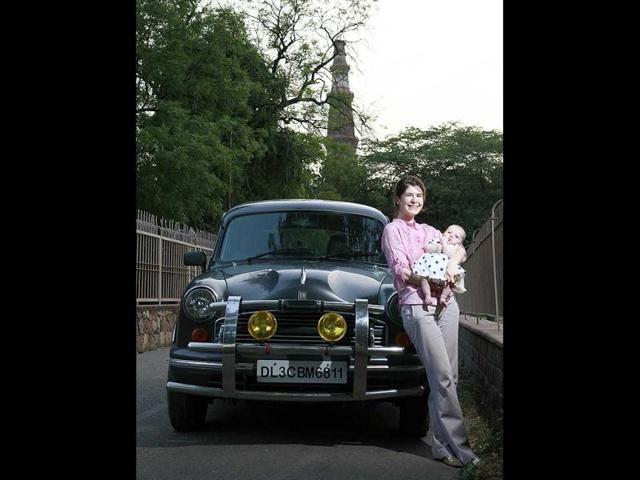
We have been living in India for a little over three years. We bought this 2010 Ambassador Grand model in January this year from a sardarji who was moving to America. He really loved it and had done it up with new seats and dashboard and he'd spray-painted the body a dark metallic blue. We loved it at first sight!
Before this, we didn't own a car; we used to travel by Metro. But when our baby was due in April, we decided we needed a car. We looked at smaller, newer cars but they were more expensive and had less space than what we wanted. The Ambassador was the most economical for the amount of space it gave us. Also, it's really fun. The expat community is fascinated with the Ambassador because it's a classic car. It is also symbolic of India's past and is something that we don't often get to see on the roads in the West. My family in England actually has a smaller version of an Ambassador - the Morris Minor. So it's a kind of family tradition to own such cute cars, which don't go very far but are nice to look at. In the past five months of owning it, we have had quite a few mishaps and regular breakdowns. But the car is built like a tank, so we came off better than we would have in any other car. We had a dream of driving back to the United Kingdom in the Amby. Our daughter Miriam loves it too, it puts her to sleep. It will, however, be very expensive for us to take it home and keep fixing it every time it breaks down. So our dream may remain just that, after all. - Joanna MacAskill is the editor of India Real Time, Wall Street Journal
It's another day at the office for me. I am on the road with a convoy of beautiful classic and vintage cars, including a Mercedes 190SL and a 1961 Chevrolet Biscayne. But my eye hunts out a car owned and driven by an Italian called Donald Tomassi. No, it isn't some Italian car. It's a 1965 Mark II Hindustan Ambassador. When the cars are parked during a coffee break, I sneak a peek inside. It's exactly the way I remembered it. The Bakelite steering wheel, the indicator switch located at the centre of the steering wheel, the thin gear column attached to the steering shaft, the foot-operated headlight dipper switch; everything was the way it was on my father's Mark II, DHB 7125, the car I learnt to drive on.
If there's one car that's etched into the consciousness of India, it is the Ambassador. Now that Hindustan Motors has pulled the plug on the Ambassador, let's take a drive down memory lane.P.S. I grew up driving the Ambassador and dreaming of sleek, powerful, modern cars. And now that I drive those sleek, powerful, modern cars, I am seriously contemplating buying an old Mark II. And if anyone has DHB 7125, please contact the Autocar office.
- Joy Choudhuri (creative editor of Autocar India)

1942The Ambassador, as we know it, was launched in 1957 but the seed was sown in 1942 when BM Birla founded Hindustan Motors (HM) and set up a small factory in Port Okha in Gujarat to assemble passenger cars.1946The company started importing the Morris 10 Series M kits for local assembly. In India, it was sold as the Hindustan 10. The 1140cc side-valve engine developed 37bhp at 4600rpm, with a top speed of 100kmph. Next year, HM launched the Hindustan 14, based on the Morris 14. The Morris Minor also joined the line-up, with the name Baby Hindustan.1954When the company wanted a new model to replace its Hindustan models, it settled on the Morris Oxford Series III, launched in India as the Hindustan Landmaster. The car initially came with a 1489cc side-valve engine but was later improved to an overhead valve engine. It was quite an innovation with a semi-monocoque chassis, which is why it was very spacious inside. The car cost Rs10,000.1957All the tooling of the British Morris Oxford Series III was transferred to India. A small tail fin was added on either side of the rear fenders, along with a new, dimpled hood, and the car was re-christened the Ambassador Mark I. The car cost Rs17,000.1963It underwent a frontal facelift with a closely-checkered grille and was named the Ambassador Mark II. It would be 12 years before another redesign.
Dr Vishwapati Trivedi with the quintessential sarkari car (Photo: Raj K Raj)
Most officers, when they join the Indian Administrative Service, look forward to that one thing that for them has been the symbol of government officerhood - the Ambassador car.
I felt the same way. But it was only after I joined the IAS in 1977 that I realised the prized 'official car' wasn't so easy to get. No new recruit is entitled to the Ambassador. What we got at the beginning of our service as SDMs was a jeep. Only the Collector in a district and officers above the rank of Collector in the government, were entitled to the grand car. So in a lot of ways, the Ambassador was an aspirational car even for many of us officers for the longest time.
Once the car came, the love affair started. As officers, we looked forward to every new upgrade. The Ambassador launched the Mark II model with the Isuzu engine and that became the next obsession. And then came the model with bucket seats. It became an instant hit with officers.
I took a lot of interest even in the interiors of my car. Curtains and a little fan were basics. I changed the upholstery, got wood panelling, fitted a rotatable passenger seat next to the driver. My affair with the Ambassador continued till my last posting. I had to give it up when I took over my current post. But my love for the Ambassador remains.
- Dr Vishwapati Trivedi is Secretary, Shipping, Govt. Of India
"I have driven 4 Amby models"
I have been driving an Ambassador taxi for 33 years. At 16, I came to Delhi in 1972 from my hometown Pathankot in Punjab. After a few years at a painting job, I began to learn driving an Ambassador from some friends. I began driving for the Imperial Hotel soon after. Two years later, I bought my first car and of course, it was an Ambassador! It had cost only `1.80 lakh back then.
Thirty three years hence, I have bought and driven four models of this beautiful car. I have never driven or wanted to drive any other car. Even today, the Amby is in high demand amongst the (Imperial) hotel's foreign guests. Now that the plant is shutting down, I am hoping I can manage to maintain my car for another 5-7 years at least. After that? What can I do? I will have to switch over to a different car. I won't like it one bit, I will miss my kali-peeli Ambassador taxi. But I need to send my kids to college after all.
"It's better than my Mercedes!"
My Ambassador is not some old relic. In fact, I bought it only in 2008. It's one of the newer models - nice bucket seats, power steering, power windows and air conditioning. I love cars and I'm fortunate to have several of them, a Fortuner, a Sumo, a Verna, a Mercedes and a couple of others. But nothing compares to my Ambassador. Back when I bought mine, people wondered why we were wasting our money when there were other vehicles that were better value. But the Ambassador is not just a vehicle; it's a legacy, a symbol of majesty, elegance and a piece of India's history.
It's truly a VIP car. For me, the Ambassador was the only car that deserved a special registration number - the license plate reads Q 1. And you really feel like a VIP when you sit in it. I'm very law friendly for someone with a VIP-type car, but I can say that even the police look at you with respect - though the respect is all for the car! On the road, people's expressions say, "Who on earth is driving an Ambassador in this day and age?"
Some years ago, when I'd drive my Mercedes, people would stare and say, "My God, a Mercedes!" But luxury cars are now so commonplace, people actually stop and say "My God, an Ambassador!" so it feels like things have come full circle.
People in Mumbai still haven't got over the notion of a woman behind the wheel of a luxury car or an Ambassador. There is always a double take: "Does she know how to drive it? I don't trust her. I'd better stay away!" That works out wonderfully for me; I get lots of space to drive.
At home, we call her the Amby or the Ek Number, because of her license plate. She's been with us to Goa twice and all around Bombay. My son, Ruhaan, is about two-and-a-half years old, so I like to say that six-year-old Amby is the older baby, the one who came first and got all the attention!
But really, she's just a big baby. We take care of it as we would a baby. It's not our primary car and it's not at all practical. It's heavy on the steering and a bit slow on the pickup and God, it's broken down so many times! My uncle says we've repaired everything except the engine and gearbox. But then again, it's so sturdy. The Ambassador is one car that can handle the potholes in Bombay. There's headroom, great shock absorbers and it's not low slung. Plus it's easier to find repairers for an Ambassador than a Mercedes because there are no specialised high-tech repairs.
Would I give her up? I was actually keen to sell this car, but now that they've stopped production I get more emotionally attached every day. I wish they'd have figured out a way to modernise the car instead of just giving up. I'm the only one among my friends who owns one, and every time I sit inside it, I feel proud. She's a grand old lady who ages gracefully.
"My 1961 Amby is not my baby; it's the first love of my life!"
Businessman Ashok Shah painted his car green (Photo: Vidya Subramanian)
It's a family heirloom. In 1961, my father bought a sky-blue second-hand Ambassador. It became the first car my family ever owned, but more importantly, it became the first love of my life. I was five and I would excitedly fit my body under the lower board of the car to understand its workings. It is what made me want to become a mechanical engineer.
I grew up repairing the car. Soon, I could handle it on my own. I had already driven it in my mind a hundred times but I drove it for the first time when I was 16. I haven't stopped since. I have painted it with my own hands. I decided to quirk up its sky-blue days. So I mixed colours till I found the perfect shade. I narrowed it down to metallic green, the same shade you'd see on a Mercedes. No other Ambassador in India has been painted in this colour. To break the monotony, I added a green border along its edges.
I can't tolerate a scratch on my car. But my car has tolerated much more. In 1979, on a trip to Jamnagar, my car decided to break down. Its body fell apart. We somehow kept it moving at 30km per hour, and drove it back to Mumbai. Another time, a truck hit the back of the car, which was worse.
My Ambassador has also been stolen. After filing a police complaint, I went to a temple - full movie style - and pleaded with God to help find it. Soon, my neighbour spotted the car, abandoned, near Panvel. The thief had tried to sneak it out of the city, but met with an accident. It was in very bad shape and I was told that it couldn't be repaired. I offered my repairman any sum he wanted to fix it. It took time, but eventually my car was back on its feet... or wheels!
My Ambassador is an ambassador of comfort. I have added power steering, new gear, power brakes, bucket seats, mag wheels and a brand new engine. I spent around `2 lakhs to change the body and the engine. People thought I was mad. Well, I am mad, I'm mad about my car!
You could say that my green car makes people green. A random person once walked up to me at a petrol pump and offered me `2 lakhs if I sold my car to him on the spot. I told him, "Offer me 2 crores, I still won't sell it". My brother once sold it; I bought it back in 1996. It has been officially mine since. Now, no one can touch it as long as I am alive.
My Ambassador car has dropped my kids and nephews to school. My son, Jay, would initially be embarrassed and would ask me to send another car, but I wouldn't. Slowly he grew fond of it. As time passed, all his friends wanted to hop in.
I still drive it. I don't think anyone close to me or my family has not sat in this magnificent car. I wouldn't have it otherwise, anyway.