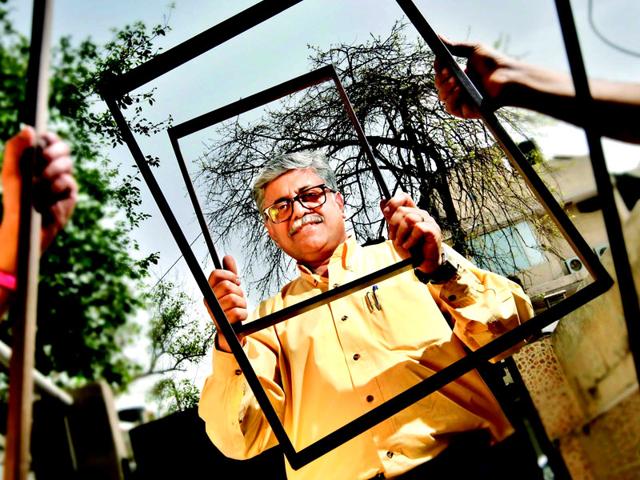
Frames are the superheroes of the art world. They can turn any artwork around – for better or worse. Which is why Murti Ahuja’s studio in New Delhi has the who’s who of the visual arts – artists, curators and collectors – dropping in.“Believe it or not,” says Ahuja, “paintings that have not been able to sell for years sell within months when their frames are changed.”Adds Delhi-based art restorer Priya Khanna, “For a conservator, the frame is a helpful clue to determine the authenticity and provenance of a painting.” In medieval altarpieces, the frames were carved on the same wood panel that carried the artwork. At the time, it is believed that the role and remuneration of the carver was possibly greater than that of the artist. The 14th century Renaissance frames were wide, golden and heavily carved, but were simplified when the Impressionists came into the picture during the 19th century, rebelling against everything that so far had qualified as high art – their frames were either bright in colour or stark white.
Behind the scenesIt’s always busy at Ahuja Framers. The hallways are stacked with paintings and photographs. In the background, the phone rings off the hook, you can hear the wood cutting machines at work. When you step into Murti Ahuja’s office space, you are surrounded by walls adorned with messages, signatures and canvas drawings – gifts from patrons – all subtly framed in matte white. Before there is a picture, there is a frame, reads a testimony by London-based photographer Sunil Gupta. There is a drawing by MF Husain, a painting by Subodh Gupta, a watercolour by Paresh Maity. Somewhere in the middle is a tiny watercolour landscape, 2” x 1” in size – it’s mounted in such a way that even from a distance, each aspect is clear. The final product is bulky, but you will have eyes only for the painting. “It took us days to conceptualise this type of step-wise mounting, but we decided to go after the concept of the cinemascope,” says Ahuja. This is a family-run show. The business was started in the early 1950s in a shop in Paharganj, run by Ahuja’s father. Shri Dina Nath Ahuja was a spiritual man, who began framing paintings of Gods. This attracted young artists – like Manjit Bawa – to him. “Manjit ji told me stories of how they had very little money and had to get the framing done on credit basis,” says Murti. A teenaged Murti began assisting his father in 1972 and took the reins of the business after finishing school in 1975, precariously balancing it with evening college to complete his education. He has no formal training in art. But after 10 years as a framer, came his big break. There was an urgent need of over 300 aluminium frames for a Biennale in Lalit Kala Akademi in 1985. Ahuja took on the challenge, purchased the machinery and worked overtime. And it paid off. The first machine Ahuja ever used – a small red one that cuts wood – was brought from Italy by a friend. “We used to hide from our competitors and work in absolute secrecy because the use of a machine for framing was unheard of,” he says.Ahuja’s frames start from Rs 100 per square feet but can go up to Rs 4,000 per square feet – and even more if specialised material is used. Archival and museum-quality framing is twice as expensive.
Edge of eternityAhuja has a unique bond with artists. Says photographer Raghu Rai, “My preferences vary depending on whether the photograph is black-and-white or in colour, but one thing remains constant – I don’t like shine in the frame. Murti is sensitive about this.” Sometimes “there is a clash between what the artist wants and what the collectors want,” laughs Ahuja, “and I get caught in the middle.” The artist-collector frame battle is not new either. Impressionist Edgar Degas, who painted beautiful ballerinas, was so finicky about his frames that he even drew possible designs for them. Once, he sold a painting to a collector who swapped his frame for a glittering gold one. A furious Degas barged into his house, removed the canvas and marched off with it. “The skill of a fine framer is the ability to make the onlooker look at the painting,” says SH Raza, the iconic abstract painter. “The frame should absent itself and accentuate the painting. A beautiful woman is beautiful in herself, but when she dresses up it’s a matter of taste and choice. Similarly, a frame dresses up the painting and can never be more important than the painting itself.” Ahuja agrees. “I treat the frame like a piece of clothing, providing something that complements the unique personality that each artist tries to attain,” he says. Ahuja’s frames are everywhere: people’s homes, prestigious collections around the world and even around a Husain – gifted to Bill Clinton by then President KR Narayanan – at the White House.From HT Brunch, June 28Follow us on twitter.com/HTBrunchConnect with us on facebook.com/hindustantimesbrunch
{{/usCountry}}Edge of eternityAhuja has a unique bond with artists. Says photographer Raghu Rai, “My preferences vary depending on whether the photograph is black-and-white or in colour, but one thing remains constant – I don’t like shine in the frame. Murti is sensitive about this.” Sometimes “there is a clash between what the artist wants and what the collectors want,” laughs Ahuja, “and I get caught in the middle.” The artist-collector frame battle is not new either. Impressionist Edgar Degas, who painted beautiful ballerinas, was so finicky about his frames that he even drew possible designs for them. Once, he sold a painting to a collector who swapped his frame for a glittering gold one. A furious Degas barged into his house, removed the canvas and marched off with it. “The skill of a fine framer is the ability to make the onlooker look at the painting,” says SH Raza, the iconic abstract painter. “The frame should absent itself and accentuate the painting. A beautiful woman is beautiful in herself, but when she dresses up it’s a matter of taste and choice. Similarly, a frame dresses up the painting and can never be more important than the painting itself.” Ahuja agrees. “I treat the frame like a piece of clothing, providing something that complements the unique personality that each artist tries to attain,” he says. Ahuja’s frames are everywhere: people’s homes, prestigious collections around the world and even around a Husain – gifted to Bill Clinton by then President KR Narayanan – at the White House.From HT Brunch, June 28Follow us on twitter.com/HTBrunchConnect with us on facebook.com/hindustantimesbrunch
{{/usCountry}}