When you’re a pint-sized musical prodigy, perhaps starting with the mridangam at the age of four is not the greatest of ideas. Too small to hold the instrument then, BC Manjunath thus began his music lessons with konnakol vocal exercises – the foundation of rhythm in Carnatic music.
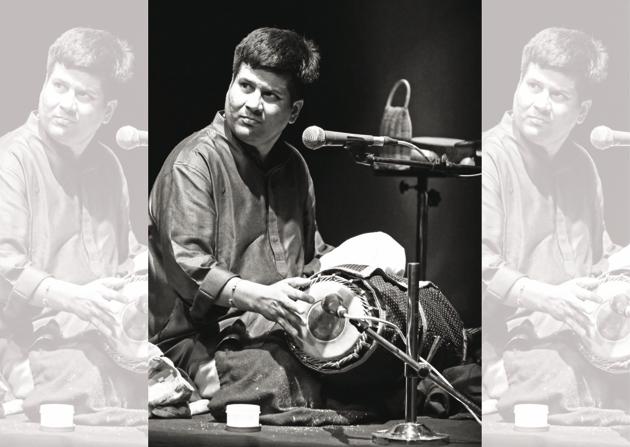
Today, Manjunath swears by konnakol. It’s the best teaching tool ever for online classes, he says, remembering his recent three-part webinar with Boston’s Berklee Indian Ensemble, helmed by the director of the programme, Annette Philip.
“It’s an easier way to communicate while teaching music online, when you’re looking into the camera and speaking rather than sitting with an instrument,” the 44-year-old Bengaluru musician says.
Key communicator
Born into a musical family, Manjunath’s father was the veteran mridangam artist Dr BK Chandramouli and he learnt the mridangam from Vidwan KN Krishnamurthy. Now, he has spent 22 years as a mridangam player but still believes konnakol is the best way to begin learning music.
You could say konnakol is a more staccato, percussive version of a cappella. “Think of it as one of the voices of mridangam, which you echo vocally,” Manjunath explains. “It’s one of the most sophisticated percussions due to how intricately detailed it is – it shows the cellular form of rhythm.”
Slow and steady
{{/usCountry}}Slow and steady
{{/usCountry}}As you master konnakol, you can attain a speedy and expressive crystal-clean recitation of the intricate rhythmic patterns. But learning it has to be a slow and steady process.
“You can’t learn it overnight. It needs to literally get under your skin. There are about 50 to 60 basic lessons and there’s actual formal science behind learning the art form,” Manjunath says.
This ancient art form is now being picked up by musicians around the world, because it’s something anyone can do.
Though it was earlier also used in melodic ensembles, the konnakol we hear today is built upon the percussion ensemble-focused version that revived in the 1980s. It’s also gaining popularity due to its mental health benefits.
“Personally, it’s given me clarity of thought because there’s a brain compartmentalisation that happens after regular practise,” Manjunath reveals.
The science of it
The scientific secret behind konnakol is this: it has a lot of syllables structured in such a way that they induce internal vibrations in the singer’s body. “And so I have never had any cold or lung-related issue,” says Manjunath. He also gives us observational proof: His father had a wheezing problem that he controlled via regular konnakol practise. But how can Manjunath be sure? “When he skipped konnakol practise, the issue would resurface. If he got back to it, it would be gone within six months,” he says.
Try it out!
Over decades as an educator, Manjunath has also seen students manage their stammering (konnakol literally means to stammer) and even saw one person emerge from a left-side paralysis after practising konnakol.
“It’ll help, but it’s not a cure. The best part is that you can practise it anywhere – while cooking or travelling – because you can do it mentally too,” he says.
Follow @KKuenzang on Twitter
From HT Brunch, August 16, 2020
Follow us on twitter.com/HTBrunch
Connect with us on facebook.com/hindustantimesbrunch