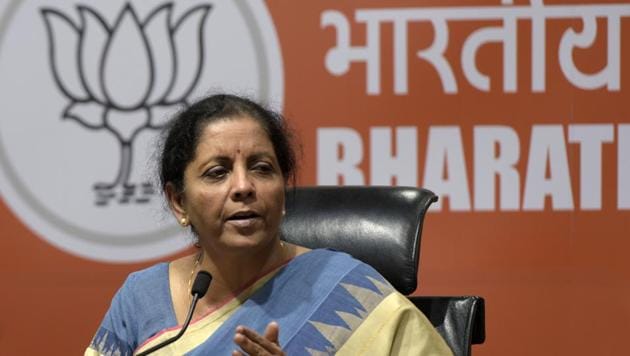
India’s economic growth could get a boost and be more inclusive with a simplified minimum wages system backed by law, the Economic Survey 2018-19 released by Union finance minister Nirmala Sitharaman on Thursday said.
One in every three wage workers in India is not protected by the Minimum Wages Act. A revamp of the country’s archaic system of minimum wages will spur incomes and consumption demand among the “vulnerable bottom rung of wage earners”, the survey said, laying down broad proposals for a policy framework to streamline wages.
Budget 2019 Live Updates: Nirmala Sitharaman arrives in Parliament, will present budget shortly
Minimum wages, a welfare feature of most advanced and developing economies, are floor wages benchmarked to inflation and designed to protect vulnerable workers from exploitation.
The government is slated to introduce The Code of Wages Bill, 2019 in the current session of Parliament, aimed at rationalising minimum wages in step with proposals made out in the Survey. A key change is that minimum wages will now be backed by law.
Read: Sitharaman to do a tightrope walk in first budget of Modi govt 2.0 today
{{/usCountry}}Read: Sitharaman to do a tightrope walk in first budget of Modi govt 2.0 today
{{/usCountry}}This bill amalgamates the Minimum Wages Act, 1948, the Payment of Wages Act, 1936, the Payment of Bonus Act, 1965 and the Equal Remuneration Act, 1976 into a single piece of legislation. “Rationalisation of minimum wages as proposed under the Code on Wages Bill needs to be supported,” the Survey stated.
India has a maze of different minimum wages for various scheduled job categories for unskilled workers across various states. The Minimum Wages Act, 1948 does not cover all wage workers.
“One in every three wage workers in India has fallen through the crack and is not protected by the minimum wage law,” the Survey said.
India has at present nearly 429 “scheduled employments”, or job categories in the organised sector. Similarly, there are 1,915 in different job categories for unskilled workers.
A simple, coherent and enforceable minimum wage system, backed by technology will push incomes up and reduce wage inequality without “significantly affecting employment”, the Survey said.
The proposed Code of Wages Bill will also prescribe a universal minimum wage, doing away with job categories.
Economists have long debated the minimum wage. One risk often cited is that a higher floor wage can, at least, theoretically drive up unemployment as firms will tend to cut back on hiring if forced to pay more.
The Survey, however, cited evidence to show that minimum wages have little or no adverse impact on employment.
Also read: Digital infra, Aadhaar, cellphones can expand outreach of schemes
“The new wages code bill is revolutionary because it brings statutory backing to minimum wages, a long pending labour right. Yet, having a national rate and then different rates for different zones and states still makes it cumbersome,” said KR Shyam Sundar, an economist with the Xavier Labour Relations Institute.
The current federally adopted non-statutory “national floor level minimum wage” is R176 a day. However, different states have varying minimum wage rates, mainly because economic prosperity varies across states.
Quoting a study (Kannan and Papola, 2017), the Survey noted that 39% of the male casual workers and 56% of women casual workers in rural areas, apart from 28% of male casual workers and 59% of women casual workers in urban areas, received wages below the federally fixed minimum wage in 2012.
Such a scenario has resulted in low pay and wage inequality, which in turn pose “serious obstacles towards achieving inclusive growth”.
Also read: Congress attacks survey, says govt seems pessimistic about economy
With 93% of “workers in the informal economy”, a well designed minimum wage system, the Survey stated, can cut inequalities in incomes, close gender gaps in wages and alleviate poverty.
An effective minimum wage policy can help in driving up aggregate demand and building and strengthening the middle class, and thus spur a phase of sustainable and inclusive growth.
(For full budget coverage log on to livemint.com)