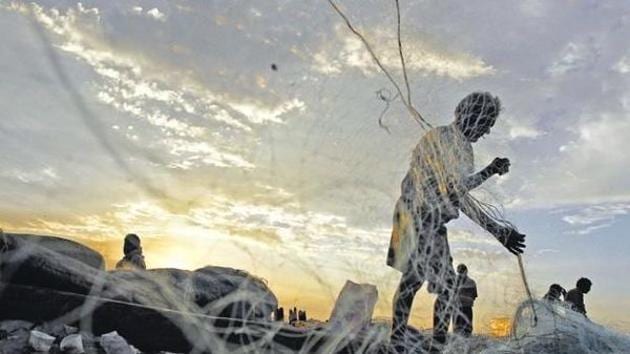
Last week, N. Devdas, a deep sea fishing boat owner in Rameshwaram, Tamil Nadu, was happy with his crew’s effort that managed to get a bounty of six tonnes after almost 25 days of sailing. But the prized catch of soorai (tuna), seerfish, kerai (yellow tuna) and mayil (sailfish) among other varieties, fetched him just ₹4 lakh against the ₹7 lakh he had estimated based on the price it had fetched a month ago.
Devdas was told by the middlemen, who sell to export firms, that the export market was deeply impacted due to the coronavirus (Covid-19) outbreak.
The virus, which originated in China’s Wuhan, has so far infected 90,000 people and claimed 3000 lives. China accounts for about 20% of India’s ₹46,589 crore marine products exports market.
“We don’t know how the coronavirus impact will play out or what will happen next,” Devdas said.
Devdas is one of the thousands dependent on the fisheries industry witnessing a sharp slide in prices due to an apparent dip in the marine products exports market.
“Everyone is concerned about this (coronavirus) generally so they are trying to get the situation assessed,” Elias Sait, Secretary General of the Seafood Exporters Association of India said.
As a destination and transit point for meat, seafood and other consumables that have a short shelf life, exporters globally have suffered due to the strict enforcement of quarantine in China to contain the spread of the virus and the misinformation that engulfs it.
{{/usCountry}}As a destination and transit point for meat, seafood and other consumables that have a short shelf life, exporters globally have suffered due to the strict enforcement of quarantine in China to contain the spread of the virus and the misinformation that engulfs it.
{{/usCountry}}Sait said that ports in China were full and delivery of consignments was taking longer than usual but denies any impact to the business.
“Right now, the situation is such that even if people ship goods to China, companies there may not take deliveries. While there is loss of orders as such, people are delaying shipments,” said Ajay Sahai, director general of Federation of Indian Export Organization.
Sahai said fresh food with low shelf life has been particularly affected, adding that marine products fall in such a category.
“People are generally cautious about food products following the outbreak of coronavirus. Therefore shipments are not taking place. That is happening in India, but not exclusively, as other countries are also affected. Some I believe are sending back products like lobsters back into the sea,” he said.
The outbreak has even threatened to halve global gross domestic product (GDP) growth, according to a new report by the Organisation for Economic Co-operation and Development (OECD).
Pushkar Mukewar, co-CEO, Drip Capital, which offers credit lines to exporters, said the impact of the outbreak on the company has been minimal because it doesn’t finance perishable goods.
“...But we understand seafood exports from Kerala have been particularly hit hard. We do have clients in frozen foods. We have seen orders getting cancelled. Even orders that have been shipped out are not being picked up. Some of the offices are closed and port clearances are not happening. China has emerged as the second largest buyer of seafood in the last 18-20 months,” Mukewar said.
Sait says that though there is no impact on exports as yet, the drop in prices could be due to a dipping demand for cuttlefish and squid from the European markets that account for almost 20% of Indian exports, and have also reacted to the outbreak.
Of the 1300 marine products exporters, 550 processing facilities that are located across the coastal states and export to China, are mostly from the west coast of India, especially Maharashtra and Gujarat.
A Marine Products Exports Development Authority (MPEDA) spokesperson said categories such as frozen fish, dried and live items have borne the impact.
However, he attributed this mainly to dwindling catches and not the virus. The MPEDA says that it expects normalcy to return in a couple of weeks, adding “similar situation never experienced before.”