There is a distinctiveness that underlines Apple’s approach to the standard iPhone in this year’s line-up, and it has certainly taken a positive turn as a result. At first glance, this may seem familiar, but Apple’s sharpened focus on the hardware this year, more than the last time of asking. Different moments in time, different responses required. It is with the Apple iPhone 17 that the dream of a 120Hz Super Retina XDR display, gets ticked off finally. Total up everything else that makes up generational progress on the iPhone 17, and it morphs into an iPhone that’ll simply work for most folks.
I’ll draw your attention to some data, which will impress the importance of Apple’s generational evolution with the standard iPhone. Tata Group’s omni-channel electronics retailer, Croma, in some data just ahead of this year’s iPhone keynote suggested that their sales information indicates that the “non-Pro iPhones formed just over 86% of total sales” across all iPhones, with certain colours able to find traction to match up to the evergreen (no pun intended) black. That is very much likely to be the trend with the iPhone 17, and it’ll lead the bulk of the familial sales over the next few months.
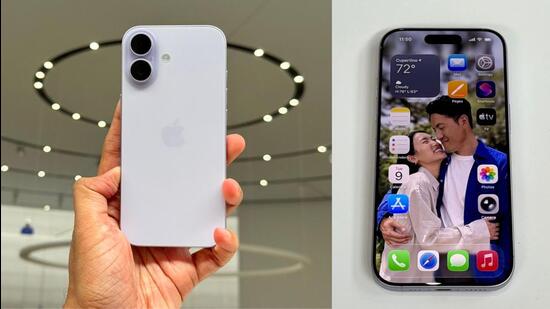
The base storage has gone up from 128GB to 256GB, and while I wouldn’t classify as generosity (it is more an overdue correction), this does bring the iPhone 17 more in line with usage trends which lend some credence to future proofing. The iPhone 17 is now priced ₹82900 onwards (as against ₹79900 last year), and there’s immediate value padding for that slightly higher price. It is still fun to pick colours on the new iPhone 17, with Lavender, Sage and Mist Blue meeting White and Black. That said, this design maintains a whiff of familiarity complete with a likeable matte texture, unlike the iPhone 17 Pro Max models which have seen a significant visual overhaul alongside the introduction of the svelte iPhone Air. Perhaps next year is when the standard iPhone (iPhone 18?) sees bigger design changes.
There’s more refined value to be found. I had mentioned the display which now peaks at 3000-nits brightness, instead of 2000-nits. The real estate is also now 6.3-inches instead of 6.1-inches (and more pixels too), which I’d classify as a better point to balance compactness and useability. Even under the typically bright afternoon sun even though it should be the fag end of this year’s summer, you’ll not have any issues with screen legibility — this is where the anti-reflective coating also helps. The 1-120Hz refresh rate capability was long due, considering the Pro phones have had it for four years now. The display experience is a step up, and reduces the gap between this and the Pro models.
{{/usCountry}}There’s more refined value to be found. I had mentioned the display which now peaks at 3000-nits brightness, instead of 2000-nits. The real estate is also now 6.3-inches instead of 6.1-inches (and more pixels too), which I’d classify as a better point to balance compactness and useability. Even under the typically bright afternoon sun even though it should be the fag end of this year’s summer, you’ll not have any issues with screen legibility — this is where the anti-reflective coating also helps. The 1-120Hz refresh rate capability was long due, considering the Pro phones have had it for four years now. The display experience is a step up, and reduces the gap between this and the Pro models.
{{/usCountry}}In terms of performance, the A19 chip in the iPhone 17 is a different configuration to the A19 Pro that does duties in different specs in the iPhone Air and the iPhone 17 Pro as well as iPhone 17 Pro Max. I’d say this is closer to the iPhone Air’s scenario, being in the same ballpark for not just real world performance but also synthetic benchmarks to illustrate any differences. The iPhone Air logged single-core and multi-core scores of 3457 and 8612 in Geekbench 6. The iPhone 17 settles in with 3514 and 8901. This is the fastest standard iPhone ever, representing what is generationally its biggest leap yet.
Despite not having an elaborate cooling system like the iPhone 17 Pro range, the iPhone 17 still manages to remain quite cool and thereby holds performance consistently, even under sustained loads. It is only when you begin some serious gaming (and you can crank the graphics really high) for about 15 minutes or so, does the back begin to heat up considerably. Yet, as you’d use this phone every day with regular apps and multi-tasking, there is barely any hint of heat.
That has a positive spin on battery stamina as well, returning close to six and a half hours of on-screen time every charge cycle after the initial settling period had passed. That plans this right in the middle of the iPhone Air and the iPhone 17 Pro, with the iPhone 17 Pro Max leading the stamina stakes.
While it is USB-C all round for the iPhone 17 line-up too, the port on the iPhone 17 is restricted to 480Mbps transfer rate, which is essentially USB 2.0, as against 10Gbps on the Pro models. Chances are you’ll move your data between devices wirelessly (wireless data transfer initially and then AirPlay), which means this may not be a limitation much beyond a number on the spec sheet.
Must talk about the cameras, which have received some important upgrades. The main wide sensor is carried forward but with a different image processing pipeline at work. The ultra wide is a significant switch, from 12-megapixels to 48-megapixels, and a 18-megapixel Center Stage FaceTime camera. This will, in the real world stakes, compete with the Google Pixel 10, and in most comparative photography scenarios, the iPhone 17 returns livelier and crisper photos. The ultra wide, with the new hardware, is much closer to the Pro phones results. The one area where you’ll need to make some effort, is getting zoom photos to deliver precise detailing — it’s very much possible, you need really stable hands though.
The reality is, and I allude to this considering many friends have asked this — will the iPhone 17 be able to deliver the Apple Intelligence features 3 years down the line? I don’t have a definitive answer to that at this point, but I get where this concern is emerging from — the 8GB memory, versus 12GB that the iPhone Air and iPhone 17 Pro get. To that, I’ll simply say it’s not something to worry about now. At this point, the iPhone 17 is the closest a standard iPhone has come to the Pro variants in terms of overall capabilities. And that is where you’ll draw maximum value, and future proofing. The iPhone 17 is more iPhone than what most iPhone 17 users would utilise to the fullest.