E-Paper



Apple iPhone Air review: A solid statement now, and slim enough to be the future
The iPhone Air is a resounding statement from Apple that hints at a future playbook, while largely tacking uncertainties around battery, performance and the camera

 Prefer HTon Google


In Apple’s 2025-26 scheme of all things iPhone, and it is a significant collective step forward generationally, the one that matters most is their slimmest iPhone yet. At 5.6mm, the iPhone Air has flaunt value that only the newest iPhone 17 Pro and 17 Pro Max can match, is thinner than the phone many with an Android enthusiasm will point to (the Samsung Galaxy S25 Edge that’s 5.8mm), and isn’t a compromise that many expected. In fact, as I had noted, this may well be a glimpse at one half of what’ll essentially make up the foldable iPhone, expected next year. For now, it replaces the erstwhile iPhone 16 Plus, albeit at a very different price point — ₹1,19,900 onwards.
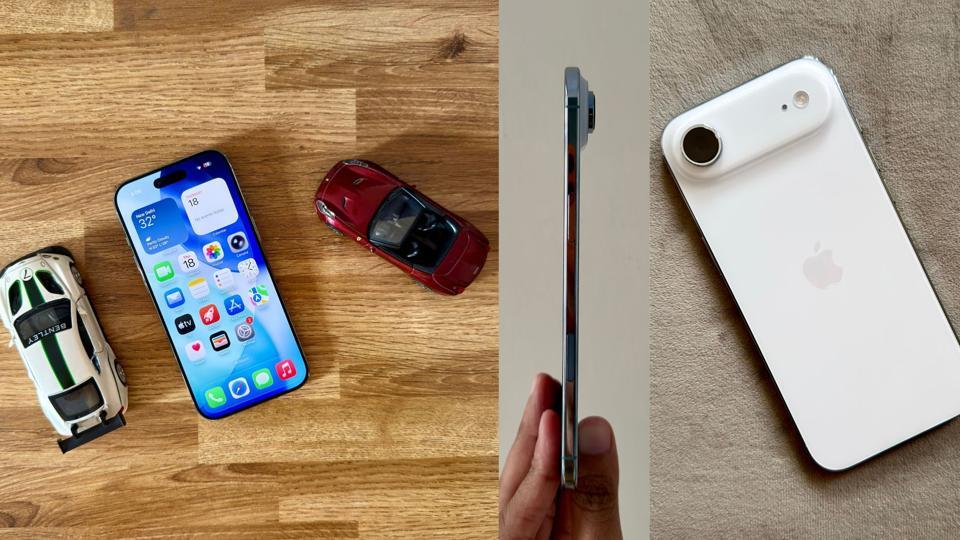
There is some tech wizardry, which Apple engineers must be credited for, considering how a 6.5-inch iPhone Air is holding up to the pressures of real world usage. For starters, visualise an entire phone worth of components essentially packed behind the camera bar as you see it on the back. The rest of it below, is all battery. To be able to fit everything including an A19 Pro chip, neural engine, image processing, the antennas and more, and even the cooling mechanism, in such small real estate and yet for the iPhone Air to not feel top heavy, is quite simply a work of art. Could this computing power architecture, in fact, be an early hint at new form factors? AI powered smart sunglasses, perhaps?
Wizardry of design
The design art aspect shines through as you pick up the iPhone Air, because it may be barely any thinner than the Galaxy S25 Edge and indeed some of the older iPhones (the iPhone X, for instance), but you’ll be surprised with how thin and light it feels. To hold, to pull out of the trouser pocket, or as it sits on your work desk. Those millimetres make all the difference, as does weight distribution and the materials used for the Air’s chassis. This is walking the path defined by the MacBook Air many years ago.
For a phone as slim as this, three potential concerns logically bubble to the surface — battery life, ability to hold performance, and camera capabilities. On all three fronts, the iPhone Air is much, much more capable than anticipated (of course, most folks set the bar low, because of how Android’s ultra-slim phones tend to be). Of course, there will be subjectivity to some of these.
Don’t hold your horses — they’ve already bolted
Let’s talk about performance first, and there is some shocking data to ponder over. I’m not the one to ponder much over benchmarks as an assessment of performance and comparison, but here, it is important to illustrate how the iPhone Air and the A19 Pro hold up against the competition. Not just the Galaxy S25 Edge, but also the flagship chips that define current generation Android phones. The difference between the A19 Pro in the iPhone Air and the A19 Pro in the iPhone 17 Pro series, is the former has a version with one less GPU, or graphics processing unit. The fact that the iPhone Air also doesn’t have the Pro iPhone’s vapour chamber cooling, makes these numbers even more impressive. At which point, important to note that the iPhone Air remains surprisingly cool as you get about with regular usage, only betraying some heating just above the Apple logo, when you may play a game for 15 minutes or use record 4K videos for longer than 5 minutes.
The GeekBench 6 benchmark, common across Android and iOS, tells us the single core and multi core chip performance levels. The iPhone Air delivers 3457 and 8612 scores. The Qualcomm Snapdragon 8 Elite, which is further optimised for Samsung, on the Galaxy S25 Ultra (I did not have the Galaxy S25 Edge anymore) returns scores of 1459 and 7177. Google’s latest flagship, the Pixel 10 Pro XL, returns with 2320 and 6094 on the scoresheet. The fact that an ultra-slim Apple iPhone Air is doing better than the latest Qualcomm chip in the priciest of Android flagships, throws conventionalism out of the window — super slim phones don’t need to throttle performance (and experience) to stay cool, hold performance and be excellent in general. Qualcomm would be very worried.
Outlasts the clock, and doubts
Battery life, despite being better than expected, may still not be enough for some use-cases. It is purely subjective. That is where it is important to know whether you’re better off buying an iPhone 17 Pro, an iPhone 17 Pro Max, or would the iPhone Air suit you just fine. Apple is using a high-density lithium-ion battery, a traditional composition, instead of silicon-carbon as some recent launches have leaned towards. Clearly they see better returns from this.
Alongside, the A19 Pro optimisations as well as iOS 26’s handling of efficiency (the new AI powered Adaptive Power mode) means the iPhone Air in my tests returned close to five hours and fifteen minutes of screen time. This, as a regular phone on a typical workday, which starts with wireless CarPlay streaming, and all that is usually syncing on our phones these days. This is in stark contrast to the Galaxy S25 Edge, wherein I had noted charge levels “would dip to a fairly uncomfortable level by around 3pm”. Yet, this isn’t going to be the iPhone for a typical user who may otherwise buy a Pro iPhone, for the battery stamina.
There is that additional peace of mind that Apple wants to sell you, an ultra-thin in its own right MagSafe battery pack (that’s an additional ₹11,900) that is meant specifically for the iPhone Air. Magnetically align this, and the thickness goes slightly beyond the camera bar bulge. That may just prove to be the insurance for those who may be a bit unsure about an iPhone Air on some days, if at all you’d wish to walk that path.
Camera plays it safe, when the phone doesn’t
Where a subjective limitation does come through, is with the camera system. There is a valid argument that a single camera system, no matter how good it may be, seems out of place on a ₹1,19,900 phone. Less so on a ₹59,900 iPhone 16e, where it feels less of a compromise. In reality, a lot of people may actually be fine with what Apple calls a 48-megapixel Fusion camera system doing the job, because they aren’t as finicky about things — a friend noted as much, once things had calmed down in the aftermath of the keynote, as we gazed out across his back yard. Yet, Apple has perhaps missed a trick by using the slightly smaller main sensor from the iPhone 17, instead of the slightly larger one that does duties in the latest iPhone 17 Pro.
The iPhone Air, instead of the 1/1.56-inch sensor may have been better served with the 1/1.28-inch sensor instead — in camera hardware terminology, a smaller denominator in the fraction indicates a larger physical size. The result is, there is greater reliance on the image processing pipeline, to optimise. An Apple executive confirmed to HT at the keynote, that all iPhones tend to have varying optimisations for image processing, depending on the hardware they’re working with. Two optical lengths are available, 26mm and 35mm (that’s at 24MP and 48MP), along with 2x telephoto (that’s 52mm, at 12MP) and 10x digital zoom.
The reality is, you can click some great photos with the iPhone Air, but this camera system is just not its strongest point, something you’ll realise in edge cases where it just doesn’t have the sort of versatility that an iPhone 17 would have, as well as the iPhone 17 Pro. That said, most users wouldn’t mind an ultra-wide being missing, because those scenarios tend to be lesser than standard shorts and getting close to a subject. At this time, there is some aggressive smoothening noticeable in some low light photos, and that often sees finer details smoothened away. Yet, good light ambiences can deliver some absolutely fantastic shots at 26mm, 35mm, 2x zoom and if you hold your hand stable enough, 10x zoom too.
iPhone Air wears slimness like a well-tailored suit
Time and again, the novelty of this ultra-slim design keeps getting refreshed (this is clearly a scenario where the initial novelty seems to hold for longer), be it picking it up, sliding it into the trouser pocket, or even a backpack pocket as you send that in for security check at an airport. I can’t comment on third-party accessories, but for Apple’s own MagSafe case designed specifically for the iPhone Air, you’ll barely notice any additional weight. Even the Bumper Case, albeit it adds a bit in terms of heft.
A long-term concern could be the wobble every time you place the iPhone Air on a flat surface, and then attempt to tap the screen. The camera touches the table surface first, followed by the bar, while the bottom of the phone is resting on the flat surface all this while. Put on the MagSafe case, and this problem gets solved. At this point, worth noting the 6.5-inch display is better suited for one-hand use without the thumb needing to do its version of gymnastics to reach the far ends of the interface.
Network connectivity is top notch (no one misses Qualcomm at all), with the C1X modem (this is an upgrade to the C1 we’d seen earlier this year on the iPhone 16e) supporting 5G (sub-6 GHz), and the Apple N1 chip adding support for Wi-Fi 7.
Is the iPhone Air a preview of Apple’s playbook?
The iPhone Air is an absolutely resounding statement from Apple, and since I’m looking at this closely, the fact that they’ve pretty much the entire iPhone’s components behind the camera bar, is an indication of the future. As is the ultra-slim design, which may just be half a showcase for the foldable that awaits us. Who knows, further refinements of the iPhone Air’s design in its next generation, could get us a dual camera setup too. For now, Apple has tackled the uncertainties that this sort of a form factor brings around battery life, sustained performance and battery stamina.
Apple needs the iPhone Air to click with buyers. In the past decade, a smaller screen size (the iPhone mini) as well as a larger screen size (iPhone Plus) product lines haven’t really worked. For different reasons, perhaps even pricing. They need this ultra-slim pivot to deliver. Otherwise, it doesn’t look good for a fifth option beyond the standard iPhone, the two Pro variants, and the affordable “e” spec. Anyone walking into a party with an iPhone Air, will certainly not need another conversation starter. At least for the next few months.