E-Paper



Apple iPhone 17 Pro Max review: A summit Android rivals will struggle to climb
A lot has changed visually with the iPhone 17 Pro, but its most radical upgrades, the A19 Pro chip and vapour cooling system, work silently out of sight.

 Prefer HTon Google


Calling the Apple iPhone 17 Pro Max — and its sibling, the iPhone 17 Pro — an “incremental upgrade” would be like calling lightning a gentle spark. These don’t merely succeed the iPhone 16 Pro series; they eclipse flagships of this generation with multi-faceted audacity. The Cosmic Orange finish alone signals that Apple is comfortable not being conservative with the more expensive iPhone models, embracing a chromatic boldness that mirrors greater technical ambitions. That colour is merely an opening act, followed by a redesigned camera plateau housing an updated sensor arsenal, while the A19 Pro chip doesn’t just warrant a mention in the same sentence as MacBooks — it leaves many an Android flagship rival questioning their relevance in performance benchmarks. Even what cynics might dismiss as “table stakes improvements” reveal their collective power under scrutiny.
Also Read:Apple iPhone Air review: A solid statement now, and slim enough to be the future
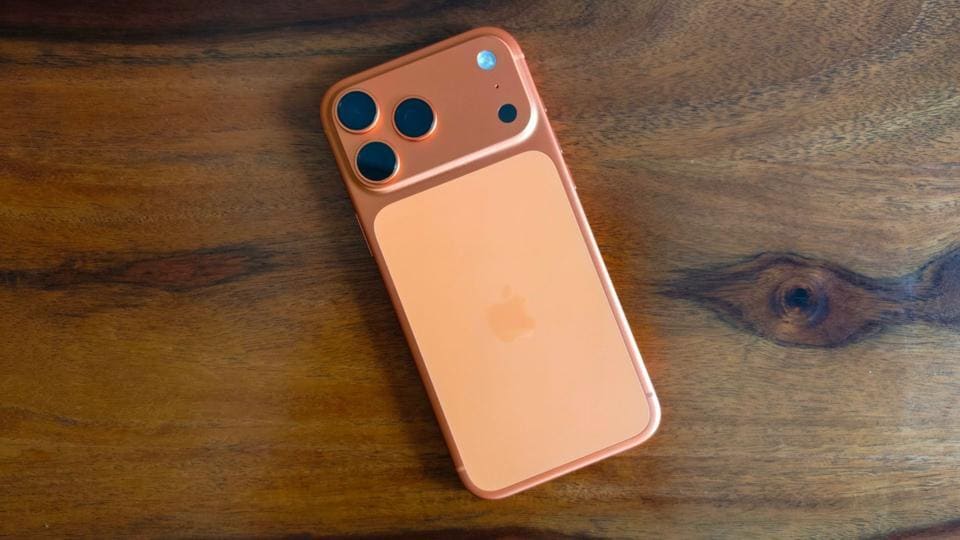
There is definitive battery endurance enhancement that pairs with superior thermal management, and a brighter than before display, none of which are minor refinements. Think of these as foundation stones of a fundamentally transformed user experience? Over the years, the iPhone Pro series has always been Apple’s showcase for top-tier capability, but the iPhone 17 Pro generation is appreciably less restrained. There is no black option with the Pros this time, and that says something. This isn’t evolution; it’s revolution wearing a somewhat familiar face. The only familiar element is the pricing, with the iPhone 17 Pro demanding you part with at least ₹134900 while the larger iPhone 17 Pro Max (which you see photographed above) sporting a sticker price of ₹149900 onwards.
Bright isn’t enough, the future blazes orange
Look closely at the design, and you’ll notice the antenna lines running around the new, wider camera plateau. This should, in theory, pay dividends in typically low signal zones. There’s a generational change in the primary metal used to build the chassis. The stainless steel era between 2017 and 2022 was succeeded amidst much fanfare by titanium for 2023 and 2024. Now, its over the aluminium, and two primary reasons for that — getting Cosmic Orange and Deep Blue as they have finally emerged was possible on aluminium than on titanium, and also, this material helps with passive heat dissipation better. The 6 gram weight difference compared with the iPhone 16 Pro can be attributed to a larger battery in play now, as well as the elaborate thermal management system (which we’ll get to, in a moment).
The full-width camera plateau visually grows on you. It is certainly a bold choice, rather than a gentle initiation over a couple of years, but it also opens up space for upgraded camera hardware. There’s a dual tonality to the back panel (a nice cue for the MagSafe capability), with a more prominent Ceramic Shield at the back to complement the metal, instead of glass. This is absolutely worth everything that Apple claims about robustness, having experienced the iPhone 17 Pro Max take a mighty tumble on the hard floor. That gets me to a very important point — the iPhone 17 Pro and iPhone 17 Pro Max take a couple of days to get the hang of in terms of the dimensions, bulk and grip, even if you are upgrading from the iPhone 16 Pro Max. Look closely, the edge curves seem a bit more pronounced, and that really helps with ergonomics.
Also Read:Retailers rush to collect iPhone 17 series and iPhone Air pre-orders
Hot, and the vapour chamber keeps it cool
On to the vapour chamber that figures in an iPhone for the first time, to keep things cool. I had the chance to see it in action, alongside a complete teardown of this system, and this puts the A19 Pro chip in a good position to hold performance for much longer with processor intensive tasks, than the previous two generation of chips could with titanium and no specific cooling architecture to contend with. This is key to the A19 Pro being able to show off its capabilities as often and as much as it wants to — and this is when we are talking about this chip doing better than the M-series chips in the MacBook, in certain AI compute scenario.
Mind you, there are still moments when you may notice some tepidness just between the plateau and the Apple logo, but in the same workload, the iPhone 16 Pro would feel considerably hotter still. If you are wondering about the performance, I have already illustrated what the one GPU lesser iteration of the A19 Pro is capable in the iPhone Air review, and leaving Qualcomm’s Snapdragon 8 Elite and Google’s latest Tensor silicon, quite some way behind. The A19 Pro in the iPhone 17 Pro and iPhone 17 Pro Max, with one GPU more, will score even higher still. In summary, you’re looking at the smartphone benchmark which Android’s chipmakers will now spend the next 12 months trying to catch up to.
Battery stamina becomes the personality
That’s had an incredibly positive spin on battery life as well, and I’ll particularly reference the iPhone 17 Pro Max which builds on already robust stamina of the iPhone 16 Pro Max. Mind you, this is the physical SIM version that I’m testing (the eSIM only versions get a higher capacity battery, making use of the space that opens up). After the first 4-5 days of settling down with a whole lot of syncing, a fully charged battery at 7:30am still had 50% charge remaining at 7:30pm. That is roughly 5 hours and 45 minutes of on-screen time, when used as a primary phone with your work and personal life syncing all through.
In the same usage, a Samsung Galaxy S25 Ultra runs this somewhat close, returning with around 40% battery for similar on-screen time. But the likes of the Google Pixel 10 Pro XL manage to do around 9 hours on-screen time in total for a charge cycle, when really careful.
Another instance of the iPhone 17 Pro Max’s battery robustness was illustrated when streaming the Formula 1 Azerbaijan Grand Prix for close to 2 hours and 40 minutes (whilst on roaming, with very inconsistent and exasperating 4G/5G connectivity) and the battery dipped from 99% to 91%. Of course your mileage may vary depending on usage, but the already high benchmark that the iPhone 16 Pro Max had set with battery runtimes, has been improved resoundingly.
Also Read:A19 Pro chip is why Apple aren’t kidding about iPhone 17 Pro and MacBook parity
As megapixels meet nuance, balance is right
Cameras are the primary reason why you’d probably buy an iPhone 17 Pro or an iPhone 17 Pro Max, over the standard iPhone 17. Not just that one extra camera to make a troika, but there are differences in sensors too. On the iPhone 17 Pro Max, there are now three 48-megapixel cameras, the one that stands out most is the 48-megapixel 4x optical zoom lens that also is at the core of the 8x cropped zoom using the centre pixels of what’s a larger sensor than before, to deliver much more detail too. You can shoot at 48-megapixels too, but for most users, the 24-megapixel photos put together using the data from 48-megapixel resolution do collect a lot of fine details. Optical image stabilisation, at the much more usable higher zoom levels, works its magic.
There is a new image processing pipeline at work, and the results are perceptibly better in more complex scenarios. Colours look better, there’s just the light contrast, and the iPhone 17 Pro Max is much more comfortable taking photos looking into a light source. What I realised the more time I spent using the iPhone 17 Pro Max camera is, the more I used the 4x and 8x zoom. Apple says the 8x is equivalent to a 200mm lens, and you’ll notice a viewfinder open up to guide you exactly where in the frame you may be pointing the camera.
Selfies are where Apple has delivered a rather innovative solution — change, as in expand the field of view, to take landscape selfies while holding the phone in portrait mode. I’d say that’s really helpful, considering this is a big phone (and I appreciate all the help I can get, considering I’m terrible at clicking selfies). Dual capture video is, while not a first (if memory serves me well, the Nokia 8 Sirocco had delivered this as far back as in 2017), but with content creation now almost the primary profession for the Gen Z, this may have been timed for relevance. The more ‘pro’ photographers would appreciate the ProRes RAW recording option, though you’ll need an external drive to save those.
Also Read:Apple launches iPhone lineup. Tim Cook says it’s unlike anything we created before
At this point, it must be noted that the Camera app with iOS 26 has received its most significant redesign in years. Not sure if everything is there to like about this evolution (could this be another chapter like Photos, which has been corrected this time around). For starters, you only see two modes — Photo and Video, and you need to tap and slide on these to unveil the likes of Portrait, Spatial, Pano, Cinematic etc. The menu icon has been redesigned to a tiny grid icon, one that’s easy to miss, and I feel a size increase may be on the cards in one of the future iOS 26 updates. This could just be the annoying period, called a learning curve, after years of being used to a particular way.
Apple Intelligence skips this semester
Through the iPhone 17 communication, Apple has barely mentioned Apple Intelligence. Two reasons for that. First, there is no significant new feature to announce, with the smarter Siri awaited. Secondly, Apple realises the AI hype is exactly that, a hype. For The CEO of T-Mobile to say that they’ve recorded the biggest weekend ever in terms of Apple iPhone sales (this on September 22) tells us the buyers also couldn’t care less about the AI hype when deciding on a new phone. But this doesn’t mean Apple Intelligence won’t make big strides in the next year, because my expectation is, a few big things are lined up.
It won’t be easy to climb this summit
This is one of the simpler conclusions for the iPhone ‘Pro’ line-up, after many years. Irrespective of which generation you already use, the iPhone 17 Pro and iPhone 17 Pro Max represent a significant upgrade, across the board — particularly raw performance. Undeniably the most powerful smartphone, with the iPhone 17 Pro Max also proving to be the most frugal amongst all Android flagships as competition (better battery life means you’ll this lesser and wear out the battery slower), significantly better cameras and not just in terms of megapixels, as well as a design that has as much happening in the innards as you can see outside. It doesn’t get much better than this. Particularly in orange. This isn’t the top of the mountain, this is the entire mountain that the likes of Android phone makers as well as Qualcomm and MediaTek will have to try and reach the summit.