E-Paper



Baffling Tata Play Smart, Vi prepaid family & gauging Mijia Smart Air Purifier 6
Beyond the regular noise, a closer look at personal technology. 22 October 2026.

 Prefer HTon Google


Opening thoughts. A few days ago, there was some excitement about a Vi prepaid family plan. This is essentially the first of its kind in India, but it’s a concept familiar to postpaid users who have increasingly bundled multiple connections into a family plan to save some money. That was my expectation when I heard about the Vi prepaid family plan. Alas, as you understand most things, this becomes more an exercise in wondering what really was the need for this prepaid collective? I’ll explain why.

Three key elements define the Vi prepaid family plan proposition, which can hold up to four members.
- First, a member of a prepaid family plan can share data with another member of that group. But this is limited to 500 MB of available data at a time through the Vi App, once a day, up to twice a week and a maximum of four times in a calendar month. The transferred data is valid only for that particular date. While this would be handy to get a UPI payment through if a user is running low on data, I’m not entirely sure how far 500MB gets in this era.
- Vi says that each member of a prepaid family will be able to get discounts of up to 10% on every recharge. I am not sure how that is quantified—is it on the price of the recharge pack, the duration or some other metric? Vi hasn’t said, and I don’t have the humans required to create a prepaid family pack.
- Vi also says prepaid family users will get ‘exclusive benefits’, but that also remains unquantified regarding the specifics of what these would be.
Basically, this is an attempt by Vi to add stickiness and loyalty to the prepaid connection proposition (loyalty is usually more associated with postpaid users). It may well work out for them if the recharge discounts aspect is well implemented—those discounts will go a long way in adding a proposition of value, and keeping users on the network. What this needs is a lot more. Curated recharge packages that offer better pricing or bundled inclusions would be a start. And logically, how about a prepaid recharge plan that incudes up to four users within the same fold, with the overall data and calling minutes pool shared between them? That will simplify pricing, and convenience.
Previously, on Wired Wisdom: Microsoft’s Edge tactics, assessing Samsung Galaxy S26 FE, XECH and Siri AI
EDITOR’S MARGIN: TATA PLAY SMART AND AN IPTV QUESTION
I don’t like to encounter otherwise easily avoided complications. Subscriptions, particularly. I’m pretty certain you’d have similar views too. A few days ago, direct-to-home (DTH) company Tata Play launched its Tata Play Smart service which streams Live TV channels on smart TVs via their app (so far, Live TV channels were only on the Tata Play mobile app), without needing a DTH connection or a set-top box (STB). The idea is appreciated because, while they’re technically not terming this as IPTV (or internet protocol television), it’s routed the same way via any broadband connection without restrictions.
Tata Play needed this diversification, and the logic is understandable. User preferences are changing to on-demand viewing rather than just linear TV broadcasts, and secondly, viewing across a variety of devices instead of just on a TV via an STB. Though that conventional proposition still remains very relevant for many users, that volume is reducing. The TRAI Pay TV data indicates this trend. DTH had 48.56 million subscribers in India in June this year, down from 49.05 million in March, and a significant reduction from 56.07 million in June last year. Tata Play is the leading DTH player in terms of active subscriber base, followed by Bharti Telemedia.
But I want to point out a few things about the implementation. And from the outset, it is important to note that for now, there is no clear guideline that Tata Play or any IPTV platform must charge separately for streaming Live TV channels to a smart TV. This seems like a revenue stream, and no revenue stream shall be left untapped.
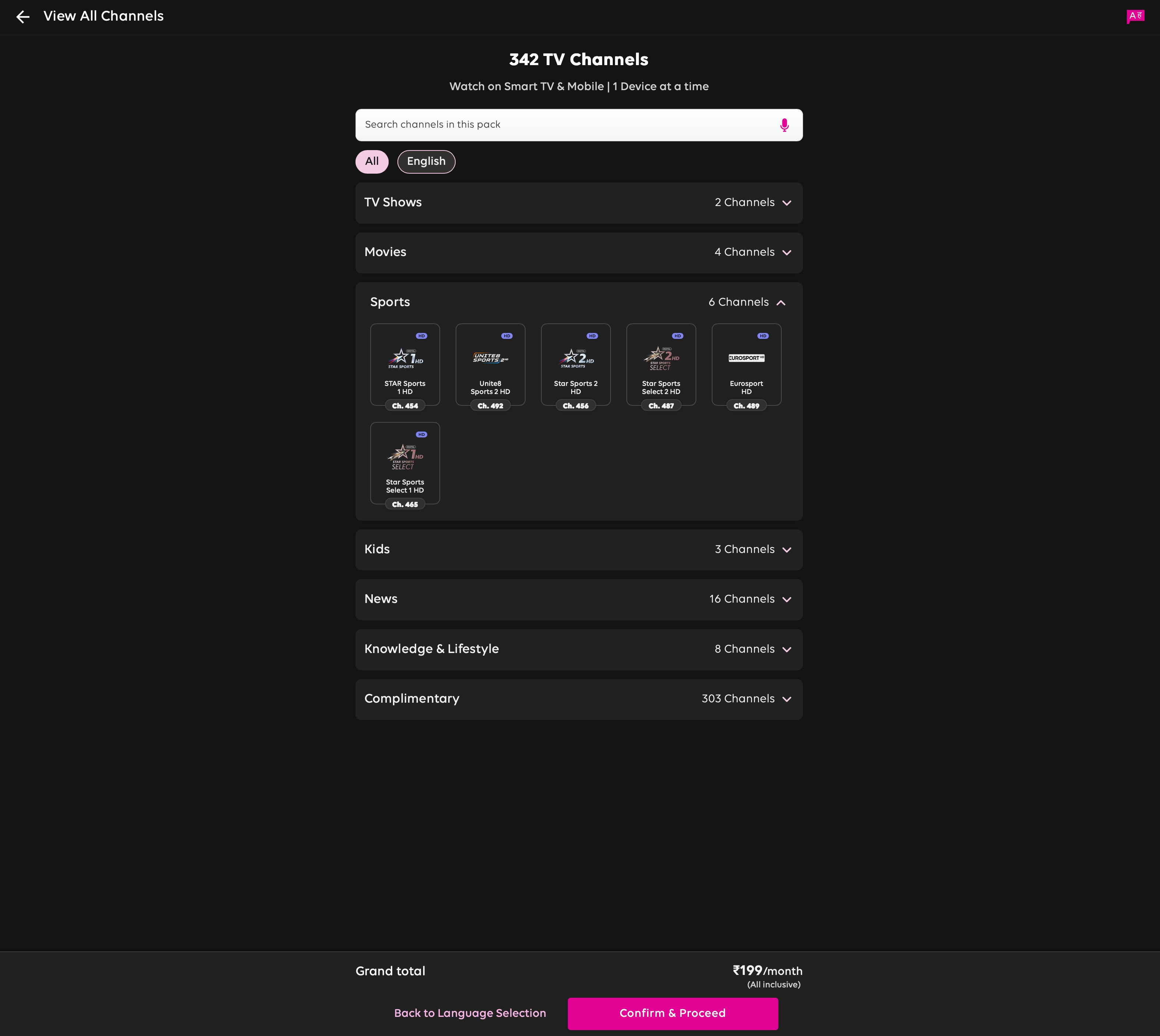
There are two distinct ways of looking at this—as an existing Tata Play DTH subscriber, and as a new subscriber simply signing up for Tata Play Smart streaming. I sit in the former (and have been a Tata Play subscriber ever since 2006; they were called Tata Sky then), and despite existing relationships, using Tata Play Smart for streaming Live TV channels on a smart TV such as a Google TV-based smart TV requires an additional subscription starting at ₹199 per month for a single-language set of channels, and ₹99 per month additionally for every language set you add. These channels are available to stream without this subscription on the mobile app. That is incredibly confusing for most customers, and unnecessary friction in the overall experience.
If you aren’t a Tata Play DTH subscriber, you’ll need the subscription to even view Live TV channels on the mobile app.
And to that point, Tata Play says the service streams more than 500 Live TV channels. Great number to have and a lot of potential. But here’s the reality. None of Sony’s sports channels are listed (Sony and Tata Play’s issues aren’t new, but do consumers really care about the tussle?) and that is a big miss. For instance, key upcoming cricket including India’s tour of New Zealand, as well as the UEFA Champions League football, are on the Sony Sports channels. In the English movies and entertainment section, well-known channels including Star Movies and Star Movies Select, Sony Pix, and Colors Infinity are missing. These are just some examples.
Potentially, Tata Play Smart could have been the answer to a seamless Live TV platform without requiring a DTH connection. For now, it isn’t exactly there. It could be, if developed carefully. I cannot comment on streaming quality or stability because, as a Tata Play HD+ user, I refuse (maybe it’s just me) to be arm-twisted into paying additionally for a service which subscribers should get irrespective of.
The answer actually could come from an app that has surprised me in recent weeks. It is called VZY, and it has OTT plans (including 23 OTTs such as JioHotstar, Zee 5, Sony Liv and more), standalone Live TV plans with more than 200 channels (for ₹179 per month), and a bundle of both depending on how a subscriber wants to configure the subscription tenure. This has the full gamut of sports channels, including some Sony Sports ones (complications galore, like I said). Some movie and entertainment channels are missing here too.
What this market really needs is a complete Live TV streaming app—an affordable subscription, that works across devices and broadband networks and doesn’t have any complication between TV and mobile apps. It’s been tried before by JioTV+ and JioTV but they only work on a Jio network. And Airtel’s Xstream IPTV service has DTH-like subscription package structures, which are comparatively more costly.
The latest, on Neural Dispatch: Sonos and Plaud define AI utility, Adobe’s report, and Microsoft sells a solution
TECH SPOTLIGHT: XIAOMI’S MIJIA AIR PURIFIER
I’ve said it time and again. Get ready, because the pollution season is upon us. Indoor air purifier purchases are best done in advance because once the AQI deteriorates rapidly, you’ll find the good ones out of stock more often than not. Xiaomi’s smart move ahead of the winter is to try something new, with elements that have previously worked well for them. The arrival of their Mijia smart home brand is marked by a familiar product, the Mijia Smart Air Purifier 6 (alongside an intriguing Mijia Smart Air Purifier 4 Compact).
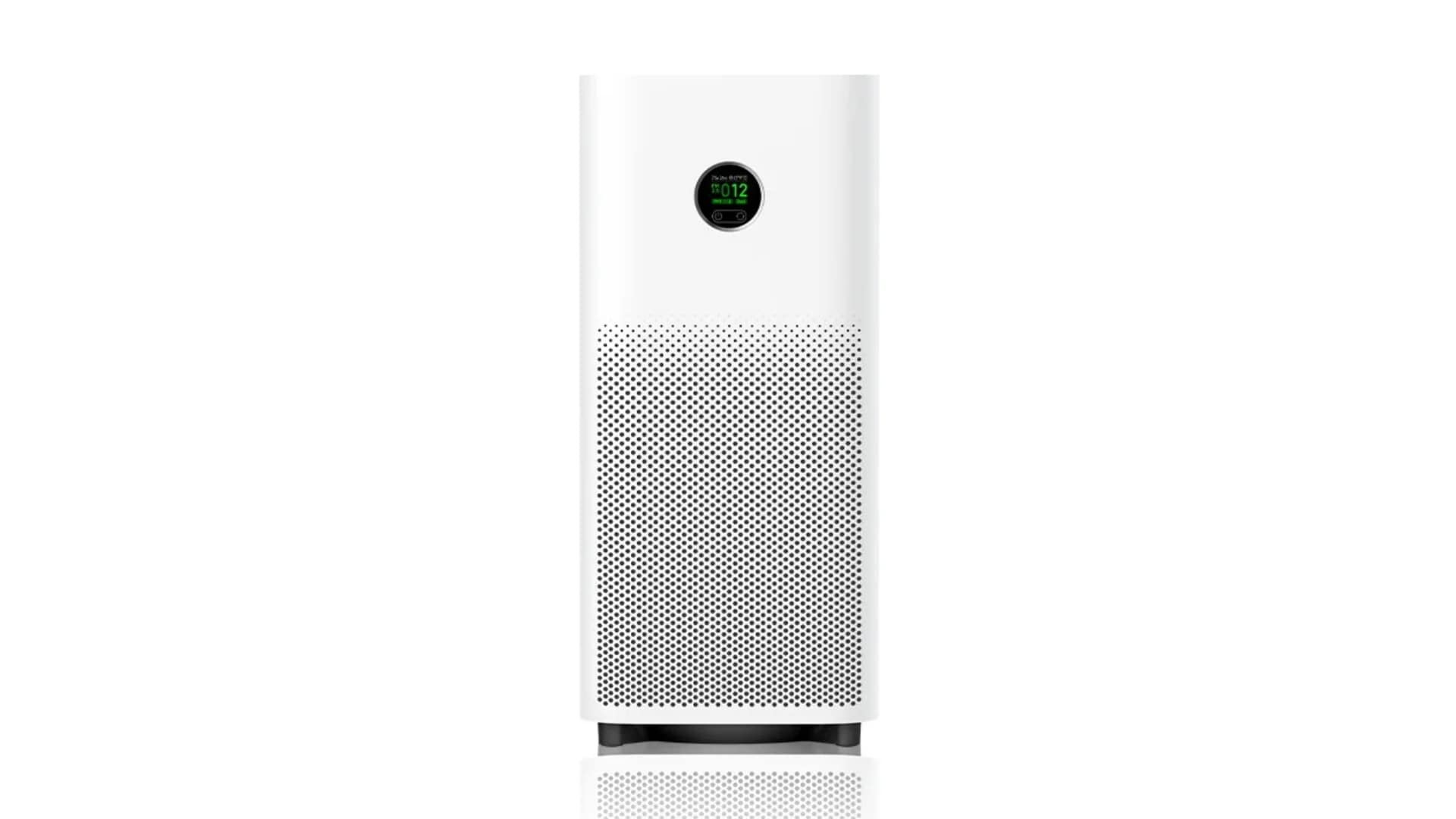
The Mijia Smart Air Purifier 6 is priced at ₹17,999 which if I’m not mistaken, makes this the most expensive air purifier in Xiaomi’s recent lineup. The replacement filter, which you will need a few months down the line, costs ₹3,499. This is the logical successor to the Smart Air Purifier 4 which itself has been a very reliable performer over the years. The key upgrade is the ‘Pentaclean’ technology. It works with monitoring, with the new 5-sensor AQI monitoring collecting data for PM1 particles (this is rare in purifiers), PM2.5 particles, dust, temperature and humidity. It is also dictating the filtration process, which now has a primary filter for larger particles, a Xiaomi High-Efficiency Filter, UV-C sterilisation, negative ionisation and activated carbon.
I had the chance to test this as the AQI began to significantly deteriorate in the NCR, which gave us a good barometer of how the new filter packaging in particular is a step forward from something that was already so good. In the same bedroom where the Smart Air Purifier 4 was, the Mijia Smart Air Purifier 6 held the AQI at a slightly lower (read, better quality) reading through the day and night. And it does so while staying quite silent at fan speed 1 as well as in sleep mode. You will notice the fan at higher speeds, but those moments may be necessary to quickly clean indoor air after a spurt of outdoor pollution enters.
The UV-C module, which is still rare in home air purifiers, is an effective way of countering airborne viruses that inevitably wriggle between even the densest of filters. The Mijia Smart Air Purifier 6 maintains an overall AQI around 15 with all metrics (PM 2.5, PM1 and Dust) on the LCD display in green. It brought the indoor AQI from around 230 to 50 in about 7 minutes in auto mode. And if you are someone who likes to maintain things as they are supposed to be, the detachable top cover makes it much simpler to clean the duct and fan blade every once in a while.