
 E-Paper



Google Has the Muscle to Overpower Spending Worries
AI investment and delays are concerns, but the company’s core businesses look strong.


 Prefer HTon Google


Google-parent Alphabet has been on a tear the past year. There are plenty of reasons to believe its stock still has room to run, despite worries about its AI spending.
Last summer, the company was mired in antitrust scrutiny and facing questions about its dominance in search ads. The threat that OpenAI’s ChatGPT could take away search traffic and erode its more than 90% market share seemed real. Google hadn’t established itself as a force in AI. Some analysts even suggested the company would be more highly valued if it were broken up.
A year later, the company’s antitrust troubles are mostly behind it. The search threat turned out to be overstated. Alphabet’s moves to protect a franchise that supplies more than half of its revenue have worked. The cherry on top: It has gone from AI laggard to vying for a leadership role.
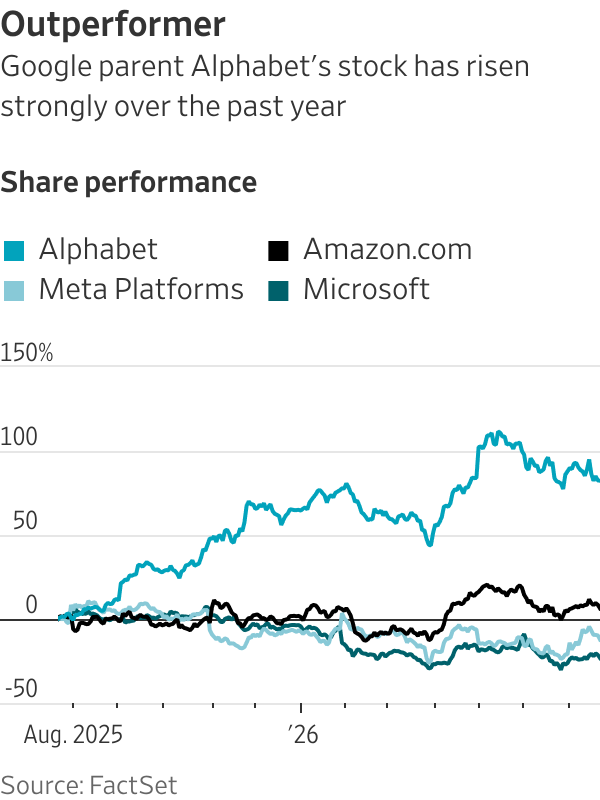
Alphabet’s stock has soared more than 80% in the past year, enough to make it the world’s third most valuable public company behind Nvidia and Apple. That has also pushed its price to about 25 times forward earnings—a relatively rich valuation, to be sure. But it is hardly stratospheric considering the company’s growth prospects.
Those were apparent in Alphabet’s quarterly earnings Wednesday. They included a 24% revenue rise and surging sales in its cloud-computing unit.
There are still challenges, of course. Markets fretted Wednesday after Alphabet raised guidance for capital spending this year by $15 billion to around $200 billion and suggested a bigger amount was on tap for next year. Analysts expect $257 billion of capital spending in 2027, according to FactSet—more than Amazon, Meta or Microsoft.
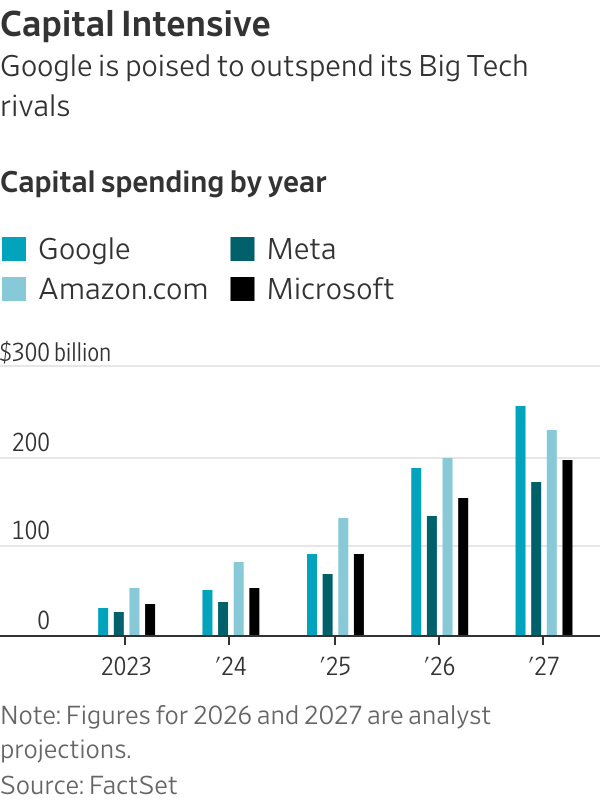
That would nearly turn Alphabet free cash flow negative, if consensus estimates are correct. But it also means it likely won’t be the first company to blink on AI spending. That ought to help it stay technologically competitive—especially if rivals are forced to put on the brakes.
Alphabet also has fallen a bit behind in the race to make the most advanced, most capable AI models. Its state-of-the-art Gemini 3.5 Pro model has been delayed for weeks after the company initially said it would be available in June.
Delays are bad news in the AI world. Those who fall behind often struggle to catch up, because competitors aren’t standing still. Meta Platforms recently learned this lesson.
But delays aren’t likely to hit Alphabet as hard. Unlike Meta, it has a large base of corporate AI customers that won’t jump ship because of a brief delay.
And corporate customers are flocking to Alphabet, not fleeing. The company’s Gemini Enterprise—a cloud-based AI service for companies—had 40% quarter-over-quarter growth in paid active users in the first quarter, Chief Executive Sundar Pichai said earlier this year.
The delay doesn’t help Alphabet’s ambition to provide state-of-the-art AI-coding tools—the area where its AI strategy is most lacking. But there are many parts of the company’s business where having a world-leading model isn’t critical.
The company recently has focused on releasing more efficient models. These should help AI tools like its Gemini chatbot generate quicker responses and conserve computing resources.
That is a shrewd move when competition for computing power to feed AI is fierce both inside the company and among customers. At this stage, generating responses quickly might also matter as much as a super-advanced AI model in attracting and retaining users.
Other aspects of Alphabet’s business look healthy.
Advertising spending is resilient, and the AI overviews Google has added to its search engine are boosting traffic. Analysts at BMO Capital Markets expect revenue from Google’s search business to generate double-digit quarterly growth for at least the rest of the year. Search revenue rose 17% in the second quarter, the company said Wednesday.
Perhaps even more promising, the company is vaulting forward in cloud computing. Alphabet said Wednesday that cloud revenue grew 82% to $24.8 billion, and pointed to a backlog worth $514 billion, driven by customers including Apple, Meta and Anthropic.
Google is also starting to sell its custom AI chips, called TPUs, to customers for use in their own data centers. The company expects this to add substantially to revenue starting next year.
That all suggests Alphabet is positioned to gain cloud market share as long as AI-driven demand doesn’t wane. Amazon, the leading cloud-computing player, reported $37.6 billion in revenue in the first quarter, growing just 28%. Microsoft’s cloud business, the industry’s second biggest, grew at a 40% pace in its latest reported quarter.
Alphabet is capturing that growth, moreover, without breaking the bank. After raising around $60 billion from bond sales this year and nearly $85 billion in equity in June, the company had $242 billion of cash and marketable securities on its balance sheet as of the second quarter. While AI-linked bonds haven’t performed well lately amid concern about the large supply of them, Google should have more room than its rivals to keep up spending.
Alphabet’s stock trails the Nasdaq Composite Index this year and has fallen in recent sessions amid news of its AI delays. Bubbling but likely transient worries about cheaper Chinese AI models haven’t helped, either.
Even if its stock has momentarily lost a step, Alphabet’s growth prospects have hardly dimmed.
Write to Asa Fitch at asa.fitch@wsj.com


