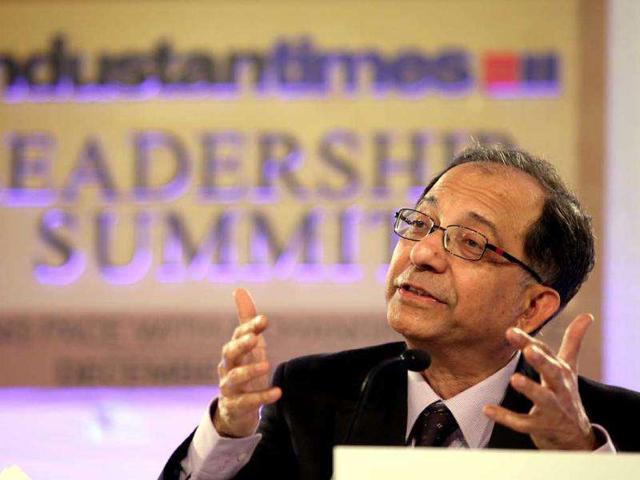
There has been a slowdown, but India is the second-fastest growing country in the BRICS cluster and the third-fastest in G20. The "good news" about India is that poverty is declining, says Kaushik Basu, the outgoing chief economic advisor, to Gautam Chikermane in Part 1 of an interview.
Gautam Chikermane: The world's biggest story is that the world's second-fastest growing economy, India, is already the third-fastest. What has gone wrong?
Kaushik Basu: One legitimate way to view your question is that while there has been a slowdown, rank-wise India has, nevertheless, remained roughly where it was. If you look at growth in quarterly terms, the fall is from roughly 10% to 5%, which is steep and alarming. If you looked at this in monthly terms, the fluctuation would be even greater. But the right way to look at growth is to take longer run averages, such as annual growth. This has gone down from 8.4% to 6.5% in recent times, which is disappointing but not alarming. What is important to stress is that in relative terms we are roughly in same place. India is the second-fastest in the BRICS cluster, third-fastest in G20. So, rank-wise, India remains much the same.
I agree we could have done better if we had managed to push through a couple of reforms, but policy is not made in a political vacuum. Also, we do injustice to ourselves if we don't recognise that the global slowdown is impacting all nations and India cannot be an exception. Brazil was a vibrant, buoyant economy. Last quarter, when India's growth is down to 5.3% which we are lamenting, Brazil is down to 0.7%. So, globally, our ranking remains pretty much the same. India's fundamentals are robust. With a couple of strategic policy moves, we can position ourselves so that, once the global economy revives, we are able to race ahead.
Gautam Chikermane: Everyone is talking about the impact of global slowdown on India in abstract terms. Can you quantify its contribution?
Kaushik Basu: Of the three contributors to the slowdown, two domestic and one global, the global is by far the most dominant. Our growth rate last year, even if we had got our domestic policies right, would have been, I guess, no more than 0.3 or 0.4 percentage points higher than what we achieved. The entire world is slowing down and we can't go totally against the grain.
Gautam Chikermane: That's it? Just 0.4 percentage points?
Kaushik Basu: Let me clarify that these numbers are not formal estimates based on econometric modeling, but something to give you a rough sense of magnitudes. With that in mind, an additional 0.4 percentage point growth in one year is not negligible; so I am not discounting the domestic factors.
Gautam Chikermane: What are the two domestic factors for the slowdown?
Kaushik Basu: The first is demand contraction that we deliberately implemented in order to control inflation. The second is the slowdown in reforms which we non-deliberately achieved.
Gautam Chikermane: The government is blaming everyone but itself for the slowdown. But it took all the credit for higher growth rates.
Kaushik Basu: It's human that when good things happen we take the responsibility and when it is not so good, we look harder to locate external causes. But there is some validity in our analysis. The current slowdown is caused in large measure by the Eurozone crisis. It is arguable that every country in the world, with the possible exception of North Korea, is being adversely impacted by the global slowdown.
Gautam Chikermane: Was it because of greater global liquidity?
Kaushik Basu: Yes, but there is something else. Ever since the reforms of the early 1990s, there has a shift in the thinking of the Indian people. Our analysis and thought have become more sophisticated and this is facilitating better policymaking and, in turn, higher growth. We must never discount the power of collective beliefs and collective thinking.
Gautam Chikermane: Like multipliers of earlier reforms that began in NDA times? Like roads?
Kaushik Basu: There were small reforms from early 1980s and you can almost see growth picking up in step. In 1980s, our growth was 5.2%. We had broken out of the trap of 3.5%. It gathered steam and in 1994, it jumped further to 7%. Each round of reform brings fresh capital that can have long-run benefits lasting decades. The other unwitting contributors to growth were India's emphasis on higher education --- engineering, sciences, finance, technology --- which for a long time meant that we were creating unemployed youngsters. Suddenly, when the global demand fell into place, starting with Silicon Valley, India was perfectly positioned to take advantage of this. So, we can take credit for creating the human capital, but have to thank global changes for the creation of demand for that capital. And now there is enough endogenous demand as well.
Gautam Chikermane: Do you agree with the assertion that global speculative capital has been looking for new packages of exotic investments and the coinage of BRICS or the India-China growth story was mere packaging?
Kaushik Basu: Packaging unfortunately matters, from cricket to international investment directions. If you think of the BRICS cluster, it's not a natural cluster in any sense. The countries belong to different regions and have very different strengths. It's not like we are all oil producing countries or have any other common linkages.
Gautam Chikermane: It was a statistical creation…
Kaushik Basu: …it was an arbitrary creation. But, having made the creation, it has come to gain traction as a group. Even global investors think in terms of whether or not to put money in BRICS. It has become a category of global thought. We are now even thinking of a possible BRICS-led development bank.
Gautam Chikermane: How do you view Indonesia replacing India in BRICS? It is definitely ahead in terms of per capita income, a strong measure.
Kaushik Basu: Per capita income is not quite the right view. If you go by that, then India should not be in any of these groupings. After all, in per capita terms, we are still a poor country. We are the poorest in G20, poorest in BRICS cluster. When you think of these groupings you are also thinking of a nation's global presence, its intellectual prowess, and India's importance on these counts are not in any dispute. Indonesia is doing very well, especially over the last three to four years. Indonesia is one of the finest-performing countries, according to the comparative rating index, CRIS, that we prepare at the Ministry of Finance.
But if you look at global importance and if you look at the last 15-20 years stretch, India has done consistently well. India being in BRICS is just right. And India and Indonesia being in G20 cluster, despite India being poor in terms of per capita income, is also right.
I can tell you from my own experience with G20, India gets the kind of importance that is completely on par with the industrialised countries. So, in G20 we have a voice, which is surprising given our per capita income. Part of this, of course, is to do with the fact that we are a talkative nation. We contribute through our verbosity. But it goes beyond that.
Gautam Chikermane: Growth has to mean a decent per capita income. You may say you are a $2 trillion economy but it means nothing as long as we have 850 million people living on less than $2 a day. Do you think we are headed towards becoming a middle income country and if so, by when?
Kaushik Basu: I completely agree, the income earned by individuals is fundamental. And even more than that, the per capita income of the bottom segment of population is what we should focus on while crafting policy. So, just the average per capita income rising in the country, which is happening in India and very rapidly, that in itself is good but not good enough. We must learn to evaluate a nation in terms of how its poorest segment fares. At least for me that is the fundamental focus of policymaking.
Gautam Chikermane: How do you do that?
Kaushik Basu: In one of my academic works, I developed the notion of judging the country by its bottom quintile. In India, while per capital income is rising very fast, there are large tracts of poor people. But the good news is that poverty is declining. The two distribution variables that we look at are inequality and poverty. In India inequality is rising but poverty is falling. All statistics show that the conditions of the poor are improving. But the top end income is increasing so much more rapidly that inequality is rising. I wish there were less inequality in India and the world.
Gautam Chikermane: So, how do you devise the right policies under such extreme circumstance?
Kaushik Basu: It is easy to make policy blunders, whereby you end up helping no one. For instance, some people argue that we should massively tax the corporate sector and divert that money to the poor. Trying to do this in today's world will mean that you will soon see the best companies and skilled human beings leaving the country and then there would be no wealth being generated to be diverted to the poor. And the poor will lose out. So diverting money and resources to the poor, I believe, should be our target, but trying to do that foolishly will mean that you will drive out the rich and hurt the poor.
Gautam Chikermane: And countries across the world are competing for that capital and skill.
Kaushik Basu: Right. In today's globalised world there are severe limits to what a single country can do. Here is another example that illustrates this well. Take the 30 years of Communist rule in West Bengal. In terms of the broad intention of trying to reach out to the poor and benefit them, they were right. But they made a big mistake. They didn't realise that it's a fairly globalised world and even within India capital can move from one region to another. Try to take draconian moves to help the poor, you will end up hurting them because capital and industry will move out. This was the fatal flaw that the Bengal government made.
Gautam Chikermane: Singur, for example?
Kaushik Basu: Yes, Singur is a classic example of capital moving, in this case within India.
Gautam Chikermane: So, what do we need to do to get growth back in the short term?
Kaushik Basu:In the short term we need a couple of bold reforms which may not be the deepest of reforms but which will energise the country and encourage private players to begin to invest.
Gautam Chikermane: Like FDI in retail?
Kaushik Basu: FDI in retail is just one instrument to modernise the retail sector. India's retail sector is primitive and has vast scope for expansion. You will not only improve the sector in terms of what consumers or farmers are getting but also activate the real estate sector, open up export channels, through which our products will go out to the world. This can have a big effect and is something that's doable.
Gautam Chikermane: Any other short term measures?
Kaushik Basu: The Land Acquisition Bill is another reform which would create scope for industries to expand. You don't have to do very much, just three or four things over the next six months and you will reenergise the sentiment. In the medium term, there are deeper changes that are called for. India still has a slow-moving administration and bureaucratic costs are extremely high. We know this from cross-country studies done by World Bank. We are one of the worst performers in the world. This cannot corrected overnight. But I feel this should be in the frontline of our medium-term plans.
Gautam Chikermane: It was a statistical creation…
Kaushik Basu: …it was an arbitrary creation. But, having made the creation, it has come to gain traction as a group. Even global investors think in terms of whether or not to put money in BRICS. It has become a category of global thought. We are now even thinking of a possible BRICS-led development bank.
Gautam Chikermane: How do you view Indonesia replacing India in BRICS? It is definitely ahead in terms of per capita income, a strong measure.
Kaushik Basu: Per capita income is not quite the right view. If you go by that, then India should not be in any of these groupings. After all, in per capita terms, we are still a poor country. We are the poorest in G20, poorest in BRICS cluster. When you think of these groupings you are also thinking of a nation's global presence, its intellectual prowess, and India's importance on these counts are not in any dispute. Indonesia is doing very well, especially over the last three to four years. Indonesia is one of the finest-performing countries, according to the comparative rating index, CRIS, that we prepare at the Ministry of Finance.
But if you look at global importance and if you look at the last 15-20 years stretch, India has done consistently well. India being in BRICS is just right. And India and Indonesia being in G20 cluster, despite India being poor in terms of per capita income, is also right.
I can tell you from my own experience with G20, India gets the kind of importance that is completely on par with the industrialised countries. So, in G20 we have a voice, which is surprising given our per capita income. Part of this, of course, is to do with the fact that we are a talkative nation. We contribute through our verbosity. But it goes beyond that.
Gautam Chikermane: Growth has to mean a decent per capita income. You may say you are a $2 trillion economy but it means nothing as long as we have 850 million people living on less than $2 a day. Do you think we are headed towards becoming a middle income country and if so, by when?
Kaushik Basu: I completely agree, the income earned by individuals is fundamental. And even more than that, the per capita income of the bottom segment of population is what we should focus on while crafting policy. So, just the average per capita income rising in the country, which is happening in India and very rapidly, that in itself is good but not good enough. We must learn to evaluate a nation in terms of how its poorest segment fares. At least for me that is the fundamental focus of policymaking.
Gautam Chikermane: How do you do that?
Kaushik Basu: In one of my academic works, I developed the notion of judging the country by its bottom quintile. In India, while per capital income is rising very fast, there are large tracts of poor people. But the good news is that poverty is declining. The two distribution variables that we look at are inequality and poverty. In India inequality is rising but poverty is falling. All statistics show that the conditions of the poor are improving. But the top end income is increasing so much more rapidly that inequality is rising. I wish there were less inequality in India and the world.
Gautam Chikermane: So, how do you devise the right policies under such extreme circumstance?
Kaushik Basu: It is easy to make policy blunders, whereby you end up helping no one. For instance, some people argue that we should massively tax the corporate sector and divert that money to the poor. Trying to do this in today's world will mean that you will soon see the best companies and skilled human beings leaving the country and then there would be no wealth being generated to be diverted to the poor. And the poor will lose out. So diverting money and resources to the poor, I believe, should be our target, but trying to do that foolishly will mean that you will drive out the rich and hurt the poor.
Gautam Chikermane: And countries across the world are competing for that capital and skill.
Kaushik Basu: Right. In today's globalised world there are severe limits to what a single country can do. Here is another example that illustrates this well. Take the 30 years of Communist rule in West Bengal. In terms of the broad intention of trying to reach out to the poor and benefit them, they were right. But they made a big mistake. They didn't realise that it's a fairly globalised world and even within India capital can move from one region to another. Try to take draconian moves to help the poor, you will end up hurting them because capital and industry will move out. This was the fatal flaw that the Bengal government made.
Gautam Chikermane: Singur, for example?
Kaushik Basu: Yes, Singur is a classic example of capital moving, in this case within India.
Gautam Chikermane: So, what do we need to do to get growth back in the short term?
Kaushik Basu:In the short term we need a couple of bold reforms which may not be the deepest of reforms but which will energise the country and encourage private players to begin to invest.
Gautam Chikermane: Like FDI in retail?
Kaushik Basu: FDI in retail is just one instrument to modernise the retail sector. India's retail sector is primitive and has vast scope for expansion. You will not only improve the sector in terms of what consumers or farmers are getting but also activate the real estate sector, open up export channels, through which our products will go out to the world. This can have a big effect and is something that's doable.
Gautam Chikermane: Any other short term measures?
Kaushik Basu: The Land Acquisition Bill is another reform which would create scope for industries to expand. You don't have to do very much, just three or four things over the next six months and you will reenergise the sentiment. In the medium term, there are deeper changes that are called for. India still has a slow-moving administration and bureaucratic costs are extremely high. We know this from cross-country studies done by World Bank. We are one of the worst performers in the world. This cannot corrected overnight. But I feel this should be in the frontline of our medium-term plans.