There’s a slight difference between love and like. Love does not need logic, but it’s hard to like someone for no reason. Nek Chand probably did not like Chandigarh. The brutalist buildings, the manicured roads and roundabouts, the alienation inherent in houses that looked alike, the bureaucratic system that went by the book, and an imposed modernity that insisted on a break from the past. Nek Chand wanted life in this ‘pattharan da shehar’, this city of stones.
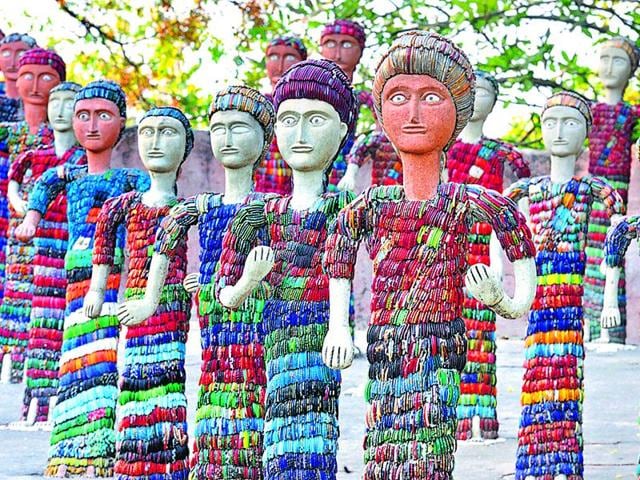
With that assumption, if one looks at his creation Rock Garden, it seems only appropriate that he made life out of stones, using construction and household waste for his artistic brilliance. The road inspector who died a legend turned large, gray rocks into rural men walking with a trademark long stick, who look like they’re conducting a ‘theekri pehra’, a night vigil, in the village. From broken bangles and teacups and saucers, he created women who carried every colour on the palette in their clothes. There were many other characters in his ‘kingdom’, but hardly any drawn from the kind of life that Chandigarh was built for. Rock Garden was a rural fantasy built in an urban utopia. It was closer to how we actually were, and still are to a larger degree.
It’s only appropriate, therefore, that when it comes to picking the most popular feature of Chandigarh now, the geometry-obsessed philosophy of Le Corbusier is relegated to the background. It has to make way for the folk characters, mysterious curves, and enchanting waterfalls made by this Partition-hit Punjabi from Shakargarh tehsil. But Nek Chand was not alone. His work was just the first manifestation of a repressed ethos.
{{/usCountry}}It’s only appropriate, therefore, that when it comes to picking the most popular feature of Chandigarh now, the geometry-obsessed philosophy of Le Corbusier is relegated to the background. It has to make way for the folk characters, mysterious curves, and enchanting waterfalls made by this Partition-hit Punjabi from Shakargarh tehsil. But Nek Chand was not alone. His work was just the first manifestation of a repressed ethos.
{{/usCountry}}Increasingly, houses in Chandigarh have started to gain their own character, subtracting the alienation, and adding elements that define the modern urban India of today, not the imagined city that Corbusier had made. City Beautiful was the imported trophy in an India that had not yet defined what is was to be modern. It is now the living, breathing city that defines its own modernity.
That does not mean perfection of any kind. A relatively large population means traffic snarls, power cuts and water shortages have arrived. No longer do you have the luxury of driving at 30km an hour by choice. No longer do the roads go quiet as the sun sets. Malls are killing Sector 17. Discotheques are big business. No longer do the houses all look alike. Gloomy is no longer the only adjective that comes to mind when you’re driving on the city’s streets.
But an expansionist tendency — shown by Nek Chand himself and also by his many admirers — may lead to an ironical situation at the Rock Garden. How much bigger does this wonderland have to be before people get tired of it, literally and figuratively? Won’t it then be as imposing as Corbusier’s giant structures? It is already spread over 25 acres and looking like it is stuck in a time warp. The structured placement of the sculptures — perhaps a hangover of the Corbusier style that even Nek Chand could not avoid — does not help matters. It needs imaginative display and proper upkeep of the existing features; and a size that does not make it seem like an endless extension of sameness. It’s defined by its spirit, not size and scale.