...
...
Next Story

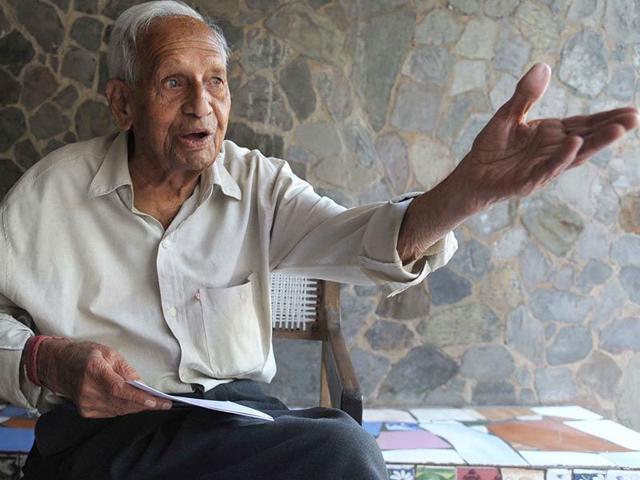
Nek Chand -- 1924-2015: He gave Chandigarh its spirit

Le Corbusier designed the city’s modern structure, but it was Nek Chand who defined the spirit of Chandigarh. In essence, the remodelling of discarded material into figures from Indian culture — women carrying earthen pots, farmers with sticks, village belles in colourful attire — defined the rebuilding of an India, specifically Punjab, that was geographically ravaged by Partition, yet robust culturally.
Updated on: Jun 13, 2015 09:38 AM IST
Hindustan Times | By , Chandigarh
Prefer HTon Google
Advertisement

Le Corbusier designed the city’s modern structure, but it was Nek Chand who defined the spirit of Chandigarh. In essence, the remodelling of discarded material into figures from Indian culture — women carrying earthen pots, farmers with sticks, village belles in colourful attire — defined the rebuilding of an India, specifically Punjab, that was geographically ravaged by Partition, yet robust culturally.

Nek-Chand-Rock-Garden-creator

Nek Chand Saini, born in the Shakargarh region of what is now Pakistan on December 15, 1924, was a sufferer of the trauma of 1947, but had found some solace in a job as road inspector with the public works department of Punjab by 1951. But it was an apparent longing for a vibrant life in the sharp-angled and exposed-concrete architecture of Chandigarh that eventually manifested itself in Rock Garden.

Also Read:

Nek Chand, creator of Chandigarh's Rock Garden, dies at 90

By the early ’60s he had cleared a forest patch near Sukhna Lake to create a set of statues in a garden. It grew to several acres with hundreds of sculptures. With labourers who worked with him on roads, he worked at night for nearly two decades to create it in a state-owned forest.

But when it was discovered in 1975, there was a threat of demolition. Thankfully, the public rallied behind him, and he instead got glory, salary and a staff of 50 to work on the project full time. He remained lifetime chairman of the society that manages the garden. He was awarded the Padma Shri in 1984. Now 25 acres are dotted with sculptures in winding courtyards; there are buildings and a series of interlinking waterfalls.

Expansion is planned, though held up.

Legendary athlete Milkha Singh puts it succinctly, “We shared the wounds of Partition, sitting together over long tea sessions, discussing our past from the ‘other side’. It was Nek Chand who made Chandigarh a lively place, else people used to not want to live in this city, which had scary forests and impersonal buildings.”

Chand died 11 minutes past midnight on Friday, at the age of 90, and on Saturday his body would be taken to Rock Garden from his house in Sector 27, from the same route that he used to take on his bicycle to build the wonderland, piece by piece, one idea at a time.

 
ABOUT THE AUTHOR
Aarish Chhabra

Aarish Chhabra is an Associate Editor with the Hindustan Times online team, writing news reports and explanatory articles, besides overseeing coverage for the website. His career spans nearly two decades across India's most respected newsrooms in print, digital, and broadcast. He has reported, written, and edited across formats — from breaking news and live election coverage, to analytical long-reads and cultural commentary — building a body of work that reflects both editorial rigour and a deep curiosity about the society he writes for. Aarish studied English literature, sociology and history, besides journalism, at Panjab University, Chandigarh, and started his career in that city, eventually moving to Delhi. He is also the author of ‘The Big Small Town: How Life Looks from Chandigarh’, a collection of critical essays originally serialised as a weekly column in the Hindustan Times, examining the culture and politics of a city that is far more than its famous architecture — and, in doing so, holding up a mirror to modern India. In stints at the BBC, The Indian Express, NDTV, and Jagran New Media, he worked across formats and languages; mainly English, also Hindi and Punjabi. He was part of the crack team for the BBC Explainer project replicated across the world by the broadcaster. At Jagran, he developed editorial guides and trained journalists on integrity and content quality. He has also worked at the intersection of journalism and education. At the Indian School of Business (ISB), Hyderabad, he developed a website that simplified academic research in management. At Bennett University's Times School of Media in Noida, he taught students the craft of digital journalism: from newsgathering and writing, to social media strategy and video storytelling. Having moved from a small town to a bigger town to a mega city for education and work, his intellectual passions lie at the intersection of society, politics, and popular culture — a perspective that informs both his writing and his view of the world. When not working, he is constantly reading long-form journalism or watching brainrot content, sometimes both at the same time.

SHARE THIS ARTICLE ON
Hindustantimes wants to start sending you push notifications. Click allow to subscribe