Sunita, a 28-year-old patient from Pathankot undergoing treatment at the Post Graduate Institute of Medical Education and Research, was told in May this year to wait till August 27 to get her ovarian cysts removed. Finally, as she prepared herself for the surgery in the morning, she was told it could not be performed.
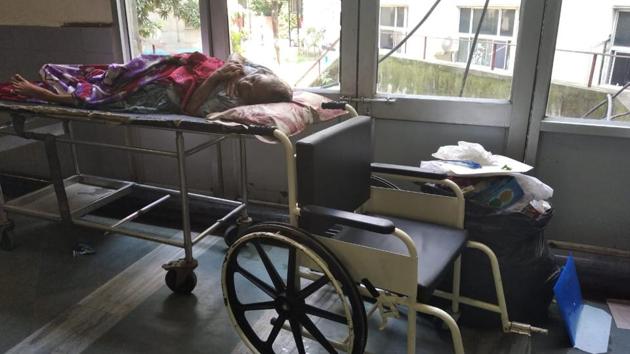
Reason: With around 3,000 workers associated with the PGI Safai Karamchari Contract Workers Union continuing their strike for the second day, there was no one to sanitise operation theatres (OTs) in between surgeries.
On 18 tables in the main OT of the institute, around 150 surgeries are conducted every day.
Early in the morning, PGIMER director Dr Jagat Ram ordered that all elective surgeries stand cancelled for the day.
“Surgeries had to be curtailed keeping in view the shortage of manpower. Without the services of hospital attendants and sanitation attendants, surgeries in the main OT could not be performed,” said the director. However, operations in the emergency and advanced eye care centre were conducted as usual, he said.
Technicians posted in the OTs said elective surgeries were conducted on Monday even as the contract workers had gone on strike. However, regular sanitation workers, who got overburdened due to the protest, did not clean the OTs properly. The PGIMER has outsourced 1,095 sanitation assistants and 969 hospital attendants while 354 sanitation assistants and 344 sanitary attendants work on regular basis.
A doctor, who was on duty, said as there is the possibility of patients getting infected due to unsanitary conditions, it was better to shut the OTs.
{{/usCountry}}A doctor, who was on duty, said as there is the possibility of patients getting infected due to unsanitary conditions, it was better to shut the OTs.
{{/usCountry}}Meanwhile, solid waste management was also hit on the campus.
A ground check revealed there was delay in emptying garbage bins located at outpatient departments, hospital wards and even in the emergency. An official posted in the sanitation department of the hospital said sweeping of floors and removal of garbage was delayed throughout the day.
Meanwhile Sunita has no idea when her surgery will be performed.
“Nobody in this institute is listening to us. Shouldn’t they at least give us a new date for surgery?” her relative questioned.
HC intervenes, contract staff to resume work
Chandigarh The Punjab and Haryana high court on Tuesday restrained PGIMER employees from going on strike. The contract workers will resume duties on August 28.
The high court also directed the UT director general of police and senior superintendent of police to ensure that striking workers do not interfere with the working of other staff.
With this order, the PGI Safai Karamchari Contract Workers Union, which has been on strike for two days, has also been restrained from observing another planned strike from September 6 to 8. The union is protesting for the implementation of “equal pay for equal work” and regularisation of services.
The HC was hearing a public interest litigation (PIL) filed by a Panchkula resident, Vijay Bansal, who had sought directions to the agitating employees to not go on strike. It was argued that it was illegal and against the provisions of the East Punjab Essential Services (Maintenance) Act, 1947.
PGIMER counsel Amit Jhanji told court that on Tuesday all major and minor surgeries were to be postponed on account of the ongoing strike. “This is a very serious matter as it directly affects the public health and the closure of the emergency services of the institute/hospital may result into a major tragedy,” the court was told, adding that the employees were not only protesting, but also stopping the other willing workers in performing their duties.
Reacting to the HC order, a union leader, not willing to be named, said the same court had given instructions to provide us equal pay and now it has denied us the right to seek its implementation.
Sripal, an office-bearer of the union, said: “In 2010, the then deputy chief labour commissioner had directed the PGIMER administration to implement equal pay for equal work in four categories — hospital attendants/ housekeeping workers, sanitation attendants/workers, security guards and bearers/masalchi. However, the administration has failed to implement it.”