The monsoons are ebbing and a historic project on bird migration is poised to take off this month. Two Pied cuckoos, tagged with satellite transmitters of 2g each and named Megh and Chatak, are expected to commence migration to Africa. Scientists are expecting to get their first definitive information on the paths they take. Associated deeply with Indian cultures and classical Sanskrit poetry as the harbinger of monsoons, the cuckoo flies into north India ahead of the monsoons to lay eggs in the nests of other birds, especially babblers. But a setback has got scientists worried as one of the tagged cuckoos, Megh, is not sending data. That means either a technical malfunction or the tag dropping off.
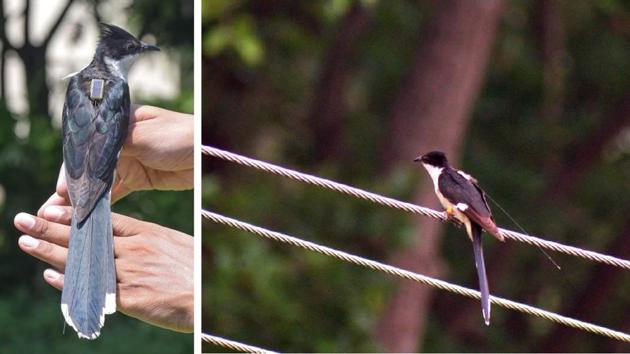
The cuckoo research project is part of the Indian Bioresource Network (IBIN) project of the Indian Institute of Remote Sensing (IIRS) in collaboration with the Wildlife Institute of India (WII), Dehradun. The IBIN project is funded by the Department of Biotechnology (DBT). This research comes in the wake of conclusive findings by international and Indian scientists of the migration paths of the Amur falcon and Common cuckoo to Africa, after travelling through India, by tracking these species through satellite tags.
Commenting on the Megh setback, Dr R Suresh Kumar of the WII told this writer: “That is something to worry about. It cannot be fixed unless I retrieve (the tag) and send it back to the company. The cuckoos don’t respond to call playback so have not been able to locate them. I have one person looking for them but he is observing three others and one is Chatak. Megh comes from a different area and he is unable to see it there. A Covid outbreak in the WII campus has constrained my movements in the field to trace Megh.”
Dr Kumar is hoping the project will provide a clear perspective to speculation that cuckoos could be going in for an elliptical migration, ie, choosing different paths to come to north India from Africa and while returning to Africa. Or, could it be that a section of cuckoos do not return to Africa and stay put in south India after flying down there from north India in September-October? Finding Megh soon will be crucial to determining the truth about a wondrous bird that has engaged the Indian imagination since centuries like few avians have.
{{/usCountry}}Dr Kumar is hoping the project will provide a clear perspective to speculation that cuckoos could be going in for an elliptical migration, ie, choosing different paths to come to north India from Africa and while returning to Africa. Or, could it be that a section of cuckoos do not return to Africa and stay put in south India after flying down there from north India in September-October? Finding Megh soon will be crucial to determining the truth about a wondrous bird that has engaged the Indian imagination since centuries like few avians have.
{{/usCountry}}SERPENTS OF PARADISE LOST
A startling manifestation of climate change is evident in the erstwhile paradise of India. Ever since epic floods swept Srinagar in 2014, snakes have surfaced in urban areas and these include the highly-venomous Levantine vipers, known in Kashmir as the ‘Gunas’. To meet the challenge of frantic calls from Srinagar residents, a courageous lady wildlife conservationist, Aaliya Mir, has rescued 110 snakes of six different species since 2014. As project head, Jammu & Kashmir, of the NGO, Wildlife SOS, Mir’s work has also shed light on the serpents of this blighted vale, which had escaped the detailed scrutiny of herpetologists due to their obscure habits and remote locations.
The serpent-human face-offs got highlighted because they surfaced in the most posh avenue and venue of Sringar. Four vipers were spotted and rescued at former chief minister Omar Abdullah’s residence on the fabled Gupkar Road, one last year and three this year. Abdullah, who has declared he will vacate his residence as he finds himself in unauthorised occupation due to entitlement changes brought about by the state’s reorganisation last year, was quite tense about the intruders. “Omar Abdullah was tense and wanted us to find a solution so that vipers never come into his residence again. But I told him that since your residence is located in the Dachigam foothills, which is the viper’s main habitat, the snakes will venture down and it cannot be avoided. His residence’s large, landscaped garden has plenty of hedges and shrubs, in which vipers can hide easily,” Mir told this writer.
At the end of Gupkar road stands an iconic hotel, the Lalit Grand Palace, that truly symbolises the grandeur of Kashmir’s tourist, golf and Bollywood legacy. Before the gun turned Kashmir into a living hell, the hotel was known as the Oberoi Palace and the favoured haunt of legendary actors. An exclusive mini-golf course for hotel guests landscaped with apple and Chinar trees adjoined the main premises.
Zeenat Aman in her heydays would breeze through the hotel’s lobby leaving onlookers gasping while the villain actor, Ranjit, in black dress and black cowboy hat, would be found sipping chilled beer at the outdoor bar in the shadows of stately Chinar trees amid open-hand-sized Kashmir roses. Not to forget dashing Dharm paaji accompanied by his customary retinue, the suave Feroz Khan and his gorgeous sister, Dilshad, married into a Kashmir family and sporting waterfall tresses of almond hair.
Their presence made the hotel a favourite buzz point for tourists wanting to gawk and giggle at filmstars in real life. Well, those memories haunt the hotel like leaves lost in Autumn’s fires and which summer shall not return, but snakes have taken up some of the vacated space. Mir has rescued a sun bingeing viper and two Himalayan Trinket snakes from the hotel’s postcard-perfect grand lawns that overlook the Dal lake’s grieving silence and empty shikaras.
vjswild1@gmail.com