
 E-Paper



Financial stress behind cow slaughter bill’s review: Cong
The Karnataka government's decision to review the anti-cow slaughter law has sparked a political row. While the BJP has warned of protests if the bill is revoked, the Congress has cited economic factors to reconsider the legislation. The finance department has said that the estimated cost of feeding the cattle in the state for four years would be around INR3,512.32 crores ($477m), while the prevention of cow slaughter would bring down beef production by 27,250 tonnes and require a subsidy of INR519 crores for sheep/goat units. Legal experts have also raised concerns about the broad powers granted to the police.

 Prefer HTon Google


The recent statement by chief minister Siddaramaiah on the government’s intention to review the anti-cow slaughter law during the upcoming cabinet meeting has triggered a political slugfest within the state. The Bharatiya Janata Party (BJP) has vehemently warned of taking to the streets if the bill is revoked, while the Congress party has emphasized that the decision to review the bill is driven not only by political considerations but also by economic factors.
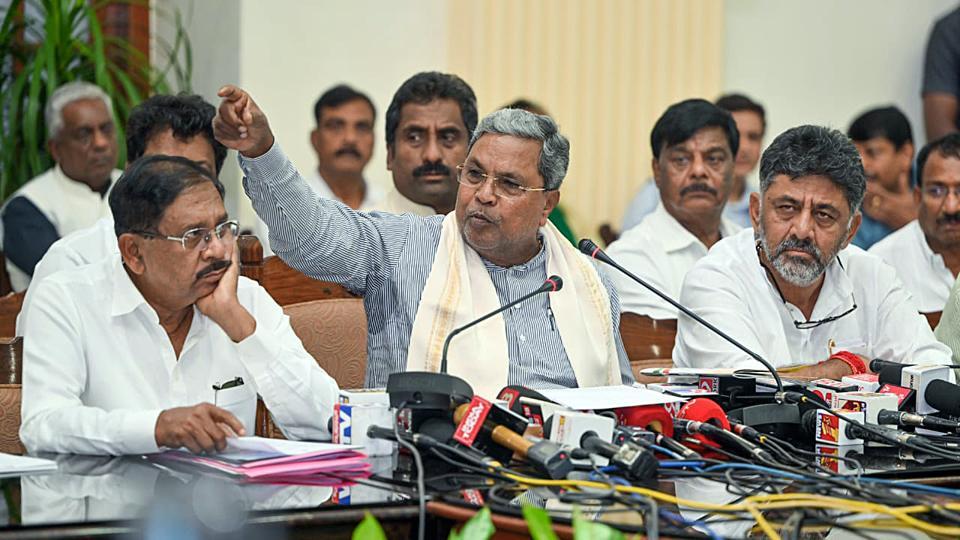
Elaborating on the reasons for the Congress government’s decision to review the controversial law, cabinet minister Priyank Kharge said the party is firm against regressive policies implemented by the BJP government.
“Any regressive policy that will impact the state’s economic growth and take the state backwards socially will be reviewed and repealed if necessary. Specifically talking about the cow slaughter bill, neither the farmer nor the industry is happy with the policy. While this was an agenda allegedly pushed by the RSS, there are enough economic factors that call for a review,” he said.
In February 2021, the Karnataka Prevention of Slaughter and Preservation of Cattle Bill, 2020, was passed amid chaotic scenes in the House. The bill became controversial as it aimed to ban cow slaughter and impose strict penalties for related offences. It also aimed to protect buffaloes and their calves. In 2010, the BJP government passed a similar bill, but it was withdrawn by the Congress government in 2013. However, the BJP reintroduced and passed the bill in 2020.
Kharge said that in a cabinet note (which the HT has seen) the finance department said that government should reconsider the anti-cow slaughter bill due to the financial implications.
The note dated December 5, 2020, read: “The decision may be reconsidered in view of the huge financial implications. We cannot agree (sic) (to) this kind of expenditure when we are struggling to meet both end meet. Next two years we expect a contraction in budget size and hence the decision of the cabinet may be kept on hold by reconsidering the matter.”
The notes further added that the estimated cost of feeding the cattle in the state for four years would be around ₹3,512.32 crores. Apart from the cost of fodder, 1,208 is required to build gow shalas (cattle care centres) since the farmers are not allowed to give their sick or unproductive cattle for slaughter.
The finance department in the note further added that the prevention of cow slaughter would bring down the production of beef by 27,250 tonnes and to compensate for that subsidy would have been to be provided to sheep/goat units, which would account for ₹519 crores.
“First of all, I don’t know from where they got the figure of ₹70 as the cost of feeding the animals, it could be as high as ₹200 per cattle. Secondly, the total cost of the amended cow slaughter bill is around ₹5,240 crores. This is big a financial burden,” he added.
About the political stand of the party, Kharge said the anti-cow slaughter bill, claiming that it was drafted solely to appease the “BJP’s higher-ups in Nagpur”, however, this legislation has failed to satisfy the concerns of farmers and the industry alike.
“We are looking at the economic growth of Karnataka. Farmers, traders, and MSMEs are not happy. We have got a huge mandate against this ideology. We have got a huge mandate to keep Karnataka on the path of progress. Being a part of the government, is it not my priority to keep every child in school? If a certain policy is regressive and is keeping my children out of school, will I keep it or repeal it?” he said.
The Congress, having secured 135 out of 244 seats in Karnataka, had promised in its manifesto to take strong action against organizations such as Bajrang Dal that foster enmity and hatred among different communities.
The bill also has legal issues that have been questioned by experts. The controversial Bill includes provisions for strict punishments, such as imprisonment ranging from 3 to 7 years and hefty fines ranging from ₹50,000 to ₹5 lakh, for individuals found guilty of slaughtering, smuggling, or illegally transporting cattle. The offense is cognizable, allowing for arrest without a warrant, and abetment carries the same penalty.
“Just to put the penalties in context, Section 304A provides for death caused due to rash negligence as 2 years and this is for human beings, whereas the sale of cattle has a minimum punishment of 3 years. And it is in this context that we really need to understand that the penalty has been so dramatically increased,” said Mythree Krishnan, a Bengaluru-based lawyer and activist.
Experts have also raised concerns about the broad powers granted to the police to conduct raids and seize property based on mere “suspicion.”
Karkala MLA V Sunil Kumar said that BJP will hold protests if the Congress government makes any attempt to withdraw the Karnataka Prevention of Cow Slaughter and Preservation of Cattle Act. “The BJP had formulated a law to prevent cow slaughter after holding a series of consultations with the people. The Congress had raised objections even when the BJP passed it,” he said.
He said that the Congress neither loves cows nor the nation. “Whatever ethos that are followed by people, the Congress opposes it. The Congress leaders and Ministers have been repeatedly stating that the government will withdraw the act and revise textbooks. These clearly indicate the aim of the Congress government,” he said.


