E-Paper



4 years of Haryana CM Khattar’s second innings: Fighting ally’s demons with Teflon image
Running a minority government, formed courtesy a post-poll alliance with Dushyant Chautala’s Jannayak Janta Party (JJP), posed to be challenging for the RSS ideologue-turned-chief minister.

 Prefer HTon Google


When Manohar Lal Khattar took oath for a second time on October 27, 2019 to start his back-to-back innings as Haryana’s chief minister, little did he know that in less than five months, an alien virus would disrupt the plans of the coalition government he helmed.
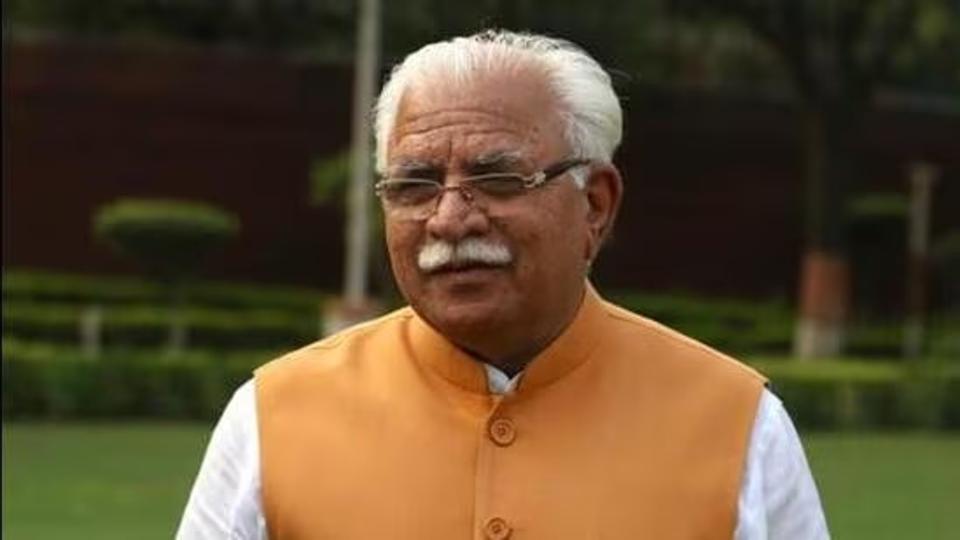
Tackling the outbreak of the pandemic, including dealing with loss of lives and dearth of medical infrastructure during the 2021 spread of highly contagious Delta variant of coronavirus apart, running a minority government, formed courtesy a post-poll alliance with Dushyant Chautala’s Jannayak Janta Party (JJP), posed a different challenge to the RSS ideologue-turned-chief minister.
As far as the public health challenge was concerned, the BJP led government did well on the vaccination front –inoculating 100% of its adult population with the first coronavirus vaccine dose and about 90% of its above 15 population with the second dose. The other challenge of running a coalition was marred by a rather uneasy relationship between the allies.
Also read: Khattar highlights anti-graft measures, economic growth
The first sign of an uneasy alliance became evident when Khattar at the behest of his home minister, Anil Vij ordered an enquiry into unauthorised movement of liquor stocks during the 2020 pandemic lockdown. The inquiry team headed by an IAS officer looked into the functioning of the excise and taxation department, a portfolio under the control of deputy chief minister, Dushyant Chautala. The inquiry brought out glaring deficiencies in the functioning of excise department and indicated collusion of officials in smuggling and illegal sale of liquor during the lockdown but was refuted by Dushyant. The findings are under investigation by the anti-corruption bureau (ACB).
Digital transformation and bridging the urban-rural divide
Khattar’s four years of the second term would be best remembered as a period where reforms were initiated as the government tried to bring in digital transformation of the government operations and delivery of services, thus, limiting human interaction with an aim to reduce corruption. The Parivar Pehchan Patra (PPP) or the family identity card is one such initiative where by assigning a unique family identifier, the state government has tried to enable transparent, simplified and efficient delivery of services including financials.
The PPP which due to various imponderables and data collection glitches have come under criticism from public and the opposition aims to make delivery of schemes, services, subsidies, benefits direct, paperless and faceless to beneficiaries through technology-based determination of eligibility based on the authenticated data. Digital initiatives like ‘meri fasal mera byora (MFMB) and e-Kharid to facilitate online and direct payment to farmers and commission agents with an eye on wooing the peasantry also had its share of snags, and so has been property ID initiative.
Leader of Opposition, Bhupinder Singh Hooda, has often mocked the present dispensation as a government of non-functional portals and vowed to get rid of digital initiatives like PPP. “What is the BJP-JJP government celebrating? They should rather apologise to the people for wasting nine years of Haryana. They consider family ID, property ID and meri fasal mera byora as its achievements, but these have become genesis of corruption and trouble for public. Even BJP and JJP MLAs publicly accept this fact,” Hooda said.
“Many of the digital initiatives are original being put into use for the first time. There are a lot of imponderables which cannot be predicted. So, at times there are difficulties which we address and improve the system,” said a top official.
A party MLA said that a large section of BJP workers, MLAs and MPs do not favour digital transformation as it reduces their own prospects of making political recommendation and intervention. “Imagine they can’t even get an employee transferred now because it is all online now,” said a BJP leader.
State BJP president Om Prakash Dhankar said there is always resistance and opposition to change. “The fact is that those who are opposed to these digital initiatives for political reasons also know their usefulness,” he said.
Dhankar, who as a cabinet minister, was part of Khattar 1.0 says though the BJP-led government’s second stint has many accomplishments, some big ones included introduction of Comprehensive Health Insurance of Antyodaya Units (CHIRAYU) - Ayushman Bharat where families having annual income of ₹1.80 lakh or less would get an annual medical cover of ₹5 lakh. Officials said that 56 lakh health cards under CHIRAYU have been issued.
“Initiatives such as Bhavantar Bharpai crop damage compensation given to farmers have ensured that the risks associated with farming no longer exists. Putting a minimum educational qualification for panchayat representatives is a landmark achievement,” the state BJP chief said.
“CM’s flagship programme, the PPP which uses systematic and scientific data for a focused intervention will help the ruling dispensation politically also during the elections,’’ said an official posted in the heartland district.
Another official said that the anti-corruption campaign launched by the chief minister through his trusted band of IPS officers is more of an exercise to send a message that resonates with masses.
“Many officials booked by the ACB might actually get off the hook. But the message – that corrupt will be taken to task- would get through,’’ an IPS officer said.
Political scientist from Panjab University, Chandigarh, Prof Ashutosh Kumar said Khattar’s biggest achievement probably is bringing in fairness and transparency in the recruitments.
“He has also shattered the impression that the politics, economy and society in Haryana are overwhelmingly dominated by a specific caste. The role of a particular community and class in determining policies and jobs is no longer there. But simultaneously, he has not altogether ignored the Jats, the dominant community. He has also tried to maintain a delicate balance between the urban and rural constituents by trying to keep the farming community happy. So, he has tried to dispel the notion that his is an urban-constituent oriented government,” he said.
Law and order, cow vigilantes remain his Achilles heel
Prof Kumar said where Khattar disappointed is his inability to act as a firm and astute administrator particularly during law and order crisis.
“He was a complete failure on law and order in his first outing, the 2016 Jat agitation a glaring testimony to it. The recent communal conflict in Muslim dominated Nuh reeked of partisanship. Worse, allowing the violence to spill over to adjoining Gurugram where a mosque was vandalised and a cleric killed is a blemish on his administrative skills,’’ he said.
Former chief minister, Bhupinder Singh Hooda said whether it was the rise of cow vigilantes or spiralling crime graph, it seemed free for all. “There is no law and order under this regime,’’ Hooda said.
While the chief minister has been able to maintain a teflon image, the same cannot be said about his party’s coalition partner. Calls for severing ties with the JJP had started gaining momentum with the BJP ranks. A number of senior party leaders, MLAs and MPs have expressed their reservations and concerns over Dushyant’s ‘style of functioning’ and its direct effect on BJPs electoral prospects.
Former union minister, Birender Singh who joined the BJP in 2014 says the sooner the BJP says goodbye to Dushyant’s outfit, the better it would be for it. “People in Haryana are much annoyed with the JJP and not with the BJP. Dushyant Chautala’s style of working raises questions and reeks of corrupt practices. Many irregularities in the portfolios held by him have come to our notice,’’ Singh said. The veteran leader said by holding on to all the portfolios allocated to him, Dushyant showed his greed.
“On one hand, the JJP leadership says we will contest all 10 Lok Sabha seats and seek a mandate for winning a simple majority in the 2024 assembly polls, but simultaneously it wants to carry on with the alliance. The BJP needs to seriously think about the future of the alliance. If it continues any longer, it will prove detrimental to party’s interests,” he said.
Khattar in true BJP style has been at the forefront of organising events to disseminate his government’s accomplishments as he enters the poll year. He has also tried to reach out to the masses in person besides the virtual mode through Jan Samvad though it may be a tad too late in the day.