Today, we are talking about floods in Punjab. Tomorrow, it could be drought.
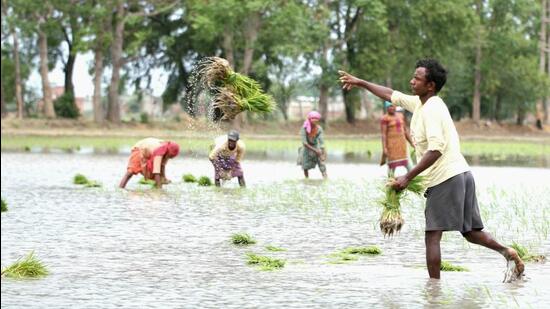
Groundwater fulfils approximately half of the world’s drinking water needs, 40% of the irrigation needs, and about one-third of the industrial needs. It also plays a key role in maintaining the base flow of rivers and sustaining ecosystems. Globally, many aquifers are being impacted, including India’s Indus basin aquifers in the states of Rajasthan, Gujarat, Punjab, Haryana, and Delhi. Studies suggest that excessive groundwater abstraction could lead to rising cost of groundwater (due to additional cost of drilling deeper), contamination due to possible salinization, decreased base-flows, depletion of groundwater storage, land subsidence, rise in the sea level, and other environmental impacts. Several risks associated with groundwater depletion include risks to food production, livelihoods, industrial production, and the overall economy.
Punjab, a northwestern state of India, is a national hotspot where, of the total 138 water blocks, 111 blocks (80%) are critical and over-exploited. Since 2011, more than 40 blocks have exceeded groundwater development higher than 200% and a few even exceeding 400%. A variety of factors have resulted in the overexploitation of groundwater in Punjab, such as high-cropping intensity, cultivating water-intensive crops, access to new technologies making groundwater extraction an affordable option, high tube-well density with no check on the amount of groundwater withdrawal coupled with subsidised electricity.
Scientific evidence predicts aquifer depletion in the state (the point where withdrawal of water cannot exceed the recharge profitably) that could result in the decline of farm employment, drastic reduction in agricultural profits, and overall impact on the state’s economy.
Despite this grim scenario, groundwater usage in the agriculture sector, the largest user of groundwater, remains exempted from the purview of regulation both at the central and state levels. The reason for exempting this sector at the central level is respecting the states’ jurisdiction to legislate/regulate water as it is a State list subject. However, the reasons for exempting agriculture sector at the state level, i.e. in Punjab Groundwater Extraction and Conservation Directions, 2023, could be manifold including the potential impact of regulation on the livelihood of millions of farmers, huge number of groundwater abstraction sources in the state, and the existence of complex socio-cultural realities where a significant part of the population does not own land. Any regulatory intervention in such a complex context is likely to face stiff resistance from the stakeholders and could have several unintended consequences. There are no easy solutions.
{{/usCountry}}Despite this grim scenario, groundwater usage in the agriculture sector, the largest user of groundwater, remains exempted from the purview of regulation both at the central and state levels. The reason for exempting this sector at the central level is respecting the states’ jurisdiction to legislate/regulate water as it is a State list subject. However, the reasons for exempting agriculture sector at the state level, i.e. in Punjab Groundwater Extraction and Conservation Directions, 2023, could be manifold including the potential impact of regulation on the livelihood of millions of farmers, huge number of groundwater abstraction sources in the state, and the existence of complex socio-cultural realities where a significant part of the population does not own land. Any regulatory intervention in such a complex context is likely to face stiff resistance from the stakeholders and could have several unintended consequences. There are no easy solutions.
{{/usCountry}}Consensus-based approach
The recent episode of farmer agitation on the farm bills is a classic example of the stakeholders questioning and rejecting the top-down approach of lawmaking. They have demonstrated that the times have changed and that if the key stakeholders are not on-board, the resultant laws won’t take off. It is important to learn from this experience while acknowledging that some form of state intervention in groundwater sector is a matter of time. So, what could such a legal or policy solution look like?
In the context of groundwater, where there are multiple stakeholders with differentiated but real interests in using and conserving this precious resource, merely legislating or regulating in a traditional way (top-down approach) may not be the answer. Therefore, lawmakers in Punjab may experiment with negotiated rulemaking in which the stakeholders and the rights holders play a key role in drafting the proposed regulation.
Negotiated rulemaking has been used in the US since the late ’80s. Examples: The Environmental Protection Agency’s rulemaking on asbestos containing material in schools (1987); the department of housing and urban development’s rulemaking on the Native American Housing Assistance and Self-Determination Act- Revisions to the Indian Housing Block Grant Program Formula (2016); and a more recent example of the US department of education’s notice in federal register to constitute a negotiated rulemaking committee to prepare proposed regulation for the Federal Student Aid programs (2023).
Negotiated rulemaking is a consultative and consensus-based process to develop the rule/regulation through a neutral facilitator and a negotiating committee which comprise of members of all interest groups, including the government.
Instead of the government agency making the first draft of rule/regulation, it is the stakeholders committee that prepares the first draft based on consensus. Such an active involvement of stakeholders and the rightsholders facilitate preparation of a regulation that is amenable to multiple interests, thus, easier to implement than a top-down rule-making process. Further, adopting such a process could serve other important goals, including increasing awareness of people and stakeholders regarding the adverse environmental impact of their unstainable practices on the present and the future generations. Also, such a process opens up the possibility of arriving at creative and more practical solutions than a straight-jacketed top-down process.
Setting an example
Given the gravity of groundwater depletion in the state and the regulatory choices being complex, negotiated rulemaking seems the best bet forward to arrive at a consensus-based solution. Punjab should demonstrate India’s first experiment in negotiated rulemaking by constituting a negotiated rulemaking committee with both private and public members, particularly whose interests are going to be significantly affected by the proposed rule/regulation such as the farmers, water user associations, agro-based industries, agriculture scientists, hydrogeologists, researchers and academicians, water supply agencies in rural and urban areas, and the like.
Instead of waiting for a human-induced calamity to happen, the law-makers and policymakers of the state may consider giving negotiated rulemaking their best shot. rupthik79@gmail.com
The writer, an IAS officer, is special secretary (department of school education) with the government of Punjab. Views expressed are personal