
 E-Paper



After Punjab win, AAP sets sights on Himachal
With Himachal Pradesh headed for elections this year-end, Aam Aadmi Party to test waters by contesting Shimla MC elections in April

 Prefer HTon Google


After its landslide win in Punjab, the Aam Aadmi Party (AAP) has set its sights on neighbouring Himachal Pradesh that goes to the polls this year-end. As in Punjab, politics in the hill state has also largely remained bipolar with the Congress and BJP being the traditional parties in power for three decades.
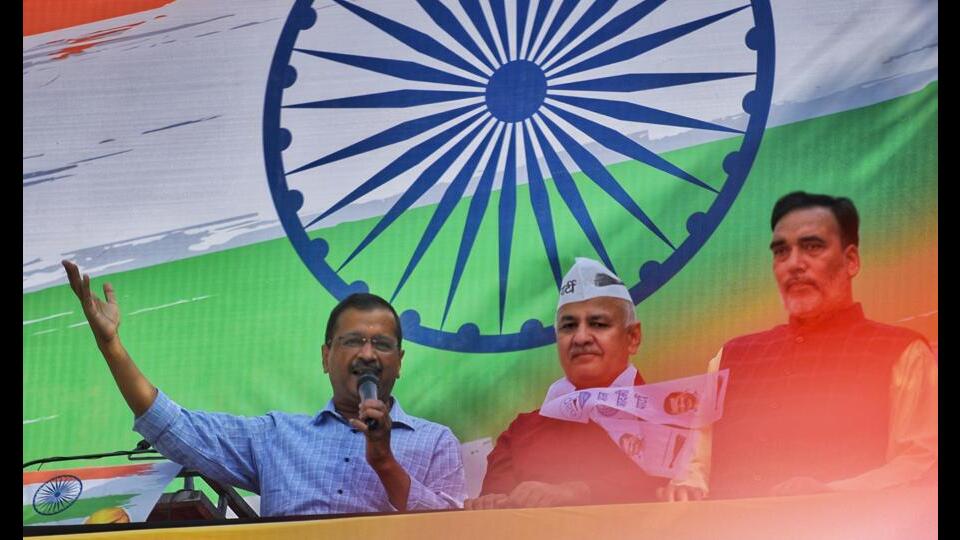
However, the recent Punjab victory has acted as a catalyst for the AAP’s Himachal Pradesh unit to step up efforts to offer a third option to voters. “The people of Himachal are also disappointed with traditional parties, such as the Congress and the BJP. The AAP will offer them an option and we promise change,” Ratnesh Gupta, the AAP in-charge for HP affairs, said on Saturday.
Buoyed by the victory in Punjab, he said, AAP leaders, including Delhi chief minister Arvind Kejriwal, will be visiting the state. “Our party prefers leaders with a clean image. Many leaders from both parties (the Congress and the BJP) are in touch with us,” Gupta said.
But before the assembly elections, the AAP plans to contest the Shimla Municipal Corporation elections in April-end. “It will give us a chance to gauge the mood of the voters and bolster our prospects,” he added.
AAP lacks structural set-up in hill state
But emulating the Punjab feat will be an uphill task for the AAP in Himachal Pradesh as it lacks a formidable face to lead the party.
The AAP had tried its luck in Himachal Pradesh in the 2014 Lok Sabha elections by fielding former MP Rajan Sushant, who had jumped the BJP ship, from Kangra and Kamal Kanta Batra, the mother of Kargil war hero Captain Vikram Batra, from Hamirpur. However, they couldn’t even save their security deposit and eventually the AAP turned away its focus from Himachal. It did not field candidates in the 2017 assembly elections and 2019 Lok Sabha elections.
Recently, it fielded its candidate in the Dharamshala Municipal Corporation elections but did not campaign hard enough.
The AAP had announced that it was contesting elections the 2017 assembly elections but later did not field any candidate as it lacked a structural set-up. The party is yet to make inroads in the tribal regions of Kinnaur, Lahaul and Spiti and Bharmour.
“Forty AAP members have been elected as panchayat presidents,” Gupta said. But there are more than 3,600 panchayats in Himachal.
No impact of Punjab win: BJP, Congress
The AAP will have to work to capitalise on political weakness of the Congress that faces a leadership vacuum after the death of former chief minister Virbhadra Singh and the governance deficit of the BJP regime in the state. “Many a times a third party has attempted to make inroads in Himachal Pradesh, but voters have always rejected them. There will be no impact of the Punjab poll results here. The circumstances in Himachal Pradesh are different. They have no leadership base here. The BJP will perform well,” state BJP president Suresh Kashyap said.
State Congress president Kuldeep Singh Rathore said: “The state unit is united. It won all the recent byelections in the state and municipal corporation elections at two places. Himachal has always seen a bipolar contest.”
Third option failed to make impact in past
The state has seen a third option emerging on the political scene but failed to make an impact. The first such regional outfit, the Lok Raj Party (LRP), was formed in 1967. Headed by former speaker Thakur Sen Negi, the LRP had another heavyweight leader, JBLKhachi. However, it could win only two of the 16 seats it contested in the 1972 assembly elections.
No third party could achieve a major success for the next two decades as power changed hands between the Congress and the BJP.
In the 1990 election, the Janata Dal emerged on the political landscape of the state. Led by Vijai Singh Mankotia, who switched sides from the Congress, the party won 11 seats in a pre-poll alliance with the BJP, which got an absolute majority with 46 seats.
The coalition government was dismissed in the aftermath of the Babri Masjid demolition. By the 1993 assembly elections, Mankotia was back in the Congress and Janata Dal faded into oblivion.
After parting ways with the Congress, veteran leader Sukh Ram founded the Himachal Vikas Congress (HVC) in 1997. The HVC won five seats in 1998 and entered into a post-poll alliance with the BJP, helping the saffron party form the government when it was one seat short of a majority.
Since then, no third party has been able to win big in the state. “The AAP is eying Himachal Pradesh after the Punjab victory but it’s too early to expect such gains here. The political landscapes of Himachal Pradesh and Punjab are different. The AAP owes its success to Punjab’s disgruntled public. Corruption by the Congress and Akalis and a weak BJP besides the farmers’ protest worked for it there,” says Harish Thakur, who heads the political science department at Himachal Pradesh University.


