
 E-Paper



Bureaucratic inertia stifling Chandigarh’s growth, says MP Manish Tewari
From the stalled Metro project to five unresolved legacy issues, including share-wise sale of property, ownership rights of people living in resettlement colonies, extension of Lal Dora, need-based changes in CHB houses and problems of group housing societies, Manish Tewari didn’t hold back in his criticism of the system


Interacting with Hindustan Times on completion of his first year in the Lok Sabha, Chandigarh member of Parliament Manish Tewari, 59, took a swipe at the UT administration, accusing it of bureaucratic inertia that he said was stalling city’s governance and development.
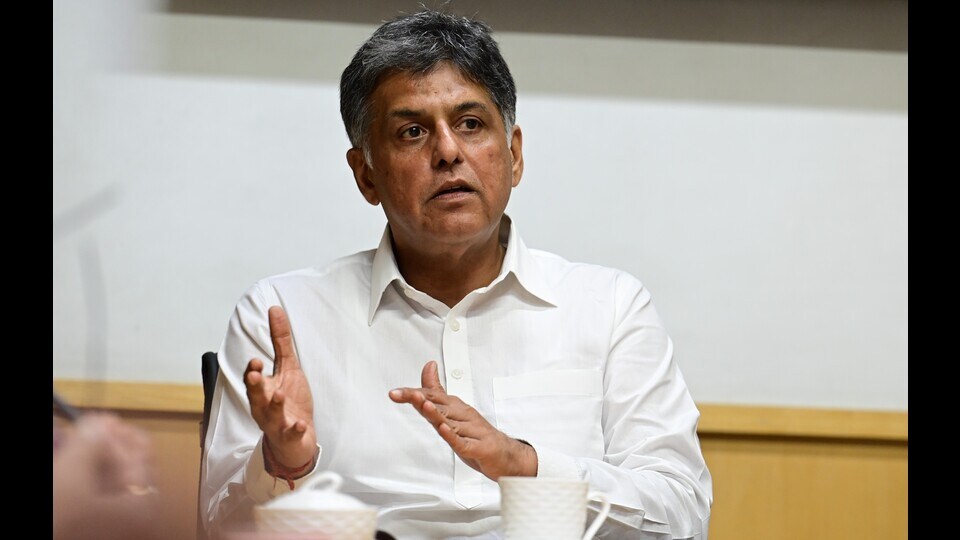
From the stalled Metro project to five unresolved legacy issues, including share-wise sale of property, ownership rights of people living in resettlement colonies, extension of Lal Dora, need-based changes in CHB houses and problems of group housing societies, Tewari didn’t hold back in his criticism of the system, while emphasising his continued commitment to resolving these long-standing problems. Edited excerpts:
How do you look at your performance in the first year as Chandigarh MP?
It’s been a new learning curve to deal with local issues, which I didn’t encounter in my two previous tenures as the MP of Ludhiana and Anandpur Sahib. There are no MLAs here, unlike in states where municipal issues wouldn’t reach the MP because they’d be taken care of by civic bodies. Here, everything lands up at your door. There is an MC, but it is inherently constricted by its design. By raising local issues, I’m trying to establish a culture of accountability. Earlier, the administration was having a free run.
In election, you had cited five legacy issues as priorities to resolve: Share-wise sale of property (not allowed at present), ownership rights of people living in resettlement colonies, extension of Lal Dora, need-based changes in CHB houses and problems of group housing societies. Any progress?
The ban on share-wise sale of property flows out of an erroneous interpretation of the Supreme Court judgment by the Chandigarh administration. The matter is listed in the apex court on July 4.
The biggest issue is about need-based changes in Chandigarh Housing Board flats. There is a need for a one-time amnesty scheme. We’ve told the ministry of home affairs that there is a need for an amnesty scheme as it impacts 3 lakh residents.
As for Lal Dora, you’ve made the entire area with the extended abadi (population) outside the Lal Dora also a part of MC wards. So where does the question of Lal Dora remain? Unfortunately, Chandigarh is run by the MHA that has other pressing issues to deal with.
On group housing societies, we’ve been able to facilitate meetings between their representatives and the DC, finance secretary and chief secretary.
The UT administration and municipal corporation are invariably at odds and the MC is perennially fund-starved. Is this impacting governance?
Absolutely. There is a fundamental problem with the governance model of Chandigarh. The bureaucracy wants to maintain its stranglehold. There are two spheres of governance, the administration and the MC. 90% of the problems of Chandigarh pertain to the sphere of the administration. In the MC, since you have elected representatives, they are still accountable.
Chandigarh gets ₹5,800 crore from the Centre. Going by the recommendations of the Delhi Finance Commission, 30% of it should be a pass-through to the panchayati raj institutions. The administration has deliberately pulled itself out of its ambit. There’s no formula of financial sharing between the administration and the MC as a result of which they don’t respect the 30% rule. They say the finance commission doesn’t apply to us, it applies to states. The MC, by the 30% rule, should get ₹1,800 crore instead of the ₹560 crore. The revenue spending departments, sewage, sanitation, parks, roads, everything falls in their ambit. So, while they have the responsibility, they don’t have the financial pipeline. People of Chandigarh also don’t want to get out of the comfort zone of being a UT. But with that comfort zone comes bureaucratic oppressiveness.
What challenges do you face as the Congress MP of Chandigarh, which is controlled by the BJP-ruled Centre?
At the central level, I’m not being undercut as an MP. The MHA has a limited bandwidth on Chandigarh because it’s fighting a million fires from Manipur to Jammu and Kashmir daily. The Centre pumps in about ₹20,000 crore into Chandigarh (including central institutes) annually. That’s a lot of money for a city that is 10x10 kms. So, where is that money going? The bureaucratic inertia that one faces is enough of a subversion.
The BJP, which runs the MC, says you only raise Chandigarh’s issues in the Lok Sabha but have failed to get them resolved.
With so many IPS and IAS officers governing the UT, Chandigarh has become a bureaucratic parking ground. That is the fundamental design flaw. When Mohali and Panchkula can be run by a DC and an SSP/SP, why does Chandigarh need such a huge paraphernalia? It’s because of this bureaucratic overload that nothing moves. A decision which should ideally be taken at the level of the DC goes up to the chief secretary or the administrator.
Issues have been pending for 25 years. The middle class today cannot buy a house in Chandigarh because a 500-yard plot is anywhere between ₹18 crore to ₹21 crore. You’re not allowing the city to go vertical. So, where do you want the city to go?
The master plan of Chandigarh-2031 onwards is going to be formulated. Till the time you don’t allow commercial spaces to go vertical, the rents in Chandigarh will remain high. Who is going to come and do business here when you can get a place at one-third the rent in Mohali? This is why the IT Park in Chandigarh never took off. Today, Mohali has some of the best cutting-edge institutions in biotechnology, nanotechnology and even artificial intelligence. Why are people preferring Mohali over a best-planned Chandigarh? That is something which the Chandigarh administration has not seriously applied itself to because nobody really has skin in the game.
Your opponent says you spend more time raising international and national issues in Parliament.
That’s because that’s the fundamental job in Parliament. MPs make laws for the country. It’s not the forum for local issues. Yet I’ve asked 24 questions related to Chandigarh. Unfortunately, we’ve messed up our constitutional system, where an MP is doing the job of a sarpanch.
The AAP-Congress alliance promised free water, electricity, and parking. Not a single promise has materialised. Instead, utility rates have increased.
We stand by all our promises. The cost of free water is ₹12 crore, something Chandigarh can afford. If the UT administration has a budget of ₹5,800 crore, which I don’t think is well spent, ₹12 crore can be spent on free water. When the MC takes a call unanimously on the issue in their domain, the administration rescinds the resolution. Just 15 days after I got elected, the free water proposal was rejected by the administration. The MC again passed the resolution, but there’s a deafening silence from the administration for a year.
Punjab can’t afford freebies because of its budget deficit. But in Chandigarh, it’s doable. I can’t understand the opposition of the BJP-controlled administration. If it’s ideological, why are you giving free foodgrains to 81.5 crore people? You won’t allow free water because Congress and AAP proposed it. If the MC is cash-strapped, funds can flow out of the administration’s budget. The MHA can be asked for an additional ₹12 crore in the supplementary demand for grants. When then AAP mayor issued an order to the MC to start giving free water, the BJP arbitrarily arm-twisted the administration officials in order to stop it.
On electricity, we are watching closely. The private firm says it took over a ramshackle infrastructure and is making a capital expenditure to upgrade it. But all that upgrade has to translate into better service, and that’s what you take your tariff on. When the issue comes before the next regulatory commission, and if there is a power hike, the private company will have to explain.
How receptive is the administration to your ideas?
The difficulty with the bureaucracy is that it’s happy with the status quo. So, it’s like getting up every morning and pushing against a wall. I feel like a woodpecker but I keep at it as it’s the only way to get things done.
There was cross-voting from the Congress-AAP alliance, which helped the BJP win the mayor’s post this January. Yet, no councillor faced disciplinary action. The alliance appears to exist only on paper.
After getting elected last year, I told then UT administrator and later his successor Gulab Chand Kataria that the mayoral election should be held with a show of hands. They kept dragging their feet on it. The MC passed a resolution on similar lines in October. The AAP took the matter all the way to the Supreme Court. The court appointed an observer but voting was conducted through secret ballot on January 30.
Yes, there was cross voting. But how do you act against somebody in a secret ballot? It’s your word against theirs. These councillors are smarter than parliamentarians.
Secondly, when it comes to distributing MPLAD funds, I’ve given more to AAP councillors than to those from the Congress. One reason, of course, is they are more in number, but we have not discriminated. I have also given funds to BJP councillors.
As far as the alliance is concerned, we have an interesting situation because the MC elections in late 2026 will overlap with the Punjab assembly elections in early 2027. I’d want the alliance to continue. In Chandigarh, it’s worked for both parties.
The Metro project is back in the slow lane, while the traffic problem is growing.
I’ve taken up the matter at the highest levels of the government. The ₹21,000-crore project will materialise if the Centre funds it in entirety. I don’t see the project come to fruition even in the next decade if you do the Haryana-Punjab-Chandigarh mix. Don’t see Chandigarh as a city, look at it in terms of its economic multiplier potential. Unfortunately, my predecessor didn’t want the Metro. As a result, we lost 10 years, while Nagpur, Kochi and Jaipur got it.
Chandigarh airport has limited international flights. You promised to look into it. Any progress?
There are two kinds of international flights. One in which domestic carriers operate to international destinations and the other is allowing international airlines to operate from Chandigarh. For the second, the airport has to be designated as a point of call. The civil aviation minister has promised that a policy decision is being taken for all state capitals to be designated points of call. Once that’s done, the market dynamic can take over. At the airport advisory committee meeting, I took up the matter with the Indian Air Force representative and found the defence side has watered down its objections.
Punjab and Haryana are not able to reach a consensus on funding Panjab University and the affiliation of colleges.
This is a complex political question. When Punjab got trifurcated, Haryana got its own universities. Now colleges affiliated to PU are in Punjab. So, it becomes the responsibility of the Punjab government. They need to walk the talk and start funding PU in a more substantive manner. PU has a budget of ₹900 crore. Of that, it gets a ₹400 crore grant from the Centre and only around ₹100 crore from Punjab. It’s a peculiar situation as PU is neither a state nor a central university.
The PU senate elections are pending for over a year amid demands for reforms. Also, what are your views on the stand against protests.
I spoke to Vice-President Jagdeep Dhankhar, who is the PU chancellor, last October. I said if you want to bring down the number of senate members, you must do it by amending the Panjab University Act. You can’t do it in a roundabout manner, exercising powers under the Punjab Reorganisation Act. This will not hold in a court of law. Till the time that amendment does not take place, the Senate elections should be held. They were supposed to announce it in January 2024. Emasculating governance institutions of a public university is not serving the cause of Panjab University.
The recent circular that students won’t agitate and are required to submit an affidavit is unconstitutional. Universities are meant to open the minds of young people. Becoming authoritarian has its implications. PU has always had a vibrant culture. It’s another matter that it shouldn’t be violent because student politics in this region has a history of violence, too.
What should be done to generate jobs? The administration is unable to spell out which sector to promote.
Implement the Micro, Small and Medium Enterprises Development (MSME) Act in Chandigarh. Allow small trades to start functioning because then those industrial plots can be used for multiple purposes, that is where the bulk of the jobs is going to get generated. In India, if you look at employment figures, it is in the MSME sector. As you go into areas of high technology, employment plummets. If you’re looking at AI or biotechnology or robotics, the machine is replacing the person rapidly. It’s in the service sector where you’ll be able to create sustainable employment. The argument given for not implementing the Act is that some trades are in conflict with the Chandigarh master plan. How can they keep sections of the Act passed by Parliament in abeyance by an administrative order? I’ve been taking it up with the MSME minister to get it implemented. The administrative ownership of Chandigarh is missing. Otherwise, why has the IT Park, set up in 2006, not taken off? Why has Mohali done better? When you’re blocking the organic development of real estate, you’re inflating rents to such an extent that it’s unviable.
What will your priorities be in the second year as an MP?
My priorities remain the five issues. I’ll keep working to resolve them. You can’t be skipping tracks. It’s possible that at the end of five years, I may not be able to get everything resolved, but it will be because of the way our governance is structured, not because of lack of trying.


