
 E-Paper



Chandigarh: No new registrations at PGI, GMCH OPDs for now as doctors’ strike continues
Due to the ongoing strike by their resident doctors, both PGIMER and GMCH, Sector 32, have decided not to accept registration of new patients at their OPDs


The resident doctors’ indefinite strike at PGIMER reached its eighth day on Monday as they continue to demand justice for the Kolkata rape-murder victim and implementation of the Central Protection Act.
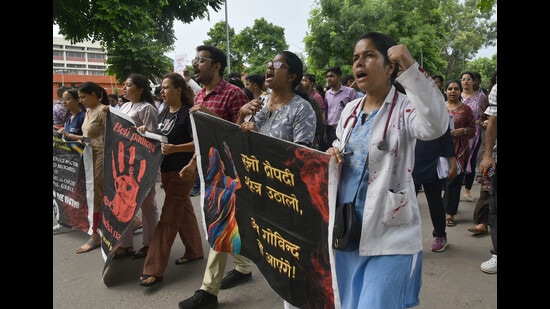
Due to the ongoing strike by their resident doctors, both PGIMER and GMCH, Sector 32, have decided not to accept registration of new patients at their OPDs.
At PGIMER, registration of only follow up (old) patients will be done from 8 am to 9.30 am. Similarly, GMCH doctors will also examine only follow-up cases, with registration timing set from 8 am to 10 am.
However, emergency services will continue to function as usual.
On the occasion of Raksha Bandhan on Monday, residents tied black rakhis to police and security officers. At GMCH-32, female resident doctors tied black ribbons on the wrists of members of public to spread awareness about the horrific crime.
Addressing the residents, PGIMER director Dr Vivek Lal said, “Your voice is being heard, but my request to you is to ensure that the protest should not go on inordinately. If you are keen on moving forward, then you don’t know where to stop. Right now, not only patients, but others are with us only. OPDs have come down, elective surgeries are not taking place. But I request you to behave in a manner that befits PGIMER doctors. The case of CPA is with the central government. Rather than escalating, think of deescalating it.”
Resident doctors write to PGIMER director for enhanced security measures
Resident doctors at PGIMER on Monday also penned a letter to the institute’s director, outlining a series of urgent security measures that they believe are essential for ensuring their safety on the campus.
The doctors demanded deployment of active security personnel across the entire campus, including hospital and hostel premises, with round-the-clock coverage. They also called for increased night patrols, night rounds and strict logbook maintenance by a team appointed by the chief security officer.
A key demand is the installation of fixed CCTV cameras throughout the hospital premises, particularly in emergency areas and near doctors’ duty rooms. The doctors emphasised the need to identify and cover all blind spots, and ensure adequate lighting across the campus, especially in critical areas like the pathways from hostels to the hospital, parking areas, the new OPD, behind research blocks and near the swimming pool.
The letter further highlighted the need for round-the-clock CCTV surveillance and dedicated security personnel in all staff parking areas. The doctors are also advocating for the installation of SOS buttons at sensitive locations for immediate Quick Response Team (QRT) action.
Additionally, the resident doctors called for the establishment of a dedicated helpline number for reporting security concerns. They insisted that any incidents reported via this helpline should be followed by a prompt, time-bound response.
One of the more pressing demands is the provision of an institutional FIR in the case of incidents like theft or violence. The residents argued that the institute should be the first responder for filing FIRs, rather than the individual residents. To further this cause, they proposed the formation of a permanent committee under the MS office to handle any instances of violence against residents.
Additionally, they demanded to enhance the security and infrastructure at PGIMER by repairing and securing Doctor’s Duty Rooms (DDRs), establishing more DDRs where needed, and ensuring all hospital and security attendants (HA and SA) wear ID cards at all times.
They sought thorough background checks on all HA, SA and security personnel before employment.


