
 E-Paper



Chandigarh Traffic Police turn lens to 5 chokepoints to help city breathe easy
The five congestion points have been selected based on persistent traffic snarls, inadequate pedestrian infrastructure and chaotic vehicular movements.

 Prefer HTon Google


In a move to address growing traffic congestion and pedestrian safety concerns, the Chandigarh Traffic Police are planning to launch a Passenger Car Unit (PCU) study at five of the city’s most critical and heavily trafficked intersections. The initiative aims to provide data-driven insights into road usage patterns and inform both immediate interventions and long-term traffic infrastructure planning.
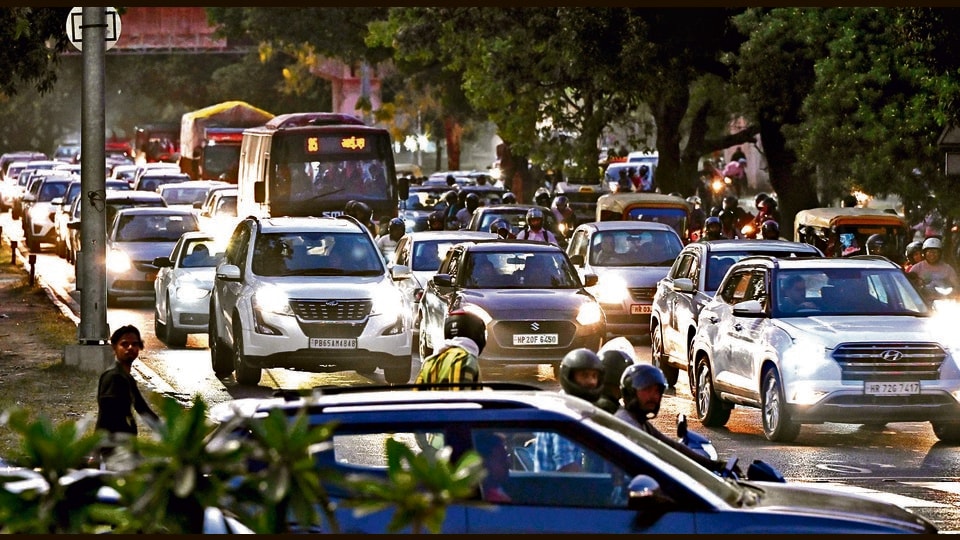
The five congestion points have been selected based on persistent traffic snarls, inadequate pedestrian infrastructure and chaotic vehicular movements.
Tribune Chowk
Tribune Chowk, also known as Junction No. 38, is one of the busiest intersections in Chandigarh, serving as a crucial node that connects Mohali, Panchkula and the city’s Industrial Area. Around 1.35 lakh passenger car units (PCUs) cross Tribune Chowk — located on the intersection of Dakshin Marg and Purva Marg — on a daily basis, as per a previous study. The high traffic density, especially the flow of heavy vehicles from National Highway-5, severely strains the intersection’s capacity. The lack of proper segregation between fast and slow traffic also leads to erratic merging and lane-cutting, compounding the chaos.
Hallo Majra light point
Hallomajra Chowk functions as a critical gateway to Chandigarh, connecting it with Zirakpur and Panchkula. It bears the traffic load of three different regions—Punjab, Haryana and Chandigarh—on a single intersection. Moreover, the intersection sees a high number of pedestrians and cyclists, particularly from nearby residential colonies like Hallomajra. However, there is no dedicated cycle track, and pedestrian infrastructure is either lacking or non-functional. The pedestrian lights installed at the junction are non-operational, leaving road crossers vulnerable.
Khuda Lahora–Khuda Jassu stretch
The road stretch leading from PGIMER toward Khuda Jassu and Khuda Lahora villages, particularly along the V-1 road near a local school, has become a high-risk zone for both vehicular traffic and pedestrians. The most pressing concern is the absence of pedestrian footpaths. Further complicating traffic safety are unauthorised encroachments by roadside shops and vendors on the berms. During monsoon, waterlogging on the stretch aggravates these risks, causing vehicles to veer unexpectedly and reducing traction. The stretch also sees dangerous U-turns at open median cuts near the villages of Khuda Jassu and Khuda Lahora.
Housing Board light point
Housing Board Light Point is a key entry point to Chandigarh from Haryana and Himachal Pradesh, resulting in consistently high vehicular volume. Two major bus shelters on Kalka Road do not have designated lay-bys, causing buses to halt directly on the road and block traffic. Pedestrians and non-motorised commuters, such as cyclists and rickshaw pullers, are forced to use the main carriageway in the absence of dedicated infrastructure, further slowing vehicular movement. Street vendors occupy sidewalks and parts of the service lanes, shrinking road space and affecting traffic discipline.
Kajheri Chowk
Kajheri Chowk, located between Sectors 52/53 and 42/43, serves as a critical junction for daily commuters, commercial traffic and public transport. Its strategic location near the ISBT-43 bus terminal, District Courts Complex, grain market, and several residential and commercial zones makes it a hub of constant activity. However, this high utility has led to chronic congestion. The intersection is burdened by the regular movement of heavy vehicles travelling along National Highway-5, which pass through without any dedicated corridor or restriction.
How will the study help
A Passenger Car Unit is a unit of measurement used in traffic engineering to assess the impact of different types of vehicles on road capacity and traffic flow.
Not all vehicles occupy the same space or affect traffic movement in the same way. Buses, for example, are far bulkier and slower to manoeuvre than motorcycles. In PCU terms, a standard car is considered 1 unit, a two-wheeler might be 0.5 PCU, while a heavy commercial vehicle can be 2.5 or more.
Unlike simple vehicle counts, PCU calculations help evaluate the real pressure on road infrastructure, enabling smarter traffic signal timing, lane allocation and road design.
The study will help the city prioritise upgrades in road widening, underpasses or pedestrian facilities based on precise data. “High-definition CCTV cameras with AI-based video analytics will be installed at these junctions for the study. The technology will classify vehicle types and calculate PCU load in real time. The data will be used to formulate targeted solutions that go beyond blanket measures,” said SSP (Traffic) Sumer Pratap Singh.


