
 E-Paper



Chandigarh’s iconic Tagore Theatre arrives at the golden milestone
As Tagore Theatre Society turns 50 today, we look back at the history of this cultural landmark, and how it must reinvent itself in keeping with the changing times

 Prefer HTon Google


Just as the original golden milestone (Millarium Aureum) was the reference point from which all distances were measured in Rome, the iconic Tagore Theatre is the cultural landmark of Chandigarh, the city built to replace pre-Partition India’s cultural capital, Lahore.
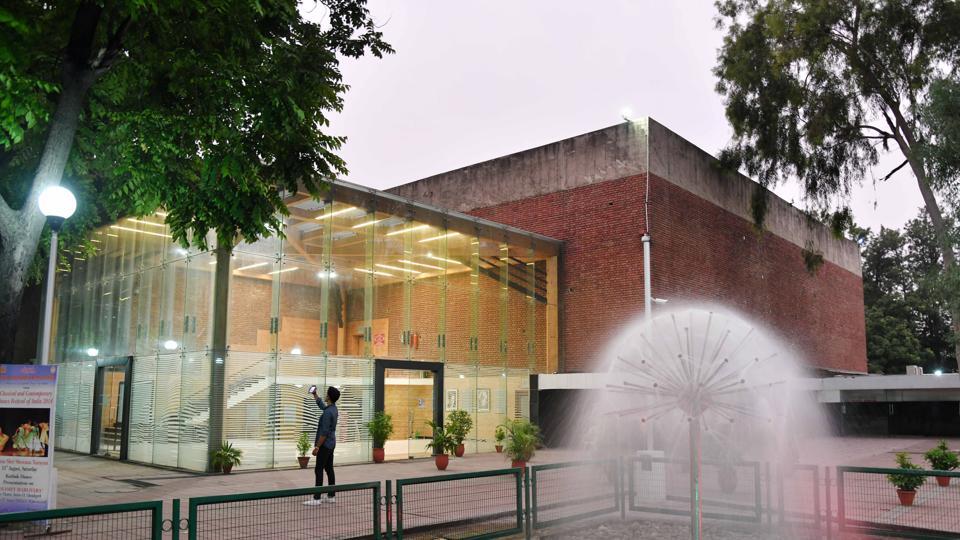
The stage came into existence in 1961 as part of Rabindranath Tagore’s birth centenary celebrations with legendary thespian Prithviraj Kapoor as the first chairperson of the Tagore Theatre Society, which was officially registered on May 30, 1972, exactly 50 years ago. Thus, began the golden era of theatrical productions in the region.
“When I came to Chandigarh in 1956, the city had no performing arts arena. We would put up shows in the open yards of the schools under ‘shaamiyanas’. Then came Kiran Theatre, which gave us a chance to perform within four walls with lights and sound. However, after the Tagore Theatre came into being, there has been a flurry of cultural activity with stalwarts such as Ebrahim Alkazi putting up productions. It became the cultural hub for the entire northern region,” says Kamal Tewari, former chairperson of the Sangeet Natak Akademi.
Old versus new
Originally, Tagore Theatre was designed by Aditya Prakash, the then principal of the Chandigarh College of Architecture, who was also a part of the Chandigarh capital project team, headed by Swiss-French architect Le Corbusier.
The theatre’s exterior presents a blank brick-walled, cuboidal structure. The interior of the theatre was designed in consultation with actor Prithviraj Kapoor and actor-director Zul Vellani, taking care of acoustics, sightlines, size of the stage with respect to the auditorium, and the maximum distance of unaided facial recognition.
The renovation sparked protests with a certain section of thespians calling the changes unwarranted and to the detriment of the well-designed heritage.
Theatre director and actor Rani Balbir Kaur says, “The original theatre was well-proportioned with well-designed double-storey green rooms. The maintenance might not be up to the mark, but it did not need to be refurbished. The new structure is rather ill-proportioned, and the acoustics are not up to the mark. People sitting on the last seats or sides are unable to see the stage or identify the actors.”
“Aditya Prakash was heartbroken at the demolition of his creation and had sat on a dharna. Thespians from across India had protested, but to no avail. Rather than renovating a perfect theatre, they should have built another one,” Kaur said.
Award-winning theatre director and playwright Atamjit Singh adds, “Earlier, the acoustics were so good that one did not even need a mike. The new structure is such that the audience is cut off from the action.”
The theatre was renovated in 2008. Architect Namita Singh, who was entrusted with the task, says, “I never brought the heritage façade down. The administration wanted to increase and improve the seating. I got the brilliant idea of flipping the theatre to increase the seating. The old entrance was small and shabby so I inserted some glass which lit up the entrance. Public utilities and washrooms too were not up to the mark. I even improved the green rooms.”
“I’m glad that the administration reposed their faith in me despite the brouhaha,” she says.
Director Sanjay Suryavanshi says things must change as per demands of time. “The theatre has perfect lighting, enough rehearsal halls, and is centrally located.”
Rajnish Wattas, former principal of Chandigarh College of Architecture and its first director, says, “The theatre design was such that everybody could see the play, and the flow of entry and exit was seamless. There were heritage cane chairs. Namita tried to retain the brick façade and added a glass foyer, but the length from the stage to the last row became longish, and the leg space became cramped.”
Sepia-tinted memories
Vikramaditya Prakash, son of Aditya Prakash, in an article published on September 15, 2008 in Hindustan Times, had recalled a famous disagreement between the Swiss architect Pierre Jeanneret and his father over the steel trusses. While Jeanneret wanted it to be covered, Aditya preferred it exposed. When it came to deciding whether the theatre should have a false ceiling, Corbusier was asked to make the final decision and the idea was scrapped.
Rani Balbir Kaur, who has been associated with the theatre since its inception, says, one of her most cherished memories is paying tribute to Pt Jawaharlal Nehru by singing, “Ae vatan waalon tumhare pyar ko” on the occasion was inauguration of the Nehru Foundation, which was attended by the then Prime Minister Indira Gandhi, son Rajiv Gandhi and his wife Sonia Gandhi. I was told that Indira was looking at me adoringly and was trying to catch my eye, but I was so shy that I did not look up.”
Recalling a humorous incident from the olden days, Atamjit Singh says, “I remember my play, Honeymoon, was to be staged here. And the newspaper advertisement for it was poorly worded as: Little Arts presents Atamjit Singh’s Honeymoon, directed by JS Likhari. We had a good laugh over it.”
The way forward
Thespian Neelam Mann Singh says, “The theatre needs to encourage platform plays where young people can perform under the foyer or trees. Tagore Theatre should have a good café which will spark intelligent conversations and make it a cultural hub. Lending spaces alone does not lead to an explosion of activity.”
Calling it the theatrical Mecca of north India, Atamjit says, “The theatre should not be under control of the administration. It will solve some problems and give rise to new ones, but it is the preferable option. The theatre should publish its achievements and set up a permanent museum on its premises.”
Kaur advocates setting up a script bank and information desk providing data about scholarships, fellowships, and money grants available to artists.
Amit Sanouria, director, Satvik Arts, says rehearsal halls should be provided at reasonable rates, Jyoti Bhardwaj of Srijan Arts suggests organising artist exchange programmes, while Wattas suggests building an open-air theatre and improving the parking space.


