
 E-Paper



Chandigarh’s public transport needs an overhaul: Study
A report by CEPT University has highlighted major weaknesses in the city’s public transport, noting that concentration of routes on some corridors in the city leads to oversupply and also creates confusion for occasional passengers

 Prefer HTon Google


Chandigarh, the city with highest density of vehicle ownership in the country and plagued with severe parking problems, needs to go for a major overhaul of its public transport system.
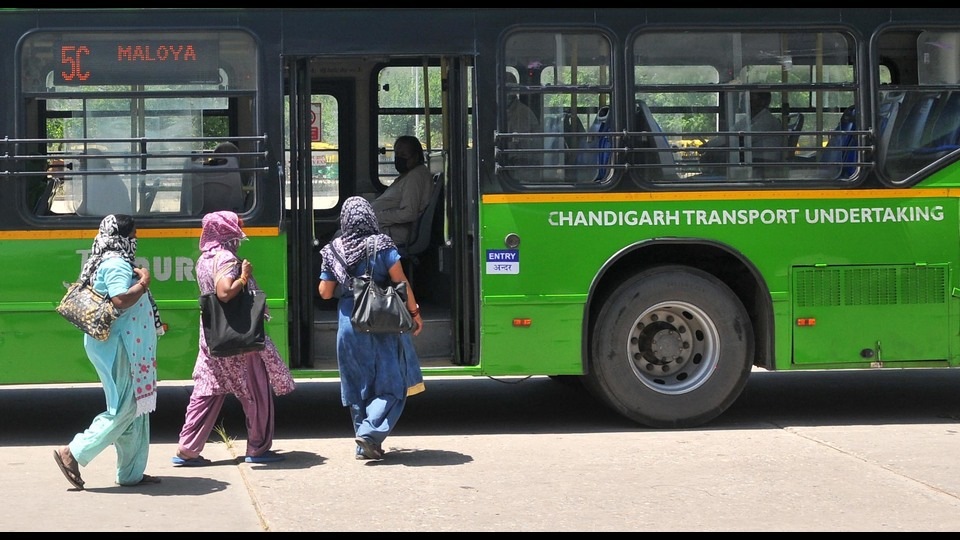
A report by CEPT University, Ahmedabad, which was instituted by the Chandigarh transport department under the World Bank-sponsored Intelligent Transport System project, has highlighted major weaknesses in the city’s public transport.
With only 11% population regularly using the bus service, nearly 80% Chandigarh Transport Undertaking buses, on an average, run vacant. “The load factor (bus seat capacity being occupied) of the service is around 22%, which is much lower than the desired range of 65-75%,” states the report, which was submitted to the administration in March.
One of the reasons is the low trust on the system. “On an average 8% trips are cancelled daily without any prior information,” states the report after a year-long survey of the Chandigarh’s public transport system that was undertaken before Covid-19 restrictions were imposed in 2020.
The report also notes that the public transport is highly centralised with most routes originating at interstate bus terminals in Sectors 17 and 43 or at the PGIMER, and only 45% of the city covered. “Concentration of routes on some corridors in the city leads to oversupply and also creates confusion for occasional passengers,” reads the report.
Low frequency
Around 66% of 3.1 lakh daily trips in the city are performed by intermediate public transport (IPT), such as autos. However, even their frequency is low, leading to high dependency on private vehicles, notes the report.
“The frequency of IPT is also very low, around 10 minutes, and fare levels are around 33-55% higher for trip lengths greater than 3km,” it says.
The report states that CTU buses are being underutilised, with the average being 187km on weekdays, which is below the benchmark of 200km per bus on road daily for urban bus service.
“Not surprisingly, against an operating revenue of ₹11.56 crore, the operating cost for CTU in 2017-2018 was ₹23.85 crore. The situation worsened in 2018-2019, with revenue at ₹14.17 crore and the cost increasing to ₹26.98 crore,” states the report.
PPP model needed
The report has suggested involvement of private operators in running and managing public transport through public private partnership (PPP) model.
“Chandigarh would require about a total of 420 to 1,000 buses depending on the level of service (LOS) targeted. As per the central benchmarks, cities should have a minimum of 0.4 buses per 1,000 population as LOS-1. Currently, 330 buses, ie 0.17 buses per 1,000 population, are operated by the CTU,” states the study.
To improve accessibility, an average distance between stops is taken as 350-400 metre within developed areas, and Chandigarh needs 84 more bus stops to achieve that, says the report.
The bus network has to cover 90% of the city, so that the service is available within 5-7 minutes of walking distance to everyone. Also, a minimum frequency of three to four buses per hour is needed at a stop.
The study has also called for rationalisation of bus fares, ranging from ₹5 for up to 2km to ₹25 for more than 10km.


