While detailed studies on cloudbursts and flashfloods in the trans-Himalayan region are yet to be conducted, weather experts in Jammu and Kashmir and Ladakh attribute the increase in their frequency to climate change.
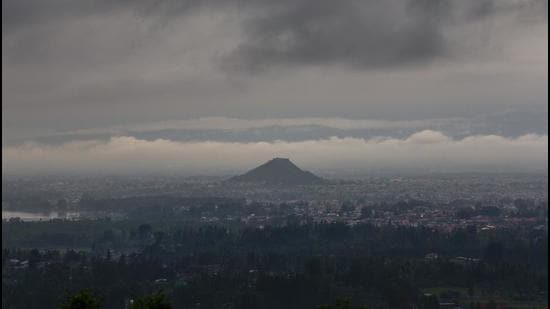
Cloudbursts and heavy rains have now become an annual feature during monsoons, not only in the Himalayan states but also in the plains, which leave a trail of death and destruction.
IMD director Sonam Lotus said, “There’s no record of cloudbursts, but instances of thunderstorms and severe weather conditions have certainly increased.”
“It has been observed by climate experts that severe weather events have increased due to the accelerated pace of global warming,” he said.
Another expert, Prof Shakil Romshoo, dean for research at University of Kashmir, said, “There is no such data on cloudbursts in the entire Himalayan region in India because it is very difficult to record them.”
He cited ‘very few’ observation stations in J&K and Ladakh as one of the reasons behind insufficient studies on such phenomena.
“Cloudbursts basically is a phenomenon that happens for a short time, usually in small valleys. For its formation, a small valley is a prerequisite,” he said.
{{/usCountry}}“Cloudbursts basically is a phenomenon that happens for a short time, usually in small valleys. For its formation, a small valley is a prerequisite,” he said.
{{/usCountry}}“It is one of the climate extremes and has been reported all over the world. The incidents have increased because of climate change,” he added.
He said that Europe and North America have had sufficient instruments for a long time and their studies have shown that the frequency of climate extremes has increased.
He, however, added that with the advent of internet and communication technology, people get to know about such incidents in real time.
“Had Kishtwar cloudburst happened 30 to 40 years ago, the people in Jammu would have come to know about it a month later. However, having said so, we cannot deny the fact that climate extremes have increased due to climate change. These are loud and clear indicators of climate change,” he said.
Recent studies have shown that temperature in Ladakh has increased by 3 degrees Celsius in the past four decades, thus impacting the region’s snow and rain cycles, he added.
Major climate extremes